EXPLORE THIS STORY
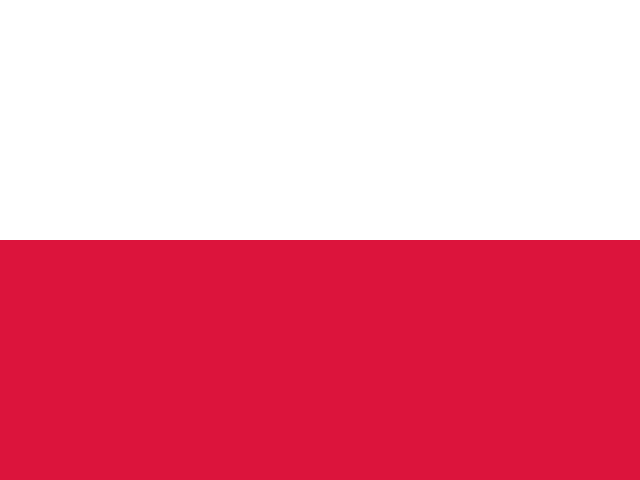
POLAND PERSPECTIVE
IRAN-US-ISRAEL CONFLICT: THE STRAIT OF HORMUZ AT THE CENTER OF GLOBAL TENSIONS
Single source
DOMINANT ANGLE
Internal political polarisation reflected in Poland's approach to the Iran-USA-Israel conflict
Dominant angle identified — does not reflect unanimity of this country’s media
ANALYSIS
Polish media coverage of the Iran-USA-Israel conflict reveals deep polarisation that mirrors the country's internal political divisions. On one side, the official government position, articulated by deputy foreign minister Bartoszewski, adopts a firmly pro-Western and pro-Israeli line, extending to contradicting assessments from credible international sources regarding the strike on an Iranian school. This stance, echoing Trump's claims without supporting evidence, illustrates Poland's strategic alignment with the United States, even at the expense of factual credibility.
Grzegorz Braun's emergence as a pro-Iranian dissident voice represents a striking phenomenon in Polish politics. His visit to the Iranian embassy and declarations of solidarity with Tehran fit within broader antisemitic and anti-Western rhetoric that frames the conflict through a conspiratorial view of global geopolitics. His slogan 'Tehran-Warsaw - common cause' reveals an attempt to forge an alternative axis, directly challenging Poland's traditional Atlanticism.
Overall media tone remains factual but reflects underlying tensions. The emphasis on disputed elements—absence of evidence in official statements, Braun's extremist positions—suggests some critical distance from political discourse. Yet silences are telling: limited analysis of implications for European energy security via the Strait of Hormuz, minimal scrutiny of regional economic consequences.
Structural biases are multiple and contradictory. The Atlantic alliance pulls toward unconditional support for Israel and the United States, whilst Poland's historical experience of foreign domination paradoxically feeds certain sympathies for Iran as a victim of aggression. Braun's rising polling (8%) indicates this second narrative is gaining traction, exposing a widening fissure in Polish geopolitical consensus that could deepen if the conflict persists.
KEY POINTS
- Government alignment with American position despite lack of supporting evidence
- Emergence of marginal but growing pro-Iranian voice (Braun)
- Deployment of the conflict by Poland's far-right antisemitic movements
- Media maintains critical distance from official political statements
- Limited coverage of energy security and regional economic implications
COGNITIVE BIASES IDENTIFIED
Atlantic alliance prioritised over factual objectivity in official discourse
Underestimation of the conflict's regional economic consequences
Disproportionate amplification of marginal pro-Iranian positions
SOURCES (1)
Does this analysis seem accurate?
AI-generated content — Analyses are produced by artificial intelligence from press articles. They may contain errors or biases. Learn more