EXPLORE THIS STORY
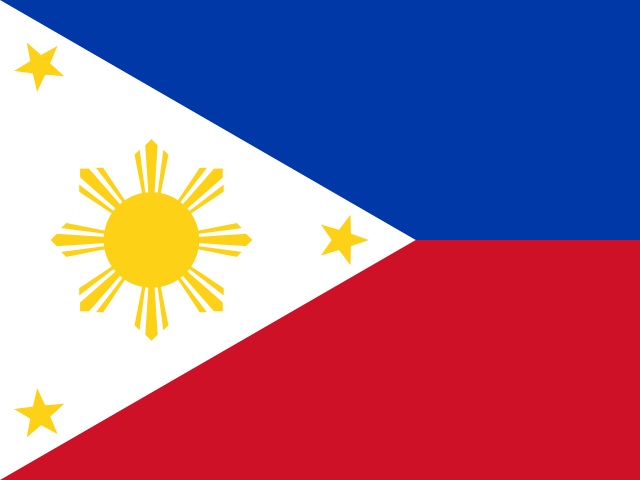
PHILIPPINES PERSPECTIVE
IRAN-ISRAEL-UNITED STATES WAR: MEDIA DIVERGENCES ON ESCALATION AND PERSPECTIVES
Single source
DOMINANT ANGLE
Distanced humanitarianism with priority on impacts on Philippine citizens
Dominant angle identified — does not reflect unanimity of this country’s media
ANALYSIS
Philippine media coverage of the Iran-Israel-United States war reveals an approach characterized by distanced humanitarianism and a priority given to practical impacts on Philippine citizens. Rappler, the main media outlet analyzed, adopts a factual but non-neutral tone, favoring Western sources (Reuters) while giving significant space to Vatican moral appeals. This perspective reflects the dominant Catholic heritage in the Philippines and the country's diplomatic tradition of privileging peaceful solutions.
The emphasis placed on arrests of alleged informants in Iran and on the papal call for a ceasefire reveals a framing that implicitly presents Iran as a repressive state while valuing voices of peace. The emotional register oscillates between factual (-0.3) for military developments and victimizing (-0.7) for humanitarian consequences, suggesting an editorial priority hierarchy that favors human impact over geopolitical analysis.
The silences are revealing: absence of analysis of regional energy stakes, minimization of the historical context of the conflict, and near-absence of direct Iranian perspectives. The coverage carefully avoids taking sides in the United States/Iran geopolitical opposition, reflecting Philippine foreign policy's balancing act between major powers. This apparent neutrality nonetheless masks a structural pro-Western bias visible in the choice of sources and the terminology employed.
The narrative framing positions civilians as victim protagonists, the United States and Israel as military actors without explicit demonization, and Iran as an authoritarian state with repressive practices. The Vatican emerges as a reference moral voice, translating the persistent influence of Catholicism in the Philippine framework for reading international affairs. This approach reveals a media diplomacy that prioritizes humanitarian considerations and regional stability, consistent with the Philippines' status as a middle power and its vulnerability to geopolitical shocks.
KEY POINTS
- Humanitarian framing prioritizing civilian victims and calls for peace
- Dependence on Western sources with minimization of Iranian perspectives
- Marked influence of the Vatican as a moral reference in conflict analysis
- Silence on regional energy and geopolitical stakes
- Apparent geopolitical neutrality masking a structural pro-Western bias
COGNITIVE BIASES IDENTIFIED
Pro-Western bias through source selection and terminology
Catholic influence in the hierarchy of editorial priorities
Middle power perspective avoiding direct geopolitical engagement
SOURCES (1)
Does this analysis seem accurate?
AI-generated content — Analyses are produced by artificial intelligence from press articles. They may contain errors or biases. Learn more