EXPLORE THIS STORY
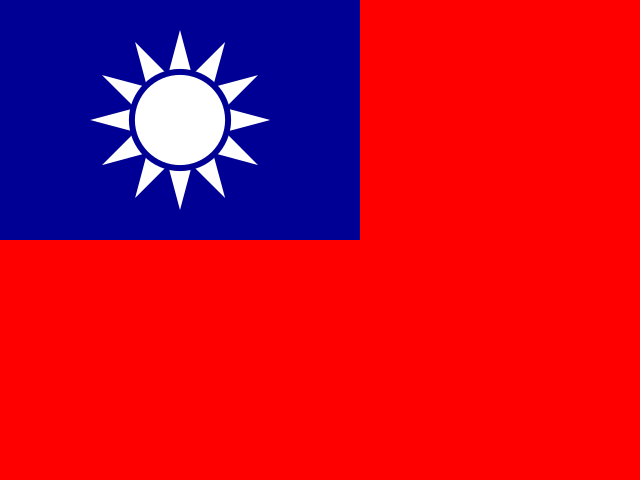
TAIWAN PERSPECTIVE
WAR IN IRAN: GLOBAL DIVISIONS OVER MILITARY INTERVENTION AND ENERGY CRISIS
Single source
DOMINANT ANGLE
Geopolitical laboratory: Iranian lessons for Taiwan's survival
Dominant angle identified — does not reflect unanimity of this country’s media
ANALYSIS
Analysis of Taiwan's media perspective on the Iran crisis reveals a distinctly strategic approach, where Middle Eastern developments are systematically filtered through the lens of the island's security concerns. The Taipei Times, through Richard D. Fisher Jr., transforms the Iranian crisis into a strategic analysis laboratory for Taiwan, demonstrating how Taiwanese media excel at transposing geopolitical lessons. This approach emphasises the tactical and diplomatic lessons Taiwan can draw from Iran-Venezuela dynamics, particularly regarding resistance to great power pressure.
The dominant tone oscillates between strategic analysis and underlying anxiety, reflecting Taiwan's precarious position in the global geopolitical order. Taiwanese media adopt a register of military and diplomatic expertise that thinly masks an existential concern about possible parallels with their own situation vis-à-vis China. This coverage privileges aspects of military cooperation and sanctions circumvention, suggesting keen interest in survival strategies employed by states under pressure.
What remains unexamined is telling: the humanitarian dimension of the Iranian crisis is largely sidelined in favour of purely geopolitical analysis. Regional Middle Eastern consequences receive minimal attention, while implications for the China-Russia-Iran alignment are emphasised. This narrative selectivity reveals how Taiwan projects its own vulnerabilities onto other geopolitical theatres.
The framing structures the Iranian crisis as a case study for understanding new authoritarian alliances and their implications for isolated democracies. Taiwan implicitly positions itself as a privileged observer of these dynamics, drawing on its experience as a de facto state confronting diplomatic isolation. This perspective demonstrates considerable geopolitical sophistication, yet also reveals a tendency toward hyper-contextualisation that transforms each international crisis into a mirror of Taiwan's own condition.
The structural biases reflect the survival imperatives of an island democracy under pressure, where every international development is evaluated against its implications for the balance of forces in the Taiwan Strait. Whilst this approach testifies to sharp geopolitical realism, it risks reducing the complexity of international crises to their strategic dimensions relevant to Taiwan alone.
KEY POINTS
- Systematic transposition of Iranian issues onto Taiwan's strategic concerns
- Emphasis on circumvention and resistance strategies against great powers
- Relegation of humanitarian dimensions in favour of geopolitical analysis
- Interest in contingent alliances formed between states under pressure
- Projection of Taiwan's vulnerabilities onto other geopolitical theatres
COGNITIVE BIASES IDENTIFIED
Hyper-contextualisation: all international events analysed through a Taiwan-centric lens
Survival bias: absolute priority given to strategic and military lessons
Overemphasis of geopolitical parallels at the expense of regional particularities
SOURCES (1)
Does this analysis seem accurate?