EXPLORE THIS STORY
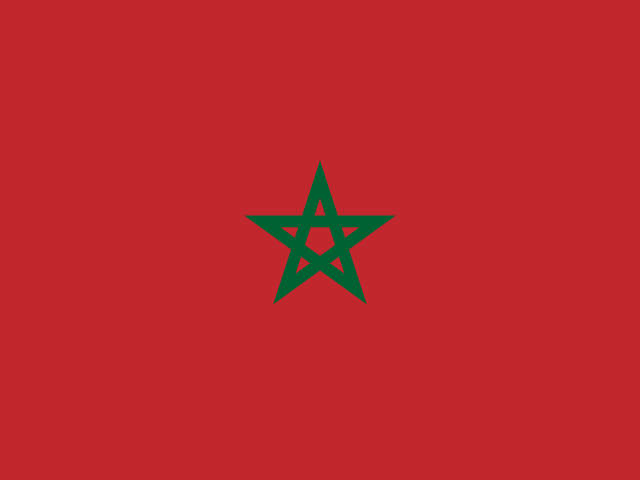
MOROCCO PERSPECTIVE
MIDDLE EAST CONFLICT: ECONOMIC IMPACT AND GLOBAL DIPLOMATIC RESPONSES
Single source
DOMINANT ANGLE
Morocco as a haven of stability and economic opportunity amid regional turmoil
Dominant angle identified — does not reflect unanimity of this country’s media
ANALYSIS
Moroccan media coverage reveals a strategically optimistic approach that repositions Morocco as a stable and reliable economic actor in a turbulent geopolitical context. The dominant emphasis falls on resilience and economic opportunities generated by regional tensions, transforming crises into national competitive advantages. The coverage of the fertiliser agreement with India exemplifies this dynamic perfectly: the Middle Eastern conflict is presented as validation of Morocco's strategic relevance, establishing it as a credible alternative supplier amid disruptions in the Gulf.
The overall tone oscillates between factual and reassuring, carefully avoiding alarmism despite the severity of regional tensions. Moroccan media deliberately downplay the direct impact of conflict on the national economy, preferring to highlight 'solid fundamentals' even during significant market corrections. This narrative approach transforms vulnerabilities into opportunities: market volatility is attributed to domestic technical factors rather than geopolitical shocks, thereby preserving the kingdom's image of stability.
The narrative framing reveals a sophisticated soft power strategy in which Morocco positions itself as a cultural and economic bridge between Africa, Europe, and the Middle East. The inclusion of the Gnaoua-Berklee musical programme is not incidental: it reinforces the image of a cosmopolitan and creative Morocco, implicitly contrasting with regional instability. This narrative diversification allows economic stakes to be balanced by a valorising cultural dimension.
The silences are telling of Moroccan geopolitical priorities. No direct criticism of Middle Eastern conflict actors is voiced, reflecting the kingdom's cautious diplomacy maintaining relations with all protagonists. Direct energy risks for Morocco are also underestimated, favouring an interpretation where disruptions primarily affect 'the poorest nations'—a geographic and economic distancing that protects the national resilience narrative.
This media coverage ultimately reveals a communications strategy aligned with Morocco's geo-economic ambitions: capitalising on regional crises to reinforce its position as a reliable partner, whilst projecting an image of stability and cultural openness that transcends Middle Eastern geopolitical divisions.
KEY POINTS
- Transformation of geopolitical crises into strategic commercial opportunities
- Downplaying of direct impact from tensions on the Moroccan economy
- Positioning as a reliable alternative supplier amid Gulf disruptions
- Use of cultural soft power to reinforce the stability narrative
- Avoidance of critical positions towards conflict actors
COGNITIVE BIASES IDENTIFIED
Systematic economic optimism that minimises national vulnerabilities
Neutrality diplomacy avoiding criticism of regional powers
Overstatement of Morocco's geo-economic role in global supply chains
SOURCES (1)
Does this analysis seem accurate?
AI-generated content — Analyses are produced by artificial intelligence from press articles. They may contain errors or biases. Learn more