EXPLORE THIS STORY

IRAN PERSPECTIVE
SOMMET XI-TRUMP
AI-generated content — Analyses are produced by artificial intelligence from press articles. They may contain errors or biases. Learn more
DOMINANT ANGLE
Tehran shifts attention away from the Xi-Trump summit: Iranian press ignores the event and concentrates coverage on regional priorities and domestic crises.
Dominant angle identified — does not reflect unanimity of this country’s media
ANALYSIS
Tehran, May 15, 2026. While the Sino-American summit in Beijing between Xi Jinping and Donald Trump dominates the global media landscape, the Iranian press analyzed today—IRNA English and Iran International—devotes no coverage to this event. This editorial silence itself constitutes a powerful signal, revealing the priorities that structure information flow in Tehran.
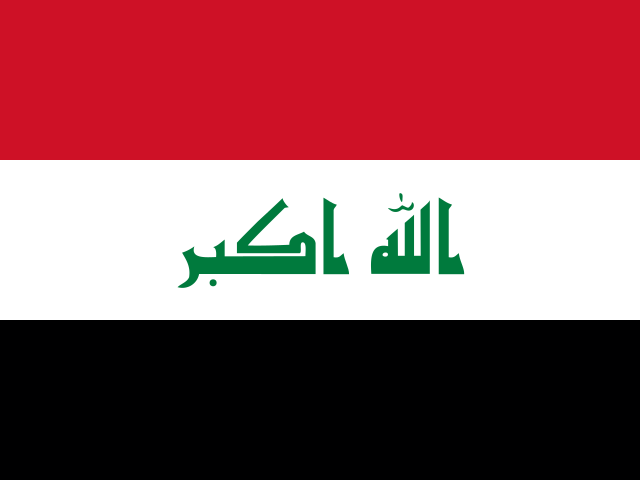
The official IRNA English agency, Iran's primary English-language government interface, has directed international coverage toward bilateral relations with Iraq. Foreign Minister Mohammad Javad Araghchi stated that deepening Tehran-Baghdad relations represents 'the absolute priority of Iran's foreign policy.' This positioning reflects coherent geopolitical logic: Iran consolidates its regional influence arc—stretching from Baghdad through Damascus to Beirut—while Sino-American dialogue remains peripheral to its immediate concerns.
On the cultural front, IRNA provided substantial coverage to the presentation of the Arabic-language version of memoirs concerning the Khamenei family. This event, presented as national-importance news, reflects the prominence state media assigns to the regime's religious and symbolic legitimacy, including its influence across the Arabic-speaking world.
Iran International, an independent English-language outlet whose website is blocked in Iran, has instead prioritized two subjects of domestic crisis. The first concerns recent earthquakes and storms that reignite fears of a 'major earthquake' in Tehran, a megacity exceeding fifteen million residents considered among the world's most seismically vulnerable. The second addresses the 'class internet'—a selective network shutdown imposed under educational pretext—triggering growing anger among households experiencing recurring electricity failures.
This editorial orientation reflects Tehran's strategic geopolitical positioning: while international attention concentrates on Sino-American realignment, state media emphasizes regional consolidation and regime legitimacy, whereas independent outlets highlight existential domestic vulnerabilities. Iranian silence on Beijing signals not indifference but rather a deliberate prioritization shaped by distinct political constraints.
KEY POINTS
- Iranian press analysis reveals selective omission of Xi-Trump summit, indicating Tehran's focus on regional consolidation over great-power realignment.
- State media emphasizes bilateral Iran-Iraq relations and regime legitimacy, while independent outlets prioritize domestic seismic and infrastructure crises.
- Editorial silence on Beijing reflects geopolitical calculus: Tehran prioritizes regional influence arc consolidation over engagement with Sino-American competition.
COGNITIVE BIASES IDENTIFIED
State agency IRNA prioritizes Iran-Iraq relations and regime cultural narratives, excluding analysis of Sino-American implications for regional power dynamics.
Independent Iran International focuses on domestic vulnerability narratives (seismic risk, infrastructure collapse) over geopolitical context or international developments.
Overall Iranian press coverage exhibits geographic insularity and domestic-priority bias, downplaying non-regional major-power developments that affect Iran's strategic environment.
SOURCES (2)
Iran InternationalCenter-right
MEDIUM
Does this analysis seem accurate?