OPEC Fractured, Hormuz Negotiated, Pakistan Mediator: The Geopolitics of Oil Tilts Toward South-South Hubs
|5 min
aeirpkqauscninsa
The UAE leaves OPEC after 59 years, Tehran proposes a phased Hormuz reopening, and Pakistan structures a mediation hub independent of P5+1 frameworks -- 20th-century oil coordination is dismantling in four weeks.
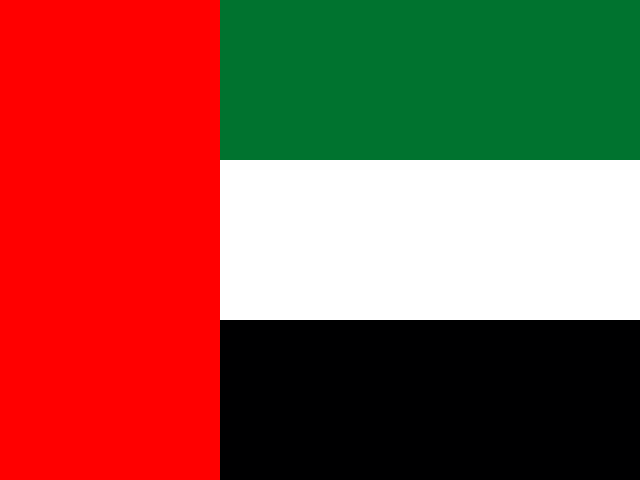
On May 1, 2026, at 00:01 Abu Dhabi time, the United Arab Emirates ceased to be a member of OPEC after 59 consecutive years. Abu Dhabi had joined the cartel in 1967 -- before even the federation of the Emirates was created in 1971 -- making it the longest Arab membership in the cartel's history. The exit was announced on April 30 by Emirati Energy Minister Suhail Al Mazrouei at a press conference in Abu Dhabi (sources: [BBC](https://www.bbc.com/news/business-uae-opec-2026-04-30), [Al Jazeera](https://www.aljazeera.com/economy/2026/4/30/uae-officially-exits-opec-after-59-years)). The closest precedent is Qatar's withdrawal in 2020 -- but Doha then produced less than 600,000 barrels per day, against 2.9 million b/d for the UAE in 2024.
The Numbers of Fragmentation
The UAE produces 2.9 million barrels per day (2024) -- roughly 8% of total OPEC production. Their exports are 70% Asia-bound: China (38%), India (15%), South Korea (12%), Japan (8%). Europe absorbs less than 12% of Emirati crude. This Asian concentration makes OPEC quotas -- based on collective price discipline -- counter-productive for Abu Dhabi: long-term contracts with Beijing and New Delhi require pricing flexibility, not production caps.
The UAE had already contested its quotas in 2021, triggering an internal cartel crisis resolved by a compromise on the production baseline (3.5 million b/d for Abu Dhabi from 2022). But the volumes effectively exported in 2024-2025 exceeded that baseline by 5-8% depending on the month, signaling progressive decoupling. The formal exit on May 1, 2026 ratifies a de facto disaffiliation.
Hormuz as Adjustment Variable
On April 29, Iran proposed a phased reopening of the Strait of Hormuz in exchange for the lifting of the American naval blockade (see our analysis). The Iranian proposal has three steps: partial blockade lifting in Iran's exclusive economic zone, reopening of the strait's northern corridor (Iranian side), then full reopening under international monitoring. NATO is not involved in the talks; Paris and London maintain their independent naval mission announced in W16.
The Islamabad talks collapsed on April 26: Trump cancelled mid-flight the trip of his envoys (see our analysis). But the collapse did not dismantle the diplomatic infrastructure. Pakistan, Qatar and the UAE now form a mediation triangle independent of P5+1 and G7 frameworks. None of these three countries is bound by EU sanctions or NATO obligations, and all three maintain operational relations with Tehran and Washington simultaneously.
Pakistan's Chief of Army Staff Asim Munir traveled to Tehran on April 16 to prepare the talks (see our analysis). Qatar maintains a direct channel with Hassan Nasrallah (Hezbollah) and the Houthi political bureau. The UAE maintains substantial commercial ties with Mossad via the Abraham Accords. This density of connections makes the triangle a unique diplomatic format: all three countries can simultaneously talk to all parties to the conflict.
The Chinese and Indian Silence
Chinese state media (Global Times, Xinhua, CCTV) have barely covered the UAE OPEC exit. Beijing imports about 50% of its crude from the Middle East -- a public weakening of the OPEC system could feed internal Chinese debate on energy security. China prefers to negotiate bilateral agreements with Abu Dhabi (Xi Jinping's December 2022 Riyadh visit had already initiated this logic) rather than signal too early the structural shift.
India -- the third emerging client -- also minimized coverage. The proximity of national elections and fear of fueling debate over gasoline prices led Times of India and The Hindu to cover the exit only through the price angle, not structural fragmentation. This combined silence creates a blind spot: oil fragmentation is documented in Abu Dhabi, Riyadh and Washington, but largely erased in the two most dynamic consumer markets.
The Brent Curve: $87 -> $124 -> $117
Brent stood at $87 on March 28, 2026, just before the Iranian closure of Hormuz. It peaked at $124.80 on April 14 (ICE Futures Europe data). After Iran's April 29 proposal, the barrel fell back to $117 on Friday May 1. The first sustained decline since the blockade matches exactly the window of the Pakistani-Qatari mediation -- markets validated the format before chancelleries did. Goldman Sachs and JP Morgan adjusted their 2026 average forecasts to $108-115, against $95 at the start of the year.
Country-by-Country Impact
- UAE: effective exit on May 1, 2026, exports recentered on Asia via the ADCOP pipeline (1.5 mb/d capacity bypassing Hormuz).
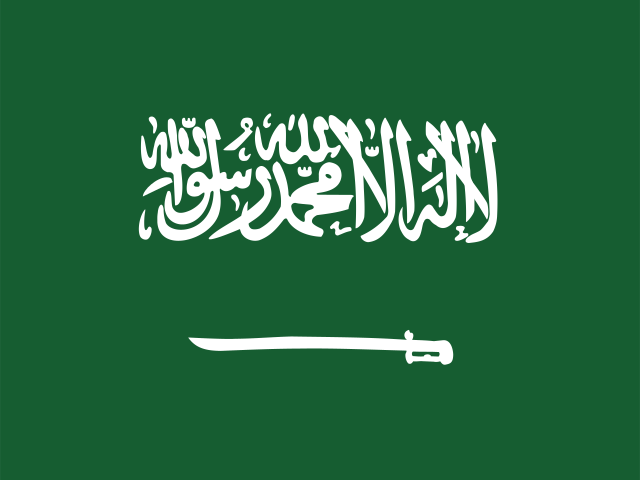
- Saudi Arabia: Riyadh remains sole guardian of OPEC price discipline -- 9.5 mb/d production, surplus capacity estimated at 2-3 mb/d.
- Pakistan: diplomatic centrality acquired without military investment -- Munir positions Islamabad as a regional hub.
- Qatar: 14% of global LNG exports, the Doha-Hamas-Hezbollah-IRGC channel continues to function.
- China: 50% of crude imports from the Middle East (UAE represents 8% of Chinese imports in 2024).
- India: 60% of crude imports from the Middle East -- direct exposure to OPEC fragmentation.
CriticalWarningAffectedNeutral
SHARE THIS COMPARISON
Show your friends how the world sees the same news differently.
AI-generated content — Analyses are produced by artificial intelligence from press articles. They may contain errors or biases. Learn more