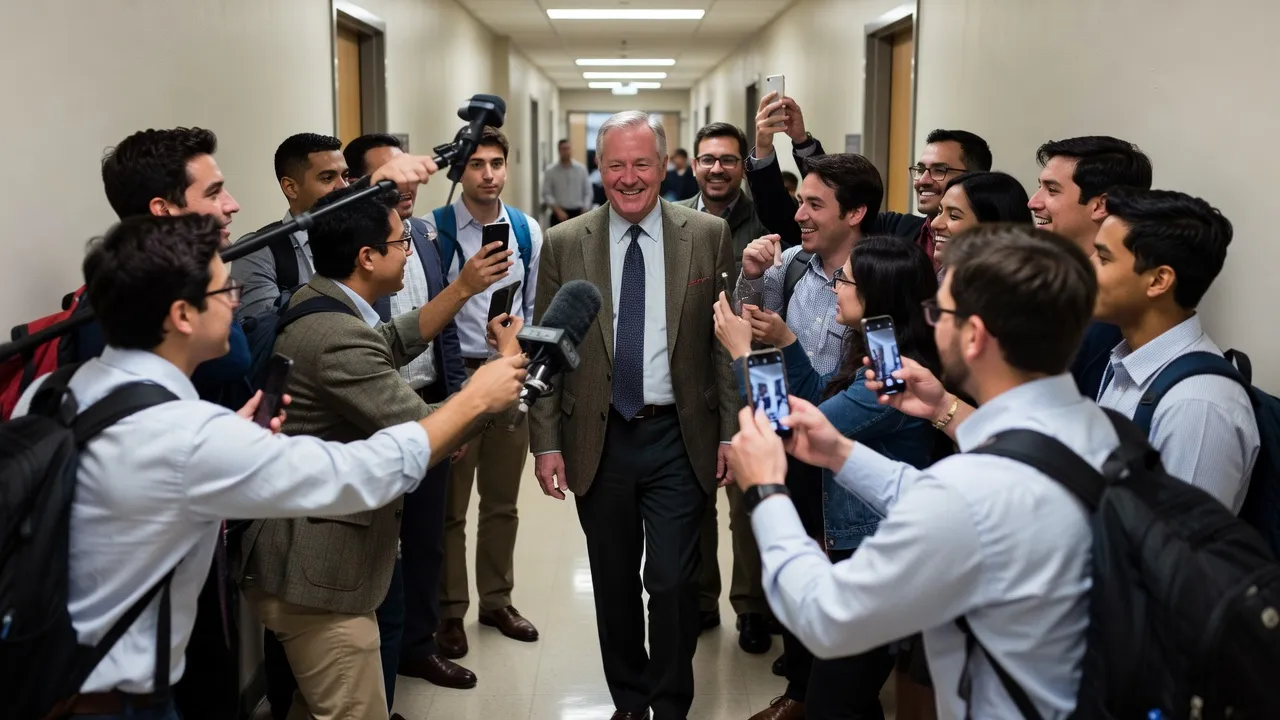
Common ground and differences in coverage across the media analysed.
What the media report in common
1
Robert E. Hall (Stanford) and Michael Woodford (Columbia) receive the Sveriges Riksbank Prize in Economic Sciences on Monday, October 12, 2026, for the "microeconomic foundations of macroeconomic stabilization".
2
John Hassler, chair of the committee, is quoted in nearly all the corpora: their work provides a theoretical basis for the models that central banks and governments use to confront shocks, including energy crises.
3
All fourteen coverages link the prize to central banks' use of the models, with the pandemic, inflation or the energy shock as a backdrop.
Where media coverage diverges
Historical reference point for the work
Which past episode should the work be tied to? Several corpora mention the failure of Keynesian models in the face of the 1970s oil shock; Canada cites the prescriptions of the Great Depression and Venezuela the crisis of the 1930s.
Buenos Aires takes from the economics Nobel the central banks' toolbox: models for cushioning supply shocks, inflation and cycles, presented in an educational way.
Canberra takes from the 2026 economics Nobel a toolbox for central banks: the Australian press mainly relays the committee's wording on energy shocks and changes in household consumption.
Ottawa frames this Nobel as the vindication of central bankers' practical tools, at a time when the energy shock tied to the Iran war is weighing on prices again.
Buenos Aires takes from the economics Nobel the central banks' toolbox: models for cushioning supply shocks, inflation and cycles, presented in an educational way.
KEY POINTS
The prize was awarded on Monday 12 October to Americans Robert Hall (83, Stanford) and Michael Woodford (71, Columbia) for the microeconomic foundations of macroeconomic stabilization.
According to the Academy, the New Keynesian models arising from their work make it possible to explain and quantify the effect of stabilization policy on cycles, and are used by central banks and finance ministries.
John Hassler, chair of the committee, says that thanks to the laureates "we are better prepared" for energy crises or sudden changes in household consumption (Perfil).
ANALYSIS
Buenos Aires, 13 October 2026. The Argentine press reports on the Bank of Sweden prize awarded on Monday 12 October to Americans Robert Hall and Michael Woodford, honored for the microeconomic foundations of macroeconomic stabilization. La Nación quotes the Royal Swedish Academy of Sciences: "On the basis of these models, well-timed fiscal and monetary policy measures can reduce the peaks and troughs of the economy". The paper notes that Hall is 83 and Woodford 71, and that their research produced a "paradigm shift" in stabilization policy.
The paper details Woodford's contribution: his model made it possible to respond more effectively to supply shocks, whether a shortage of raw materials (a negative shock) or a technological advance (a positive shock). The New Keynesian models, the jury adds, are now used by central banks and finance ministries around the world.
Ámbito adopts an educational tone, with a headline promising to explain "cuáles fueron sus principales aportes". It describes models that show how the decisions of households and firms, and their expectations about the future, influence inflation, consumption and the level of activity. It presents the laureates' careers: Hall, born in 1943 in Palo Alto, PhD from MIT in 1967, professor at Stanford; Woodford, born in 1955 in Chicopee, PhD from MIT in 1983, professor at Columbia. Faced with cycles of expansion and recession, it recalls, the authorities respond by lowering or raising interest rates.
Perfil, drawing on AFP, quotes John Hassler, chair of the committee: thanks to the laureates, "we are better prepared to face economic disruptions, such as energy crises or sudden changes in household consumption habits". The outlet explains that during the oil shocks of the 1970s, Keynesian models stopped working, which led Hall and Woodford to design new tools rather than stick to the statistical links between inflation and output.
Overall, the coverage remains technical and descriptive. It foregrounds the practical usefulness of the models for central banks facing supply shocks and inflation, with no explicit application to Argentina's situation in the available excerpts.
Australia
DOMINANT ANGLE
Canberra takes from the 2026 economics Nobel a toolbox for central banks: the Australian press mainly relays the committee's wording on energy shocks and changes in household consumption.
KEY POINTS
Robert E. Hall (83, Stanford) and Michael Woodford (71, Columbia) are honored for the microeconomic foundations of macroeconomic stabilization (ABC News Australia).
John Hassler, chair of the committee, cites energy crises and sudden changes in household consumption as the shocks these models help to face.
The award amounts to 12 million Swedish kronor, or 1.7 million Australian dollars according to PerthNow; ABC mentions about 900,000 dollars per laureate.
ANALYSIS
Canberra, 13 October 2026. Australian media treat the 2026 economics Nobel as a sober news item, focused on the nature of the work honored and its practical use by monetary authorities. According to ABC News Australia, the Americans Robert E. Hall, 83, a professor at Stanford, and Michael Woodford, 71, a professor at Columbia, were honored on Monday 12 October by the Royal Swedish Academy of Sciences for their work on the "microeconomic foundations of macroeconomic stabilization".
The Australian account rests first on the citation from John Hassler, chair of the committee. Reproduced verbatim by ABC and PerthNow, it states that the laureates' work "has provided a stable theoretical foundation for the models now used by central banks and governments around the world". Hassler adds: "With them, we are better equipped to face shocks to the economy, such as energy crises or sudden changes in household consumption." This reading, that of a toolkit for economic policy, structures both articles.
PerthNow spells out the practical reach: the two economists developed new macroeconomic models that improved the ability to carry out effective stabilization policy, allowing well-calibrated fiscal and monetary measures to soften the intensity of fluctuations.
The financial dimension has a visible place. ABC reports that each laureate will receive about 900,000 dollars; PerthNow puts the award at 12 million Swedish kronor, or 1.7 million Australian dollars. Both outlets note that this prize, established by the Swedish central bank in 1968, is technically not one of the five Nobel prizes created by Alfred Nobel's will, a point ABC attributes to "Nobel purists".
Canada
DOMINANT ANGLE
Ottawa frames this Nobel as the vindication of central bankers' practical tools, at a time when the energy shock tied to the Iran war is weighing on prices again.
KEY POINTS
Robert Hall (Stanford) and Michael Woodford (Columbia) received the 2026 Nobel Prize in economics on Monday, October 12, announced in Stockholm by the Royal Swedish Academy of Sciences.
John Hassler, chair of the committee: "With them, we are better equipped to deal with shocks," notably energy crises or changes in household consumption.
Woodford, 70, cites forward guidance, meaning explicit statements about the future path of interest rates, as an important element of the policy response from 2009 onward.
ANALYSIS
Ottawa, October 13, 2026. Americans Robert Hall and Michael Woodford won the 2026 Nobel Prize in economics on Monday, October 12, and the Canadian press treats it first and foremost as a story about tools. The Globe and Mail writes that the two academics are rewarded for "decades of work" on models built from individual behavior, now used by central banks and finance ministries around the world to stabilize economies.
The Toronto daily stresses how timely the prize is. Hall and Woodford are "frequently cited" by the major central banks which, after the inflation surge of 2022 that followed the COVID-19 pandemic, are now facing the energy shock triggered by the Iran war. It reports the laureates' central idea: the economy can only be stabilized by taking into account the millions of decisions made by households and firms, rather than through top-down theories. Woodford, 70, a professor at Columbia, said at a press conference that policymakers should not see stabilization as an exercise in pulling levers regardless of what economic agents understand.
CBC News adopts a more educational tone. It recalls that for decades, governments responded to shocks by following the Keynesian prescriptions of the Great Depression, before the two laureates' work provided a "new foundation" for stabilization policy. The public broadcaster quotes the Royal Swedish Academy of Sciences: the laureates "helped us smooth out the ups and downs of the economy."
Colombia
DOMINANT ANGLE
Bogotá takes from the 2026 Nobel in economics a toolbox for central banks: the Hall and Woodford models are presented as what makes energy crises and inflation less lasting.
KEY POINTS
The prize, worth $1.2 million, rewards Robert Hall (Stanford) and Michael Woodford (Columbia) for the "microeconomic foundations of macroeconomic stabilization" (La República).
According to the Academy as cited by Portafolio: "Recessions and episodes of high inflation have not disappeared, but they are less lasting."
Traditional Keynesian models were undone by the oil shock of the 1970s, which led Hall and Woodford to build models on a microeconomic basis (Semana, El Colombiano).
ANALYSIS
Bogotá, October 13, 2026. The Colombian economic press welcomed the Bank of Sweden Prize in Economic Sciences, announced on Monday, October 12 by the Royal Swedish Academy of Sciences. It goes to Americans Robert E. Hall (Stanford) and Michael Woodford (Columbia) "for the microeconomic foundations of macroeconomic stabilization," according to La República, which adds that the award comes with $1.2 million and closes the Nobel season.
Portafolio stresses the "paradigm shift": by building in the decisions of individuals and firms, the two researchers produced new Keynesian models that helped in tackling the pandemic and the energy crisis. The paper quotes the Academy: "Recessions and episodes of high inflation have not disappeared, but they are less lasting." It recalls that traditional Keynesian models, based on the assumed stability of statistical correlations between inflation, consumption and unemployment, were undone by the oil crisis of the 1970s.
La República expands on this historical account: faced with Western stagflation, many experts judged that stabilization policy did more harm than good. Hall and Woodford are said to have put it back on its feet by starting from economic agents who are not passive. The same outlet runs a headline about the economists who "reformulated Keynes's ideas."
Spain
DOMINANT ANGLE
Madrid reads this Nobel as the rehabilitation of anti-crisis tools: the microeconomics of Hall and Woodford is said to have given central banks and governments back the means to smooth economic cycles.
KEY POINTS
On Monday, October 12, the Royal Swedish Academy of Sciences awarded the prize to the Americans Robert E. Hall (Stanford) and Michael Woodford (Columbia) for the « fundamentos microéconomicos de la estabilización macroeconómica ».
According to Expansión, the oil shocks of the 1970s had caused the traditional Keynesian models to fail, leaving unemployment and uncontrolled inflation; the laureates' work rebuilt them.
According to the statement quoted by HuffPost España, fiscal and monetary measures taken at the right time can reduce the peaks and troughs of the economy.
ANALYSIS
Madrid, October 13, 2026. The Spanish business press welcomes the Nobel in economics as the recognition of the tools now used to cushion crises. Expansión headlines Robert E. Hall (Stanford) and Michael Woodford (Columbia), rewarded « por diseñar las herramientas anticrisis actuales », and specifies that the Royal Swedish Academy of Sciences delivered its verdict on Monday, October 12.
The story opens with a look back. Since Keynes, economic policy had sought to smooth the swings of the market by lowering interest rates and increasing public spending in a recession, or the reverse in times of bonanza. Expansión recalls that the oil shocks of the 1970s made these models « quebrar »: they did not curb unemployment and let inflation run away. After a decade of stagflation in the West, many experts judged that stabilization did more harm than good. According to the jury, quoted by the newspaper, the work of Hall and Woodford revitalized these policies at a time when they seemed to have failed.
The driving force of the prize, as the Spanish press explains it, is methodological. Rather than looking for statistical correlations between large aggregates (consumption, GDP, inflation), the two laureates based their analyses on microeconomics: the behavior of millions of households and firms. HuffPost España, which draws on the Academy's statement, repeats this formulation: understanding how all households and firms together affect the economy through their actions.
France
DOMINANT ANGLE
Paris reads this Nobel as the consecration of crisis-management tools: the French press mainly dwells on what Hall's and Woodford's models change for central banks facing inflation and energy shocks.
KEY POINTS
The prize is worth 12 million Swedish kronor (about 1.07 million euros according to Le Monde), shared between Robert Hall (Stanford, 83) and Michael Woodford (Columbia, 71).
John Hassler, chair of the committee, states that the laureates' work provides "a solid theoretical foundation for the models now used by central banks and governments around the world."
In his 1978 paper, Robert Hall establishes that household consumption is unpredictable because it reacts to new information about their future income.
ANALYSIS
Paris, 13 October 2026. The Sveriges Riksbank Prize in Economic Sciences in Memory of Alfred Nobel was awarded on Monday 12 October to Americans Robert E. Hall, 83, a professor at Stanford, and Michael Woodford, 71, a professor at Columbia, "for the microeconomic foundations of macroeconomic stabilization." The two laureates share 12 million Swedish kronor, or about 1.07 million euros according to Le Monde, which notes that they did not work directly together.
The French press first sets out to explain the methodological break. Instead of relying on correlations between large aggregates (inflation, output, consumption), RFI reports, the laureates started from the behavior of households and firms, "whose decisions, added together, make up the economy." Le Monde quotes Timo Boppart, a committee member, who considers the earlier framework a "black box that was too unreliable": Hall and Woodford made it possible to see what was happening "under the hood."
BFM Business details Robert Hall's contribution: in his 1978 paper, consumption is unpredictable because households smooth their spending according to their long-term income, which only moves in response to unpredictable news, such as a layoff or a promotion. Expectations therefore matter more than current income. HuffPost France adds that Michael Woodford, born in 1955, said he was "delighted": "It is an immense honor. It is a surprise, but it really pleases me."
Italy
DOMINANT ANGLE
Rome takes from the Hall-Woodford Nobel a manual for facing shocks: central bank models built on the behavior of households and firms.
KEY POINTS
The 2026 prize goes to the Americans Robert E. Hall and Michael Woodford for the “microeconomic foundations of macroeconomic stabilization”, announced on Monday 12 October by the Royal Swedish Academy of Sciences.
Hall is rewarded for a 1978 paper on consumers' preference for stable consumption; Woodford developed the modern Keynesian model, influential with policymakers.
John Hassler, chair of the committee, says the laureates provided a theoretical basis for the models of central banks and governments to face shocks, including energy crises.
ANALYSIS
Rome, 13 October 2026. The Italian press approaches the Nobel in economics through the lens of economic policy tools. ANSA reports that the 2026 prize goes to the American economists Robert E. Hall and Michael Woodford. The Royal Swedish Academy of Sciences announced it on Monday 12 October in Stockholm, for their “microeconomic foundations of macroeconomic stabilization”.
The agency details each laureate's contribution. Hall is honored for a 1978 paper on consumers' preference for stable consumption. Woodford went on to develop the so-called modern Keynesian model, which has proved very influential with policymakers around the world. ANSA recalls the context: during the oil crises of the 1970s, the existing Keynesian models, used to decide when and how to act against recessions, stopped working. That pushed the two researchers to devise new tools to understand which policy responses would be most effective.
The method is summed up in the jury's citation: rather than building models on statistical links between variables such as inflation, output and consumption, the laureates chose a microeconomic foundation, that is, an understanding of how all households and firms shape the economy through their actions.
John Hassler, chair of the committee, is quoted in a statement: the laureates' work has provided “a solid theoretical basis” for the models used by central banks and governments, and thanks to them “we are better equipped” to face shocks, such as energy crises or sudden changes in household consumption.
Nepal
DOMINANT ANGLE
Kathmandu takes from the economics Nobel the toolkit of central banks: models with microeconomic foundations, presented as a response to energy shocks and crises, relayed mainly through wire dispatches.
KEY POINTS
Robert Hall and Michael Woodford received the 2026 economics Nobel on Monday 12 October, worth 12 million Swedish crowns ($1.2 million) according to The Kathmandu Post.
The jury judges that their work offers "a stable theoretical basis" for the models used by central banks and governments (AFP, via The Rising Nepal).
Faced with the oil shocks of the 1970s, Keynesian models proved inadequate, hence models with microeconomic foundations (Online Khabar).
ANALYSIS
Kathmandu, 13 October 2026. Nepal's English-language press covers the 2026 economics Nobel almost entirely through wire copy, and first picks out its practical usefulness: models that central banks and finance ministries use to stabilise economies.
The Rising Nepal carries the AFP report, datelined Stockholm on 12 October: the American economists Robert Hall and Michael Woodford were honoured on Monday for their work on how monetary and fiscal policy can ease fluctuations in the economy. The jury of the Royal Swedish Academy of Sciences considers that the laureates provided "a stable theoretical basis" for the models now used by central banks and governments around the world.
The Kathmandu Post, which publishes the Reuters text, stresses the laureates' central idea: an economy can only be stabilised by taking into account the millions of decisions made at the level of households and firms, not through top-down theories. Woodford, 70, a professor at Columbia, said that authorities should not see stabilisation as an exercise in pulling levers regardless of what people understand. The paper adds that the prize, the last of the year, comes with 12 million Swedish crowns, or $1.2 million.
Online Khabar, with a dispatch datelined Kathmandu, runs the same account: during the oil shocks of the 1970s, the Keynesian models long used to deal with recessions proved inadequate. Hall and Woodford then built models on microeconomic foundations, rather than on statistical links between inflation, output and consumption.
Peru
DOMINANT ANGLE
Lima takes from the 2026 economics Nobel a toolbox against crises: the Peruvian economic press sees models now used by central banks in the face of the pandemic and the energy shock.
KEY POINTS
Robert E. Hall and Michael Woodford received the economics Nobel on Monday, October 12 for "the microeconomic foundations of macroeconomic stabilization" (Gestión).
Hall argued in a 1978 paper that changes in consumption cannot be predicted because they depend on new information (Gestión).
According to the Academy, cited by El Comercio, "recessions and episodes of high inflation have not disappeared, but they are less long-lasting."
ANALYSIS
Lima, October 13, 2026. The Peruvian economic press greets the Nobel Prize in economics awarded on Monday, October 12 to Americans Robert E. Hall and Michael Woodford as a prize for crisis-management tools. Gestión writes that the two laureates were honored for their work on "the microeconomic foundations of macroeconomic stabilization," and that their research "has given us better tools to manage economic crises," according to the Royal Swedish Academy of Sciences.
Both dailies explain the mechanism with an educational concern. Hall and Woodford laid the foundations of the New Keynesian paradigm, in which models are built "from the bottom up," starting from the decisions of individuals and firms. Traditional Keynesian models, by contrast, rested on statistical and historical relationships between variables such as inflation, output and consumption. Gestión sees in this, in the committee's words, "a paradigm shift in the theory of stabilization policies."
Gestión also recalls Hall's own contribution: in a 1978 paper, he argues that changes in consumption cannot be predicted, because they depend on new and therefore unpredictable information, which was decisive for modern research on consumption. As for Woodford, it is his New Keynesian framework that serves as the reference for monetary policy.
Pakistan
DOMINANT ANGLE
Islamabad treats this economics Nobel as the validation of concrete monetary and fiscal policy tools, useful in the face of energy shocks and inflation crises.
KEY POINTS
Robert Hall and Michael Woodford received the 2026 Nobel in economics on Monday, October 12, worth 12 million Swedish kronor (1.2 million dollars).
John Hassler, committee chair: "With them, we are better equipped to deal with shocks to the economy", such as energy crises or changes in household consumption.
Woodford cites announcements about the future path of interest rates as part of the policy response from 2009, after the financial crisis.
ANALYSIS
Islamabad, October 13, 2026. Business Recorder and The Express Tribune report, citing wire dispatches, that US economists Robert Hall and Michael Woodford received the Bank of Sweden Prize in Economic Sciences in Memory of Alfred Nobel on Monday, October 12. The prize, the last of the year, carries 12 million Swedish kronor, or 1.2 million dollars.
Both papers repeat the wording of the Royal Swedish Academy of Sciences: the laureates are honored "for the microeconomic foundations of macroeconomic stabilization". The Express Tribune specifies that their models improved the ability to carry out an effective stabilization policy, with well-calibrated fiscal and monetary measures to dampen the economy's sharp swings.
The framing adopted is one of practical usefulness. Both outlets quote John Hassler, chair of the committee: "With them, we are better equipped to deal with shocks to the economy, such as energy crises or sudden changes in household consumption." Business Recorder stresses that these models are now used by central banks and finance ministries around the world.
Business Recorder expands on the laureates' central idea: an economy can only be kept in balance by taking into account the millions of decisions made by households and firms, rather than through top-down theories. It quotes Michael Woodford, 70, a professor at Columbia: authorities should not see stabilization as an exercise in pulling levers regardless of what economic agents understand.
Sweden
DOMINANT ANGLE
Stockholm presents the economics Nobel as a proven tool: the models of Hall and Woodford, it is said, made it possible to get through the pandemic and the energy crises without a relapse into the 1970s.
KEY POINTS
Robert E. Hall (83, Stanford) and Michael Woodford (Columbia) share twelve million Swedish kronor.
John Hassler, chair of the committee, says their work gives a stable theoretical basis to the models of central banks and governments.
According to the citation quoted by Svenska Dagbladet, the pandemic and the energy crises did not have effects as lasting on growth and inflation as in the 1970s.
ANALYSIS
Stockholm, 13 October 2026. On Monday 12 October, the Royal Swedish Academy of Sciences awarded the Sveriges Riksbank Prize in Economic Sciences in Memory of Alfred Nobel to Robert E. Hall, 83, a professor at Stanford, and Michael Woodford, born in 1955, a professor at Columbia. They share twelve million kronor. Expressen reproduces the citation: they developed a new kind of macroeconomic models that markedly improved the scope for pursuing effective stabilisation policy, that is, smoothing the troughs and peaks of activity through fiscal and monetary measures.
The Swedish press first stresses practical use. John Hassler, chair of the prize committee, says the laureates' work gave "a stable theoretical basis" to the models used today by central banks and governments around the world. According to him, these models make it possible to better manage disruptions, such as energy crises or sudden shifts in household consumption. Svenska Dagbladet headlines a "paradigmskifte" (paradigm shift) in stabilisation policy, a phrase taken from the Academy's citation.
The daily insists on the historical comparison. According to the citation, the pandemic and the energy crises of recent years did not have consequences as lasting for growth and inflation as the critical periods of the 1970s. Per Krusell, a professor at Stockholm University and secretary of the committee, tells the TT news agency in summary that this work helped stabilise the economy, bring unemployment quickly back to normal levels, and likewise for inflation.
United States
DOMINANT ANGLE
Washington hails an American economics Nobel and files it under the central-bank angle: what Hall and Woodford's models change for interest rates, inflation and energy shocks.
KEY POINTS
On October 12, 2026, Robert E. Hall (Stanford) and Michael Woodford (Columbia) received the economics prize "for the microeconomic foundations of macroeconomic stabilization," worth 12 million kronor ($1.2 million) according to CNBC.
According to Axios, the prize comes as central banks fight energy-driven inflation, and Woodford cited the 2008 crisis as a test of his framework (forward guidance, asset purchases).
John Hassler, chair of the committee, states: "With them, we are better equipped to deal with shocks in the economy, such as energy crises."
ANALYSIS
New York, October 13, 2026. On Monday, October 12, the Royal Swedish Academy of Sciences awarded the Sveriges Riksbank Prize in Economic Sciences to Robert E. Hall of Stanford and Michael Woodford of Columbia "for the microeconomic foundations of macroeconomic stabilization," AP reports via HuffPost. CNBC specifies that the U.S.-born duo (Hall in California, Woodford in Massachusetts) share 12 million Swedish kronor, or $1.2 million.
The American account stresses the practical use of the models. According to CNBC, Hall and Woodford showed how the forward-looking decisions of households and firms shape the economy, and how the communications of central banks and governments "influence that view of the future." The Academy adds that, based on these models, well-calibrated fiscal and monetary measures can reduce the troughs and peaks of the business cycle. John Hassler, chair of the committee, sums it up: "With them, we are better equipped to deal with shocks, such as energy crises or sudden swings in household consumption."
Axios is the most explicit about current events: the prize comes as central banks fight energy-driven inflation and risks to growth. The site recalls that the models linking high inflation and low unemployment collapsed with the stagflation of the 1970s, and quotes committee member Timo Boppart: Hall and Woodford "built a new framework from scratch." In 2003, Woodford published a landmark book linking firms' pricing decisions to inflation and monetary policy. Hall, for his part, chaired the committee that dates U.S. recessions for 46 years.
Uruguay
DOMINANT ANGLE
Montevideo takes from the 2026 Economics Nobel the toolbox: microeconomic models that help governments and central banks absorb energy shocks and sudden swings in consumption.
KEY POINTS
Robert Hall and Michael Woodford, both American, receive the 2026 Economics Nobel on Monday, October 12 for their work on the microeconomic foundations of macroeconomic stabilization.
John Hassler, chair of the committee, says this work provides a solid theoretical foundation for the models of central banks and governments.
The jury explains that Keynesian models proved ineffective during the oil shock of the 1970s, hence Hall and Woodford's microeconomic approach.
ANALYSIS
Montevideo, October 13, 2026. The two Uruguayan outlets in the pool treat the Bank of Sweden Prize in Economic Sciences, awarded on Monday, October 12 to Americans Robert Hall and Michael Woodford, as a dispatch of practical relevance rather than an academic event.
Subrayado opens with the laureates' work: how observing the behavior of firms and households can help "take effective measures to stabilize the economy." The outlet quotes John Hassler, chair of the committee: the laureates' work "has left us a solid theoretical foundation for the models used today by central banks and governments around the world."
The account stresses the historical context. During the oil shock of the 1970s, the Keynesian models that had been used for decades to decide when and how to act against recessions proved ineffective. Hall and Woodford then chose, according to the jury as quoted, to build the models "on a microeconomic foundation" rather than on the statistical relationship between inflation, output and consumption.
El Observador, in an explanatory dispatch, spells out the title of the prize, "the microeconomic foundations of macroeconomic stabilization." It recalls that economies alternate between expansion and recession, job creation and job destruction, inflationary periods and phases of price stability, and that governments must step in so that these cycles are not destructive for citizens.
Venezuela
DOMINANT ANGLE
Caracas takes from the Hall-Woodford Nobel mainly the monetary and fiscal toolbox: models that help central banks and ministries cushion recessions, the pandemic and energy shocks.
KEY POINTS
The Royal Swedish Academy of Sciences awarded Robert E. Hall and Michael Woodford on Monday, October 12 for the "microeconomic foundations of macroeconomic stabilization".
In 1978, Hall put forward the hypothesis that changes in consumption are not predictable because they depend on new information (El Nacional).
According to EFE, cited by El Nacional, the two economists established the New Keynesian paradigm, built from the bottom up on microeconomic foundations.
ANALYSIS
Caracas, October 13, 2026. The Venezuelan online press treats the Economics Nobel as a matter of monetary and fiscal technique, without anchoring it in the national debate. Descifrado and El Nacional relay, on Monday, October 12, the announcement from the Royal Swedish Academy of Sciences: the Americans Robert E. Hall and Michael Woodford are rewarded for the "microeconomic foundations of macroeconomic stabilization".
Descifrado stresses the practical effect. According to the outlet, this work has changed the way central banks and finance ministries approach crises and intervene in cycles. It describes monetary and fiscal instruments applied at the right moment, which make it possible to "suavizar" fluctuations, cushion recessions and moderate phases of excessive expansion. The text cites the coronavirus health crisis and recent shocks to energy prices, and raises the idea of avoiding a depression comparable to that of the 1930s.
El Nacional, which relies on the EFE agency, details the theoretical content. Hall and Woodford are said to have laid the foundations of the New Keynesian paradigm, in which models are built "de abajo hacia arriba", starting from the decisions of individuals and firms. Traditional Keynesian models, by contrast, rested on statistical and historical relationships between inflation, output and consumption. The Academy sees in it "un cambio de paradigma en la teoría de las políticas de estabilización".
Explore every perspective on this subject across 14 countries.
2026 economics Nobel: Americans Robert Hall and Michael Woodford honoured for the tools of economic stabilisation
published on
October 13, 2026
14
countries
36
sources
36
articles
0/100
gap
Coverage of the prize hinges less on the announcement than on its explanation: how two economists replaced correlations between large aggregates with the behavior of households and firms, after the failure of the models of the 1970s.
Laureate Michael Woodford reacted by phone from New York; both economists have been named, with no further deadline announced in the sources.
From correlations to behavior
RFI reports that, instead of relying on correlations between large variables (inflation, output, consumption), the laureates started from the behavior of households and firms, "whose decisions, added together, make up the economy." Le Monde quotes Timo Boppart, a member of the committee, for whom the earlier framework was an "unreliable black box": Hall and Woodford made it possible to see what was happening "under the hood." Axios quotes the same Timo Boppart, according to whom the two laureates "built a new framework from scratch."
« unreliable black box »
Timo Boppart, committee member, as reported by Le Monde, October 12
ANSA places the starting point in the oil crises of the 1970s: the Keynesian models then used to decide when to act against recessions stopped working. Expansión writes that they did not curb unemployment and let inflation run away, and La República that many experts then judged stabilization policy to be more harmful than useful. CBC goes back further and mentions the Keynesian prescriptions of the Great Depression.
BFM Business details Robert Hall's contribution. In his 1978 paper, households smooth their spending according to their long-term income, which moves only in response to unpredictable news, such as a layoff or a promotion. Axios adds that Michael Woodford published a landmark book in 2003 linking firms' pricing decisions to inflation and monetary policy; Portafolio specifies that this treatise, Interest and Prices, was awarded a prize by the Association of American Publishers the same year.
Recent crises as a test
Svenska Dagbladet, quoting the Academy's citation, writes that the pandemic and the energy crises of recent years did not have consequences for growth and inflation as lasting as those of the critical periods of the 1970s. Per Krusell, secretary of the committee, summarizes to the TT agency that this work helped bring unemployment back to normal levels quickly, and likewise for inflation.
Portafolio and El Comercio report the same idea in the Academy's words: recessions and episodes of high inflation have not disappeared, but they are less lasting.
The link to current events varies by outlet. Axios writes that the prize comes as central banks fight an energy-driven inflation. The Globe and Mail mentions the post-pandemic surge of 2022, then the energy shock triggered by the war in Iran. Axios also mentions that Robert Hall chaired the committee that dates US recessions for 46 years.
What Woodford said
Axios reports that Michael Woodford, reached by phone in New York during the press conference, cited the 2008 crisis as a test of his work: central banks had brought rates close to zero without reviving activity, and his framework explained how other tools, including forward guidance and asset purchases, could support the economy. The Globe and Mail and Business Recorder place these announcements on the path of rates from 2009; Business Recorder compares them to the 1970s, when central banks struggled to fight very high inflation.
Asked by Axios about the threat to the global economy, Woodford pointed to the conflict in the Middle East, which has disrupted energy markets well beyond the region. The Globe and Mail and Business Recorder also attribute to him the idea that authorities should not see stabilization as an exercise in pulling levers regardless of what economic agents understand.
The channel of the exchange is described in two ways: a phone call at Axios and the Globe and Mail, a video link in the Swedish press (Expressen, Svenska Dagbladet). The latter reports his reaction in these terms: honored and a little surprised, but "it feels very good."
Status of the prize and limits of the coverage
Several outlets point out that this prize is not one of the five created by Alfred Nobel's will. Expressen, Axios and the Australian and Nepalese press say it was established in 1968; the Express Tribune writes 1969. The ABC attributes the clarification about the will to "Nobel purists," and the Nepalese press notes that its critics call it a "fake Nobel." According to the American press, the prize will be presented on December 10 with the others.
Le Monde notes that, of 99 laureates, only three are women, all honored in the 21st century; PerthNow and the Express Tribune cite Claudia Goldin in 2023 as the most recent. RFI stresses a delay of 20 to 25 years between the work and the distinction.
The corpus contains fourteen national coverages. This figure measures the breadth of the corpus analyzed, not the opinion of readers in those countries. In these texts, the dominant voice is that of the committee; Svenska Dagbladet, Le Monde and the Canadian press do not pair it with an outside economist or a discussion of the models' limits, according to the perspectives. Woodford's age is given as 70 by the Globe and Mail, Business Recorder and the Kathmandu Post, and as 71 by Le Monde, the ABC and La Nación.
Robert E. Hall
Aged 83, affiliated with Stanford University; his 1978 paper deals with household consumption.
Michael Woodford
Aged 71, affiliated with Columbia University; author of New Keynesian models used by central banks.
The prize
Created in 1969 by the Swedish central bank, it is not among the five prizes in the 1895 will.
Key figures
12 million kronor
Prize money, equivalent to 1.2 million dollars, according to the Pakistani press
The American dimension is noted without comment: PerthNow observes that most past laureates come from the United States and that only three women have won, the most recent being Claudia Goldin in 2023.
The articles provided contain no reaction from Australian economists or officials, and no explicit link to the Reserve Bank of Australia's interest rate policy. Australia therefore receives this prize as an international event and a tribute to tools that its own institutions use, rather than as a subject of national debate.
Both outlets carry the statement by John Hassler, chair of the committee: "With them, we are better equipped to deal with shocks to the economy, such as energy crises or sudden changes in household consumption." Reached by phone in New York, Woodford spoke of an "immense honor" and a "surprise."
The Globe also picks out the example of the financial crisis of the late 2000s: Woodford sees in it the usefulness of explicit commitments on the future path of interest rates, forward guidance, which supplemented conventional rate cuts from 2009 onward. Hall is affiliated with Stanford, in California, and Woodford with Columbia, in New York. Neither article revisits the limits of these models or the debate over their ability to anticipate inflation.
Semana and El Colombiano carry the agency wire: John Hassler, chair of the committee, says this work offers "a solid theoretical basis" for the models used by central banks and governments around the world, and that "we are better equipped" against energy shocks or sudden changes in household consumption. Michael Woodford, born in 1955, spoke of an "immense honor" and a "surprise."
Portafolio devotes a second article to the landmark works: Woodford's treatise, Interest and Prices, crowned in 2003 by the Association of American Publishers, his books with Bernanke and Taylor, as well as Hall's work on the high-tech economy and the reform of tax systems.
The Colombian view is above all technical and educational: it explains what the models change for monetary and fiscal policy. The articles provided draw no consequences for Colombia or for the central banks of emerging countries, and do not discuss the criticisms leveled at New Keynesian models.
Both outlets also relay the committee's practical conclusion. According to the statement quoted by HuffPost, fiscal and monetary measures taken at the right time « pueden reducir los picos y los valles de la economía ». When governments and central banks communicate their plans, they can influence the outlook for the future and steer the economy. These models were judged « extremadamente útiles » in the face of recent crises, and offer « una base teórica sólida » to central banks around the world.
The coverage therefore stays focused on the concrete usefulness for monetary and fiscal authorities. Neither text addresses the place of American universities in the rankings or the debates over the models' failure to predict inflation; Spain mainly takes away what the theory changes for interest rates and the management of shocks.
The practical stakes dominate the reports. L'Express quotes John Hassler, chair of the committee: the work provides "a solid theoretical foundation for the models now used by central banks and governments around the world," and "we are better equipped to face economic shocks, such as energy crises." HuffPost recalls that as early as the 1970s the oil crises had shown the instability of the links between inflation, unemployment, income and consumption, and relays the jury's view: this work "brought about a paradigm shift in stabilization policy."
A national connection surfaces: Le Monde notes that the laureates follow Frenchman Philippe Aghion, American-Israeli Joel Mokyr and Canadian Peter Howitt, honored for their work on innovation. The same article points out that of 99 laureates of the prize, only three are women, all honored in the 21st century. Finally, RFI stresses the 20 to 25 year lag between the work and the award, needed to measure its influence on public policy.
La Repubblica, in a piece by Eugenio Occorsio, headlines “models to face shocks” and stresses that the two researchers analyze how the choices of families and firms weigh on the macroeconomy. The daily adds that the guidance set by central banks is “just as, if not more, important”, because they “have the power to resolve or worsen situations”.
The Italian perspective therefore remains technical and practical: what these models change for those who set interest rates and manage energy shocks. In the texts provided, there is no mention of the limits of these models or of the place of Italy or Europe in the list of laureates.
All three outlets quote John Hassler, chair of the committee: "With them, we are better equipped to deal with shocks to the economy, such as energy crises or sudden changes in household consumption." They also recall that the prize, created in 1968 thanks to a donation from Sweden's central bank, is sometimes described as a "fake Nobel" by its critics, even though it follows the same selection procedure as the physics and chemistry prizes.
None of the articles ties the prize to Nepal's situation, its interest rates or its energy dependence: the Nobel is presented as global technical knowledge, whose interest lies in energy crises and the conduct of monetary policy.
El Comercio stresses the practical reach. This work made it possible to face crises, for example the coronavirus pandemic or the energy crisis of recent years. It quotes the Academy: "Recessions and episodes of high inflation have not disappeared, but they are less long-lasting." The committee chair, John Hassler, adds: "With them, we are better equipped to deal with disruptions in the economy, such as energy crises or sudden changes in household consumption." The newspaper titles one of its subheadings "The oil crisis challenges Keynes's model," a sign that it links the prize to the current events of energy price shocks.
The treatment remains factual and institutional: both articles mostly reproduce the committee's rationale, with no reaction from Peruvian economic circles and no discussion of how these models apply to an emerging economy. The link with the Central Reserve Bank of Peru or with the conduct of local monetary policy is not established in the texts provided. Lima therefore reads this Nobel first as a scientific validation of stabilization tools, in a context where inflation, interest rates and energy prices remain at the center of the economic debate.
The daily also reports the example Woodford gave from after the financial crisis of the late 2000s: more explicit announcements about the future path of interest rates supplemented traditional tools from 2009. He contrasts it with the oil shocks of the 1970s, when central banks struggled to fight very high inflation.
The Express Tribune adds a historical reminder: the prize, created in 1969, is not among the five prizes in the 1895 will but was established by the Swedish central bank. It notes that most previous laureates are American and that only three women have received it, the latest being Claudia Goldin in 2023.
Both articles remain factual and draw no explicit lesson for Pakistan.
Michael Woodford, who spoke by video link after the announcement, says he is both honoured and a little surprised: "But it feels very good," he says. Both outlets relay this remark without comment.
The account is that of a Swedish institution presenting its own choice: the dominant voice is that of the committee, and Expressen recalls that the prize was established by the Riksbank in 1968. Neither text gives a voice to an economist critical of New Keynesian models or discusses their limits, and the American nationality of the laureates is not commented on beyond their university affiliations.
Reached by phone in New York during the press conference, Woodford said he was "elated": "It's an immense honor. It's a surprise, but I feel very good." Asked about the threat to the global economy, he pointed to the conflict in the Middle East, which has disrupted energy markets with effects well beyond the region. He also cited the 2008 crisis as a test of his work: central banks had brought rates close to zero without managing to revive activity, and his framework explained how other tools, including forward guidance and asset purchases, could support the economy.
Finally, all three outlets underline the status of the prize: created by the Swedish central bank in 1968, it is not, strictly speaking, a Nobel, but it will be presented on December 10 along with the others. AP recalls that the 2025 prize rewarded three researchers for work on innovation and growth.
The outlet also repeats the committee's line: thanks to this work, "we are better equipped to face economic disruptions, such as energy crises or sudden changes in household consumption." It specifies that the two researchers, affiliated with Stanford and Columbia, will share an endowment of more than one million euros.
The lens is therefore economic and utilitarian: what the prize changes for those who set interest rates and run fiscal and monetary policy. Neither article mentions Uruguay or its central bank, and neither addresses the question of recent inflation forecasting. The tone remains factual and deferential toward the committee, with no debate on the limits of New Keynesian models.
Both texts also present the individual contributions. Hall published an article in 1978 arguing that changes in consumption are not predictable, because they depend on new information; El Nacional calls them decisive for modern research on consumption. Woodford's model, according to the same article, makes it possible to respond more effectively to disturbances that unbalance supply and demand.
Neither of the two articles in the corpus links these results to the Venezuelan situation, to local inflation, or to the policy of the country's central bank. The account remains that of a prestige wire story: the identity of the laureates, the Academy's citation and the usefulness of the tools as "mejores herramientas para gestionar las crisis económicas". The lens chosen is therefore economic and general, focused on what these models offer to those who set interest rates and budgets.
No story in the recent reference set has a lower score (reference: 90 recent stories measured with the same method).