Common ground and differences in coverage across the media analysed.
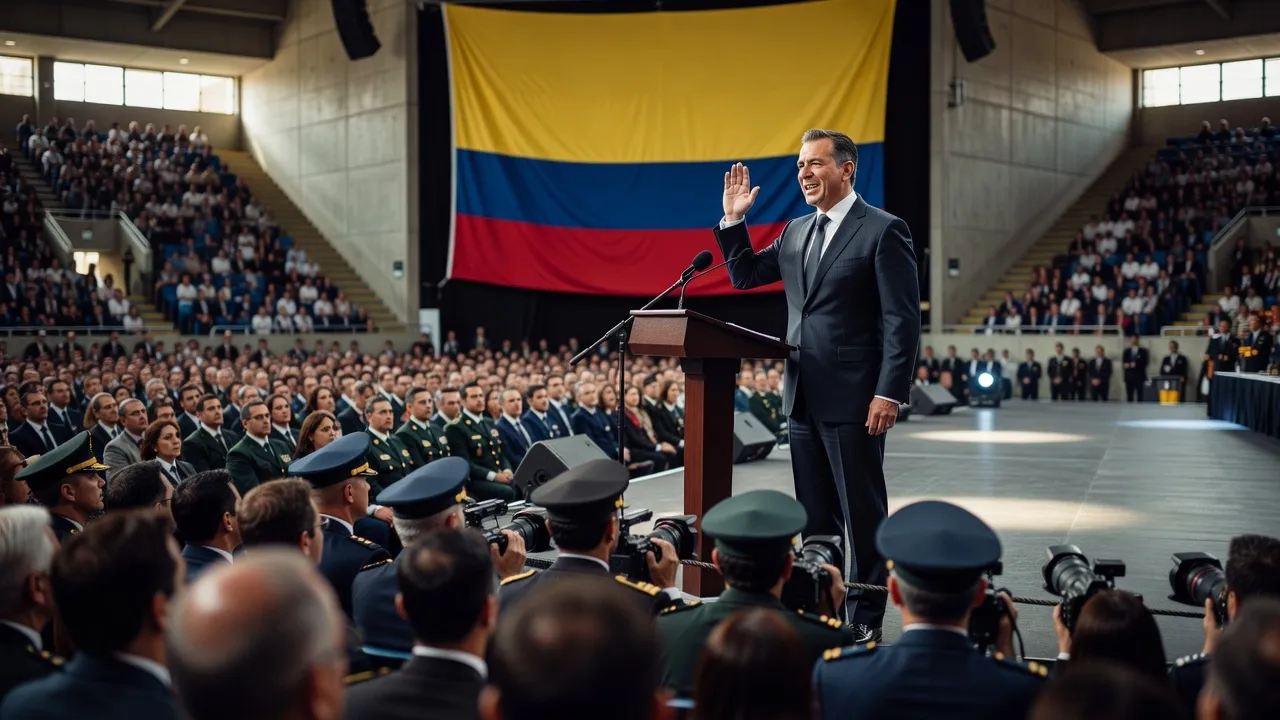
Abelardo de la Espriella, a 48-year-old millionaire criminal lawyer with dual Colombian and American nationality, was sworn in on August 7 for the 2026-2030 term, following a June 21 victory by less than one percentage point over Iván Cepeda.
For the first time in recent Colombian history, the inauguration took place outside of Bogotá, in Cali, where Congress convened for the occasion.
Outgoing President Gustavo Petro was absent from the ceremony and disputes the legitimacy of De la Espriella's electoral victory.
The same man is referred to as a 'Trump ally'/'El Tigre' (United States, Canada), a regional inspiration figure praised with accolades (Argentina, Chile), a 'far-right president' (France), or viewed solely through his economic promises as relayed by the opposition (Venezuela).
Some countries focus on the staging (Cali rather than Bogotá, barracks, armored vehicles, helicopters, 11,000 military personnel), while others only note the diplomatic or security outcome, without describing the setup.
Petro's refusal to recognize the victory and Cepeda's call to resistance are highlighted by some countries, while others treat the transfer of power as a done deal to focus on their own bilateral issues.
This grouping describes the publications analysed, not the position of these countries’ populations or of their governments.
What the coverage of each country leaves aside, while others put it forward.
Colombia
United Kingdom
Italy
Portugal
Preview: 3 of 15 media perspectives. Syntheses of the media analysed — not direct quotations. Method & limitations
Buenos Aires is witnessing the final leg of Javier Milei's regional tour in this inauguration, more so than the Colombian transfer of power itself.
3 sources · View sources
Brussels is gauging the unprecedented break that this inauguration outside the Colombian capital represents, caught between a shift to the right and the risk of social instability.
2 sources · View sources
La Paz is gauging De la Espriella's inauguration in the context of its own political turmoil, rather than examining the underlying Colombian factors.
3 sources · View sources
DOMINANT ANGLE
Buenos Aires is witnessing the final leg of Javier Milei's regional tour in this inauguration, more so than the Colombian transfer of power itself.
ANALYSIS
Buenos Aires, August 8, 2026.
DOMINANT ANGLE
Brussels is gauging the unprecedented break that this inauguration outside the Colombian capital represents, caught between a shift to the right and the risk of social instability.
ANALYSIS
Brussels, August 8, 2026.
DOMINANT ANGLE
La Paz is gauging De la Espriella's inauguration in the context of its own political turmoil, rather than examining the underlying Colombian factors.
ANALYSIS
La Paz, August 8, 2026.
DOMINANT ANGLE
Brazil gauges the rightward shift in Bogotá through the lens of its own recent political history and is opting for a pragmatic rather than ideological relationship with the new Colombian administration.
ANALYSIS
Brasília, August 8, 2026.
DOMINANT ANGLE
Ottawa is first gauging the scope of the displayed alliance with Washington, more so than the ideological shift in Colombia itself.
ANALYSIS
Ottawa, August 8, 2026.
DOMINANT ANGLE
Chile sees José Antonio Kast's trip to Cali as confirmation of a shared ideological axis with Bogotá, rather than the $1 billion US security package revealed by La Tercera.
ANALYSIS
Santiago, August 8, 2026.
DOMINANT ANGLE
Colombia has witnessed a break with protocol: for the first time in its recent history, the presidential inauguration ceremony has left Bogotá for Cali, as business leaders and former presidents call for national unity.
ANALYSIS
Bogotá, August 7, 2026.
DOMINANT ANGLE
Berlin remembers a previously attempted policy: the fear of a return to glyphosate fumigation, embodied by a farmer from Putumayo, carries as much weight as the openly displayed alliance with Washington.
ANALYSIS
Berlin, August 8, 2026.
DOMINANT ANGLE
Quito is negotiating in Cali a concrete benefit in terms of security, trade, and energy, rather than just a protocolary tribute to the new Colombian government.
ANALYSIS
Quito, August 8, 2026.
DOMINANT ANGLE
Madrid is gauging the diplomatic implications of King Felipe VI's attendance at the inauguration of a president whom Spanish media describes as "ultra-right-wing".
ANALYSIS
Madrid, August 8, 2026.
DOMINANT ANGLE
France sees Abelardo de la Espriella's inauguration as a shift to the far right in a South American country previously led by the left, viewed through the lens of the Trump-Milei duo rather than solely internal security.
ANALYSIS
Paris, August 8, 2026.
DOMINANT ANGLE
Mexico City is primarily focused on the security logistics and the boycott of the Pacto Histórico, rather than the ideological shift that other capitals are highlighting.
ANALYSIS
Mexico, August 8, 2026.
DOMINANT ANGLE
Lima welcomes a transition that it assesses mainly in terms of its own diplomatic interests, between the Pacific Alliance and a conservative shift that echoes its own.
ANALYSIS
Lima, August 8, 2026.
DOMINANT ANGLE
The United States government welcomes Abelardo de la Espriella as a renewed ally after four years of tensions with Gustavo Petro.
ANALYSIS
The United States sees the inauguration of Abelardo de la Espriella as President of Colombia, which took place on Friday in Cali, as the return of a long-awaited ally after four years.
DOMINANT ANGLE
Caracas is primarily focused on the economic program numbers presented by De la Espriella, rather than his ideological shift, and is echoing Iván Cepeda's call to "resistance".
ANALYSIS
Caracas, August 8, 2026.
Explore every perspective on this subject across 15 countries.
Compare viewpoints and see where they diverge.
published on
countries
sources
articles
gap
Abelardo de la Espriella, a 48-year-old criminal lawyer elected on June 21, 2026, over Iván Cepeda, was sworn in as president of Colombia on August 7, 2026, for a 2026-2030 term. The ceremony was held for the first time outside of Bogotá, in Cali, at the Arena USC Carlos Andrés Pérez Galindo, under the protection of approximately 11,000 police officers and military personnel. A dozen foreign heads of state attended, including Javier Milei, José Antonio Kast, Daniel Noboa, and King Felipe VI, as well as a US delegation led by acting Attorney General Todd Blanche. Outgoing President Gustavo Petro did not recognize De la Espriella's electoral victory and did not attend the ceremony.
Measured with the previous method (distance between texts), on a different scale.