
Common ground and differences in coverage across the media analysed.
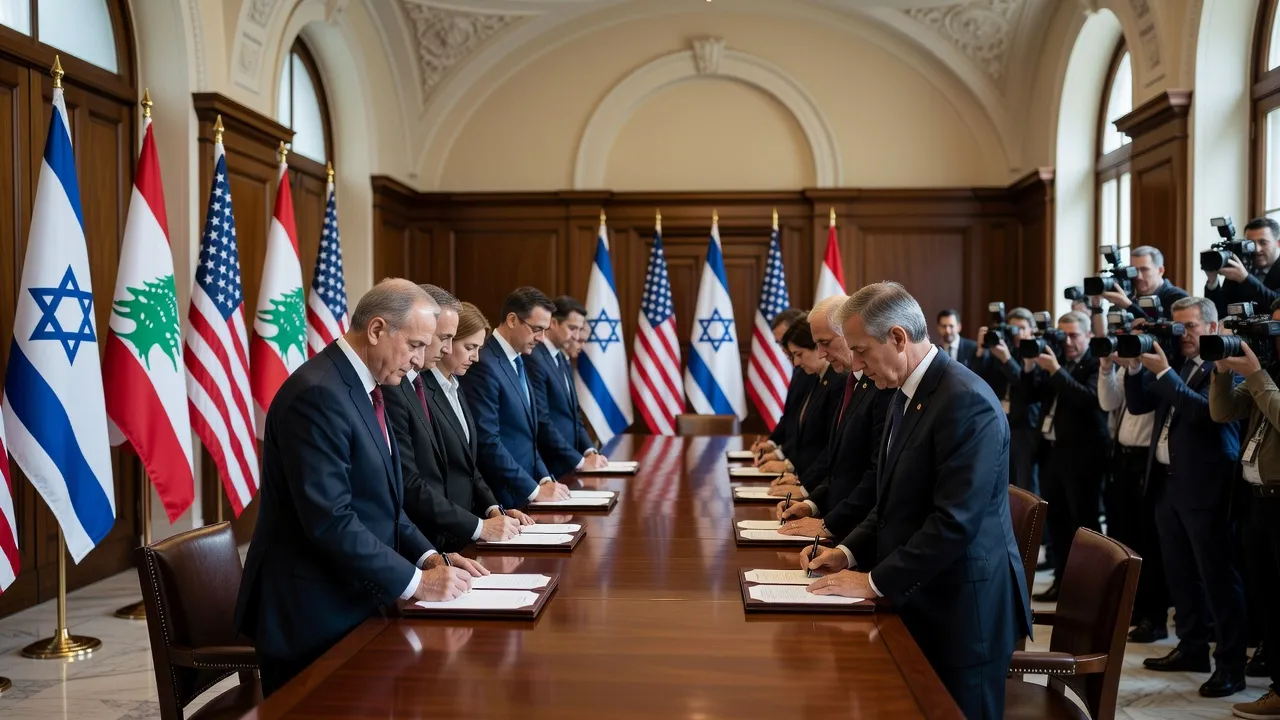
A trilateral framework agreement was signed on June 26, 2026 in Washington by the Israeli and Lebanese ambassadors in the presence of Secretary of State Marco Rubio, following the conclusion of a fifth round of direct negotiations.
Rubio described the agreement as a 'first step' and 'the beginning of the beginning', emphasizing that 'much work' remained to achieve lasting peace.
The agreement provides for Israeli withdrawal limited to two pilot zones in southern Lebanon (one to the north, one south of the Litani River), where the Lebanese army would gradually assume control.
Israel presents the agreement as a 'major success' and a 'blow to Iran', while France, Sweden, and Brazil emphasize the opaque and limited nature of the text, whose content has not been made public.
Coverage aligned with this reading
India is the sole perspective to analyze the agreement through the lens of its direct economic consequences (oil prices, margins for Indian companies, Strait of Hormuz), a dimension absent from European and American coverage.
Coverage aligned with this reading
Italy highlights the Franco-Italian coalition post-UNIFIL announced at the Antibes summit as a direct extension of the agreement, a dimension ignored by non-European perspectives.
This grouping describes the publications analysed, not the position of these countries’ populations or of their governments.
What the coverage of each country leaves aside, while others put it forward.
India
Russia
Israel
Preview: 3 of 9 media perspectives. Syntheses of the media analysed — not direct quotations. Method & limitations
Brasilia reads a historic yet fragile framework accord: Brazilian media distinguish between the diplomatic gesture and on-the-ground reality, with Netanyahu maintaining troop presence in southern Lebanon despite the signing in Washington.
3 sources · View sources
Paris watches a historic yet fragile accord unfold: France underscores the diplomatic significance of the tripartite Washington signature while flagging persistent contradictions between the text and on-the-ground realities in Lebanon.
5 sources · View sources
Jerusalem reads this trilateral framework agreement signed in Washington as a conditional strategic advance: the signature is hailed as a 'major success' by Netanyahu, yet Israel maintains that any withdrawal of its forces from Lebanon remains contingent on the Hezbollah's effective disarmament.
2 sources · View sources
DOMINANT ANGLE
Brasilia reads a historic yet fragile framework accord: Brazilian media distinguish between the diplomatic gesture and on-the-ground reality, with Netanyahu maintaining troop presence in southern Lebanon despite the signing in Washington.
ANALYSIS
Brasilia, June 27, 2026.
DOMINANT ANGLE
Paris watches a historic yet fragile accord unfold: France underscores the diplomatic significance of the tripartite Washington signature while flagging persistent contradictions between the text and on-the-ground realities in Lebanon.
ANALYSIS
Paris, June 27, 2026.
DOMINANT ANGLE
Jerusalem reads this trilateral framework agreement signed in Washington as a conditional strategic advance: the signature is hailed as a 'major success' by Netanyahu, yet Israel maintains that any withdrawal of its forces from Lebanon remains contingent on the Hezbollah's effective disarmament.
ANALYSIS
Jerusalem, June 27, 2026.
DOMINANT ANGLE
New Delhi evaluates the Washington-brokered accord through the lens of its economic interests: the gradual reopening of the Strait of Hormuz and the stabilization of the Middle East represent the authentic foundation of India's reading of this diplomatic breakthrough.
ANALYSIS
New Delhi, June 27, 2026.
DOMINANT ANGLE
Rome measures the Israel-Lebanon framework agreement through the lens of its own stakes: Italy, a key UNIFIL contributor now facing Iranian accusations of complicity, finds itself at the heart of Lebanese affairs precisely as Meloni and Macron announce a post-UNIFIL coalition at Antibes.
ANALYSIS
Rome, June 27, 2026.
DOMINANT ANGLE
Moscow interprets the Washington-Jerusalem-Beirut agreement as an American security architecture that consolidates Israeli presence in Lebanon while explicitly targeting Iran and Hezbollah.
ANALYSIS
Moscow, June 27, 2026.
DOMINANT ANGLE
Stockholm cautiously weighs the reach of the framework agreement signed in Washington: a foundational text whose gaps—partial withdrawal, Hezbollah rejection, persistence of violence—constrain the promise of peace.
ANALYSIS
Stockholm, June 27, 2026.
DOMINANT ANGLE
Singapore evaluates the Israel-Lebanon framework agreement as a fragile diplomatic opening backed by Washington but constrained by persistent geographic disagreements and an unstable regional environment.
ANALYSIS
Singapore, June 27, 2026.
DOMINANT ANGLE
Washington claims diplomatic authorship of the Israel-Lebanon framework accord, while gauging the fragilities of a text that Hezbollah did not sign and that internal polling places in a context of deep public skepticism.
ANALYSIS
Washington, June 27, 2026.
Explore every perspective on this subject across 9 countries.
Compare viewpoints and see where they diverge.
published on
countries
sources
articles
gap
On 26 June 2026, after a fifth round of direct talks, a trilateral framework agreement was signed in Washington by the Israeli and Lebanese ambassadors, in the presence of Secretary of State Marco Rubio. He described the text as a "first step" and the "beginning of the beginning", stressing that much work remained before any lasting peace.
The agreement provides for a limited Israeli withdrawal from two pilot zones in southern Lebanon, one north and one south of the Litani river, where the Lebanese army would gradually take control. The detailed content of the text has not been made public. Any broader withdrawal is conditioned by the Israeli authorities on the full disarmament of Hezbollah, which rejected the agreement and warned of a risk of "civil war". Violence persisted during and after the talks: three people were killed by a drone the day before the signing, and seven more on the day itself.
The signing comes amid a rapid reshaping of the Middle East. The Israeli-Lebanese conflict, triggered on 2 March, has killed more than 4,200 people in Lebanon and displaced over one million. The agreement follows ten days after a U.S.-Iranian ceasefire memorandum, whose fragility was underscored by fresh mutual strikes on the very day of the signing.
Several points remain disputed. Israeli and U.S. actors present the agreement as a major advance, while others stress its partial and opaque nature. Lebanon is demanding a withdrawal from its entire territory, even as the signing coincides with troops staying in place. The disarmament of Hezbollah, the border demarcation and the replacement of the U.N. force, whose mandate expires at the end of 2026, all remain open questions.
Measured with the previous method (distance between texts), on a different scale.