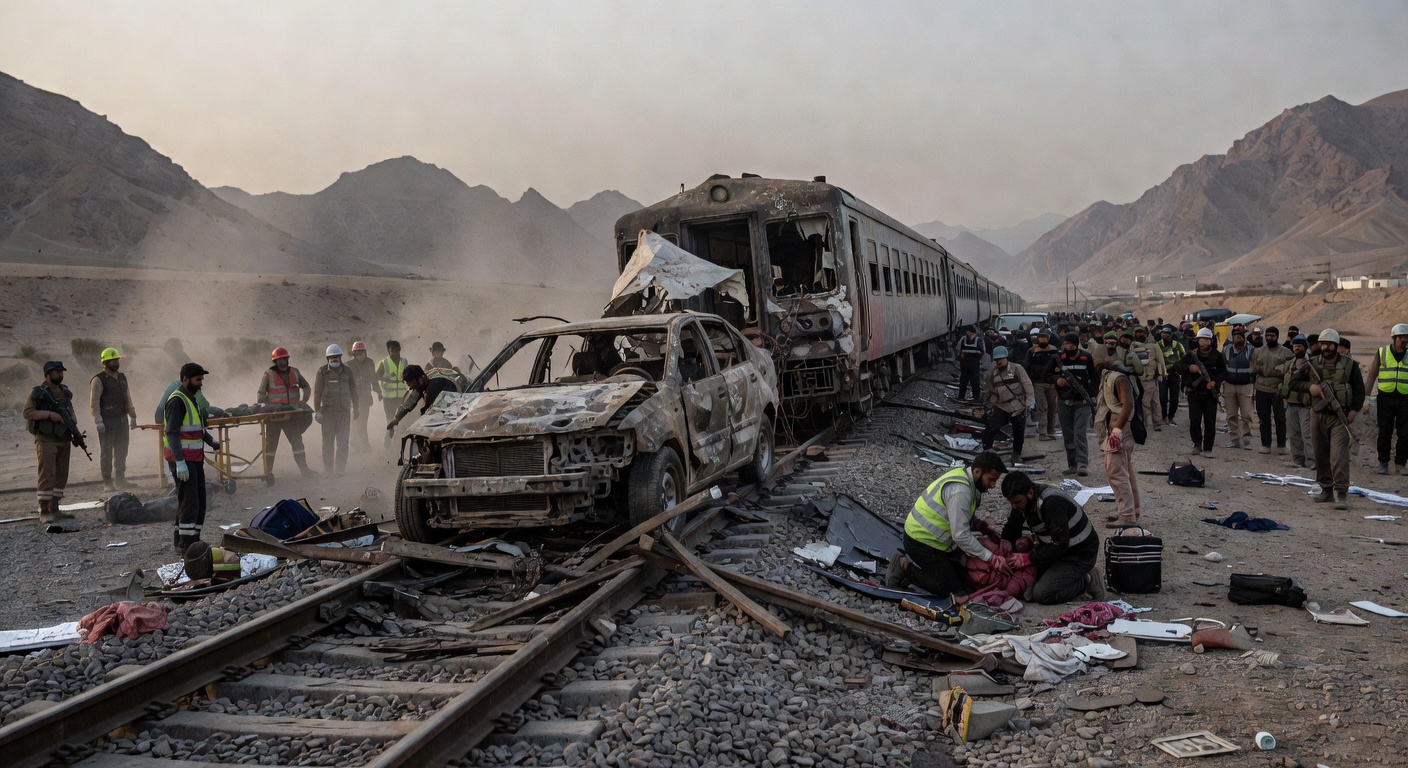
On Sunday 24 May 2026, a suicide car bomb struck a train at the Chaman Phatak level crossing in Quetta, in Pakistan's Balochistan province. The blast derailed and set ablaze several carriages, killing and wounding many among the passengers and bystanders. Provincial authorities described the act as terrorism and declared a state of emergency in the city's hospitals.
The attack belongs to a long-running conflict. Balochistan, the country's largest yet least developed province, has for decades been the scene of a separatist insurgency and recurring attacks on infrastructure and security forces. The region holds significant natural resources (gas, minerals) and is home to segments of the China-Pakistan economic corridor, regularly targeted by armed factions that denounce what they see as an inadequate sharing of local wealth.
Several points remain disputed. The toll differs depending on the actors: provincial authorities report at least 14 dead and 20 injured, while international sources put forward a markedly higher figure. A claim of responsibility attributed to a separatist group is cited by foreign actors but is not reported by Pakistani authorities. The nature of the target is also debated: described as a civilian commuter train by the authorities, it is elsewhere portrayed as a convoy carrying mainly military personnel and their families.
Finally, the weight given to the regional context varies from one reading to another. Some actors link the instability to the porous border between Pakistan and Afghanistan, while others confine themselves to the internal security frame alone. Pakistan, a nuclear power bordering Afghanistan, Iran and India, sees its domestic stability closely watched by major powers, each projecting its own interests onto it.