SHARE THIS COMPARISON
Show your friends how the world sees the same news differently.
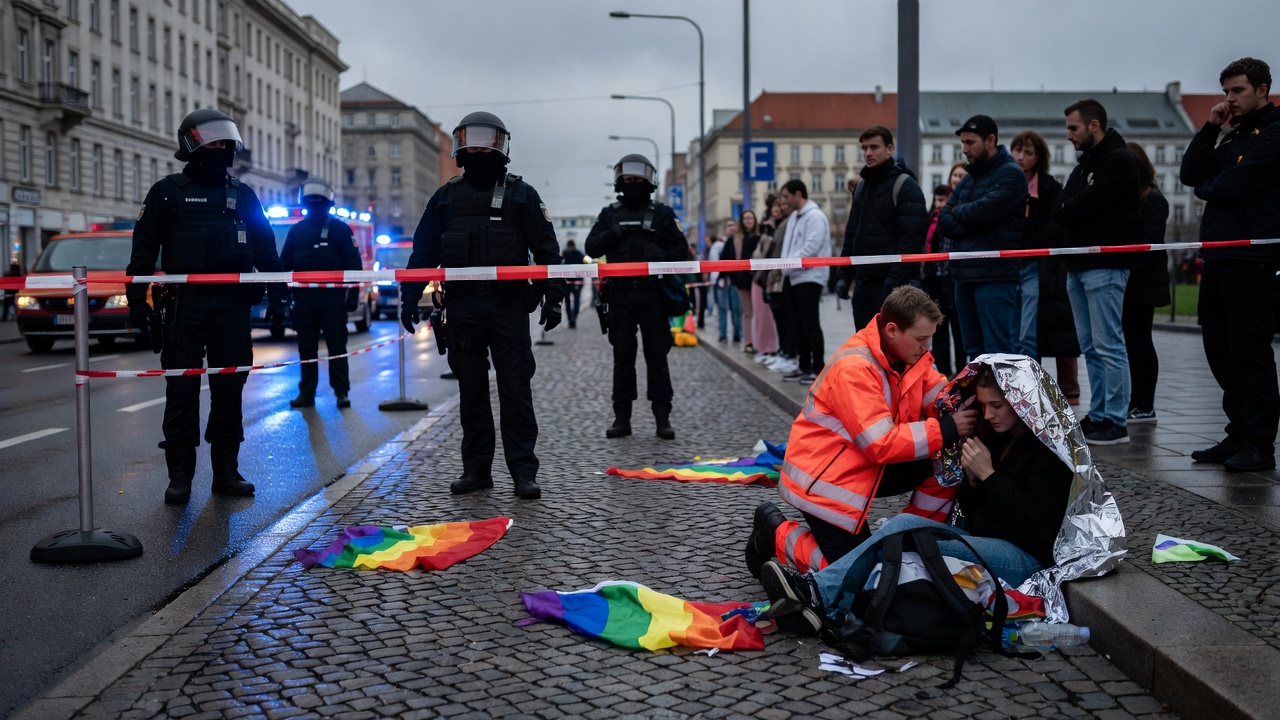
A vehicle rammed into the crowd at Berlin's Pride march on 26 July 2026, killing one person and injuring sixteen. German police are hunting a 21-year-old suspect described as tied to the Islamist scene, reviving debate over the security of large gatherings and the protection of the LGBT community.
FRAMING GAP
5/100LOW
Coverages are relatively similar
Here are the main framing differences identified between media coverages.
ANALYSIS BY COUNTRY
 AUSTRALIA
DOMINANT ANGLE
Sydney observes from Berlin a phrase echoed across Australian newsrooms, 'our freedom has been attacked', and measures the enduring vulnerability of LGBTQI+ gatherings facing vehicle-ramming attacks.
Dominant angle identified — does not reflect unanimity of this country’s media
KEY POINTS
- •One dead and approximately 16 to 17 wounded, several critically, after a vehicle plowed into the crowd at Berlin's Tiergarten according to police
- •Suspect identified: a 21-year-old man named Abdul B., described by police as a member of Berlin's Islamist circles, still at large
- •Chancellor Friedrich Merz pledged the attack would be fully investigated and punished; Berlin Mayor Kai Wegner called it an attack on freedom
BIASES
Security-focused framing: priority given to police manhunt and suspect identity rather than to the victims themselvesReliance on official German sources (police, chancellor, mayor) at the expense of direct testimonies from march participantsLimited coverage of the attacker's motivations, which remain unestablished by authorities at the time of reporting
 CANADAincl. 1 state outlet
DOMINANT ANGLE
Ottawa views the Berlin attack as a fresh security alert for Western LGBTQ+ gatherings, balancing community solidarity with concerns about Islamist threats.
Dominant angle identified — does not reflect unanimity of this country’s media
KEY POINTS
- •One person killed and at least 15-16 injured after a van struck the crowd in Tiergarten park, near Berlin's Pride march route (The Globe and Mail, Global News).
- •Police spokesman Florian Nath confirms that a suspect 'known to police' as a 'member of Islamist circles' in Berlin is actively sought but not yet arrested.
- •Over 2,200 police officers were already deployed since Saturday morning to secure Christopher Street Day, which drew hundreds of thousands of people according to CBC News.
BIASES
Security-police framing: Canadian articles prioritize statements and the narrative conveyed by Berlin police rather than direct victim testimonies.Preference for real-time wire reporting: several outlets reproduce a nearly identical narrative from the same official communications, with minimal independent contextual analysis.Limited coverage of Canadian community reactions: no consulted article reports responses from Canadian LGBTQ+ organizations or political authorities.
 FRANCEincl. 1 state outlet
DOMINANT ANGLE
Paris condemns an attack targeting the LGBT+ community and questions the recurring pattern of vehicle-ramming attacks striking Germany since 2016.
Dominant angle identified — does not reflect unanimity of this country’s media
KEY POINTS
- •A 21-year-old man identified as Abdul B. and described by police as connected to 'Islamist circles' is the subject of a manhunt (Florian Nath, Berlin police spokesperson)
- •Official toll: one dead, sixteen injured including eleven seriously, with three in critical condition according to Berlin firefighters
- •Over 2,200 police officers mobilized since Saturday morning to secure the Pride March (Christopher Street Day), now supported by helicopters equipped with thermal imaging
BIASES
Security-focused framing: emphasis placed on police investigation and suspect profile rather than on the direct experiences of victimsReliance on official police sources (spokesperson Florian Nath), with limited testimony gathered from the LGBT+ community present at the eventLimited coverage of international political reactions and broader debate surrounding LGBT+ gathering safety across Europe
 GERMANYincl. 1 state outlet
DOMINANT ANGLE
Berlin assesses the shock of another vehicle ramming attack, this time striking the Pride march, and reignites debate over security measures for major public gatherings.
Dominant angle identified — does not reflect unanimity of this country’s media
KEY POINTS
- •One death and 16 wounded, including three critically, after a vehicle struck crowds at CSD in Tiergarten Saturday evening, according to Berlin fire services.
- •Suspect Abdul B., 21, is described by police as known to authorities and linked to Berlin's Islamist circles; he was released from juvenile detention in May 2026 (dpa).
- •Chancellor Friedrich Merz condemned an 'abominable' act, and Berlin mayor Kai Wegner denounced an 'attack on our free and open society.'
BIASES
Security-centered framing: strong emphasis on suspect profile and manhunt, less focus on victim narratives and experiences of the LGBT+ community on scene.Reliance on police and institutional sources (authorities, municipal government, chancellery) at the expense of direct community testimony from those present.Limited comparative perspective on previous vehicle ramming attacks across Europe, constraining historical analysis of the phenomenon in Germany.
 GREECE
DOMINANT ANGLE
Athens watches with concern Berlin's latest vehicle-ramming attack, a symptom of Europe struggling to secure its major public gatherings
Dominant angle identified — does not reflect unanimity of this country’s media
KEY POINTS
- •A white van sped around 10:15 p.m. Saturday into crowds at Tiergarten, killing one woman and injuring sixteen people before hitting a tree
- •The suspect, Abdul B., age 21, is described by police as known to authorities and linked to Berlin's Islamist extremist circles; he was released from juvenile detention in May
- •According to BILD, cited by Greek press, the suspect carried a bladed object he allegedly directed at crowds; police deny any arrest has yet been made
BIASES
Security-chronological framing: Greek press prioritizes factual reconstruction of events over broader political analysisHeavy reliance on German police sources (dpa, Berlin police) relayed without independent Greek counter-analysisLimited coverage of LGBT societal dimensions: minimal attention given to community reactions or public gathering security concerns
 ITALY
ITALYDOMINANT ANGLE
Rome tracks Saturday's vehicle-ramming attack on Berlin's Christopher Street Day parade, anchoring it within the broader cycle of such assaults across Europe since 2016.
Dominant angle identified — does not reflect unanimity of this country’s media
KEY POINTS
- •A white van drove at approximately 50 mph into the Christopher Street Day crowd at Tiergarten on Saturday, July 25, around 10 p.m., killing one woman and injuring sixteen, according to Adnkronos and ANSA.
- •Police are searching for a 21-year-old suspect, Abdul B., who was released in May from a juvenile detention center and is known to authorities for links to Islamist circles, according to Adnkronos and ANSA.
- •Witnesses cited by Adnkronos describe a possible second phase of the attack, with stab injuries, after the vehicle struck a tree.
BIASES
Security-focused framing: emphasis on police pursuit and suspect profile rather than on responses from Berlin's LGBTQ+ community.Reliance on German police and news sources (Bild, DPA) presented without Italian independent analysis or broader context.Limited coverage of domestic Italian debate on Pride parade security, with focus remaining on the German event.
 PHILIPPINES
DOMINANT ANGLE
Manila's press treats the Berlin Pride attack as a distant foreign incident—a stark reminder of public gathering vulnerability—rather than a catalyst for domestic policy discussion on assembly security.
Dominant angle identified — does not reflect unanimity of this country’s media
KEY POINTS
- •One dead and seventeen injured, including eight seriously wounded and three in life-threatening condition, according to Berlin emergency services.
- •Police identified a suspect with known ties to Berlin's Islamist networks, still at large as of press time.
- •The white vehicle, possibly a minibus or SUV, was found empty after striking a tree; a witness cited by Bild reported a man exiting and fleeing on foot.
BIASES
Security-focused framing: emphasis placed on police manhunt and perpetrator identification rather than on LGBTQ+ community perspectives and debate raised in Germany.Heavy reliance on wire reporting: both articles reproduced nearly identical police statements without independent on-the-ground reporting or local interviews.Minimal historical context: insufficient exploration of previous vehicle-ramming attacks in Germany since 2016 or broader European security patterns.
 SINGAPORE
DOMINANT ANGLE
Singapore frames the Berlin vehicle-ramming attack within Germany's recurring series of vehicle-ramming incidents since 2016, rather than treating it as an isolated event.
Dominant angle identified — does not reflect unanimity of this country’s media
KEY POINTS
- •One person killed and sixteen injured, including three in critical condition, after a vehicle struck the Christopher Street Day crowd in Berlin, according to Berlin police cited by Channel News Asia
- •A witness cited by Bild and relayed by the Straits Times via Reuters observed a white van hit the crowd at high speed before a man exited and fled on foot
- •The Straits Times documents a series of vehicle-ramming attacks in Germany since 2016, including Magdeburg (six deaths, December 2024) and Munich (February 2025)
BIASES
Security-focused framing: emphasis on police pursuit and suspect profile rather than responses from the targeted LGBTQ+ communityReliance on Western wire sources (Reuters, AFP, Bild) transmitted without independent reporting from Singapore-based correspondentsLimited coverage of German political implications (security policy debates, government responses) in favor of factual incident narrative
 UNITED STATES
DOMINANT ANGLE
Washington connects the Berlin attack to a succession of vehicle-ramming attacks that have struck Europe since 2016, identifying a resurgent Islamist threat during Pride celebrations.
Dominant angle identified — does not reflect unanimity of this country’s media
KEY POINTS
- •Police toll: one dead, at least 16 injured with several in life-threatening condition, after a vehicle rammed into Tiergarten crowd
- •Suspect sought: a 21-year-old man, 'Abdul B.,' described by police as a member of Islamist circles in Berlin
- •More than 2,000 police officers deployed to secure Christopher Street Day, one of Europe's largest LGBTQ+ gatherings
BIASES
Security-focused framing: emphasis on suspect profile and police response rather than LGBTQ+ community reactionsReliance on official sources: nearly exclusive citations from police spokespeople and Berlin's mayorLimited coverage of German political debate on immigration and security at large public gatherings
AUSTRALIADOMINANT ANGLE
Sydney observes from Berlin a phrase echoed across Australian newsrooms, 'our freedom has been attacked', and measures the enduring vulnerability of LGBTQI+ gatherings facing vehicle-ramming attacks.
Dominant angle identified — does not reflect unanimity of this country’s media
KEY POINTS
- •One dead and approximately 16 to 17 wounded, several critically, after a vehicle plowed into the crowd at Berlin's Tiergarten according to police
- •Suspect identified: a 21-year-old man named Abdul B., described by police as a member of Berlin's Islamist circles, still at large
- •Chancellor Friedrich Merz pledged the attack would be fully investigated and punished; Berlin Mayor Kai Wegner called it an attack on freedom
BIASES
Security-focused framing: priority given to police manhunt and suspect identity rather than to the victims themselvesReliance on official German sources (police, chancellor, mayor) at the expense of direct testimonies from march participantsLimited coverage of the attacker's motivations, which remain unestablished by authorities at the time of reporting
CANADAincl. 1 state outletDOMINANT ANGLE
Ottawa views the Berlin attack as a fresh security alert for Western LGBTQ+ gatherings, balancing community solidarity with concerns about Islamist threats.
Dominant angle identified — does not reflect unanimity of this country’s media
KEY POINTS
- •One person killed and at least 15-16 injured after a van struck the crowd in Tiergarten park, near Berlin's Pride march route (The Globe and Mail, Global News).
- •Police spokesman Florian Nath confirms that a suspect 'known to police' as a 'member of Islamist circles' in Berlin is actively sought but not yet arrested.
- •Over 2,200 police officers were already deployed since Saturday morning to secure Christopher Street Day, which drew hundreds of thousands of people according to CBC News.
BIASES
Security-police framing: Canadian articles prioritize statements and the narrative conveyed by Berlin police rather than direct victim testimonies.Preference for real-time wire reporting: several outlets reproduce a nearly identical narrative from the same official communications, with minimal independent contextual analysis.Limited coverage of Canadian community reactions: no consulted article reports responses from Canadian LGBTQ+ organizations or political authorities.
FRANCEincl. 1 state outletDOMINANT ANGLE
Paris condemns an attack targeting the LGBT+ community and questions the recurring pattern of vehicle-ramming attacks striking Germany since 2016.
Dominant angle identified — does not reflect unanimity of this country’s media
KEY POINTS
- •A 21-year-old man identified as Abdul B. and described by police as connected to 'Islamist circles' is the subject of a manhunt (Florian Nath, Berlin police spokesperson)
- •Official toll: one dead, sixteen injured including eleven seriously, with three in critical condition according to Berlin firefighters
- •Over 2,200 police officers mobilized since Saturday morning to secure the Pride March (Christopher Street Day), now supported by helicopters equipped with thermal imaging
BIASES
Security-focused framing: emphasis placed on police investigation and suspect profile rather than on the direct experiences of victimsReliance on official police sources (spokesperson Florian Nath), with limited testimony gathered from the LGBT+ community present at the eventLimited coverage of international political reactions and broader debate surrounding LGBT+ gathering safety across Europe
GERMANYincl. 1 state outletDOMINANT ANGLE
Berlin assesses the shock of another vehicle ramming attack, this time striking the Pride march, and reignites debate over security measures for major public gatherings.
Dominant angle identified — does not reflect unanimity of this country’s media
KEY POINTS
- •One death and 16 wounded, including three critically, after a vehicle struck crowds at CSD in Tiergarten Saturday evening, according to Berlin fire services.
- •Suspect Abdul B., 21, is described by police as known to authorities and linked to Berlin's Islamist circles; he was released from juvenile detention in May 2026 (dpa).
- •Chancellor Friedrich Merz condemned an 'abominable' act, and Berlin mayor Kai Wegner denounced an 'attack on our free and open society.'
BIASES
Security-centered framing: strong emphasis on suspect profile and manhunt, less focus on victim narratives and experiences of the LGBT+ community on scene.Reliance on police and institutional sources (authorities, municipal government, chancellery) at the expense of direct community testimony from those present.Limited comparative perspective on previous vehicle ramming attacks across Europe, constraining historical analysis of the phenomenon in Germany.
GREECEDOMINANT ANGLE
Athens watches with concern Berlin's latest vehicle-ramming attack, a symptom of Europe struggling to secure its major public gatherings
Dominant angle identified — does not reflect unanimity of this country’s media
KEY POINTS
- •A white van sped around 10:15 p.m. Saturday into crowds at Tiergarten, killing one woman and injuring sixteen people before hitting a tree
- •The suspect, Abdul B., age 21, is described by police as known to authorities and linked to Berlin's Islamist extremist circles; he was released from juvenile detention in May
- •According to BILD, cited by Greek press, the suspect carried a bladed object he allegedly directed at crowds; police deny any arrest has yet been made
BIASES
Security-chronological framing: Greek press prioritizes factual reconstruction of events over broader political analysisHeavy reliance on German police sources (dpa, Berlin police) relayed without independent Greek counter-analysisLimited coverage of LGBT societal dimensions: minimal attention given to community reactions or public gathering security concerns
ITALYDOMINANT ANGLE
Rome tracks Saturday's vehicle-ramming attack on Berlin's Christopher Street Day parade, anchoring it within the broader cycle of such assaults across Europe since 2016.
Dominant angle identified — does not reflect unanimity of this country’s media
KEY POINTS
- •A white van drove at approximately 50 mph into the Christopher Street Day crowd at Tiergarten on Saturday, July 25, around 10 p.m., killing one woman and injuring sixteen, according to Adnkronos and ANSA.
- •Police are searching for a 21-year-old suspect, Abdul B., who was released in May from a juvenile detention center and is known to authorities for links to Islamist circles, according to Adnkronos and ANSA.
- •Witnesses cited by Adnkronos describe a possible second phase of the attack, with stab injuries, after the vehicle struck a tree.
BIASES
Security-focused framing: emphasis on police pursuit and suspect profile rather than on responses from Berlin's LGBTQ+ community.Reliance on German police and news sources (Bild, DPA) presented without Italian independent analysis or broader context.Limited coverage of domestic Italian debate on Pride parade security, with focus remaining on the German event.
PHILIPPINESDOMINANT ANGLE
Manila's press treats the Berlin Pride attack as a distant foreign incident—a stark reminder of public gathering vulnerability—rather than a catalyst for domestic policy discussion on assembly security.
Dominant angle identified — does not reflect unanimity of this country’s media
KEY POINTS
- •One dead and seventeen injured, including eight seriously wounded and three in life-threatening condition, according to Berlin emergency services.
- •Police identified a suspect with known ties to Berlin's Islamist networks, still at large as of press time.
- •The white vehicle, possibly a minibus or SUV, was found empty after striking a tree; a witness cited by Bild reported a man exiting and fleeing on foot.
BIASES
Security-focused framing: emphasis placed on police manhunt and perpetrator identification rather than on LGBTQ+ community perspectives and debate raised in Germany.Heavy reliance on wire reporting: both articles reproduced nearly identical police statements without independent on-the-ground reporting or local interviews.Minimal historical context: insufficient exploration of previous vehicle-ramming attacks in Germany since 2016 or broader European security patterns.
SINGAPOREDOMINANT ANGLE
Singapore frames the Berlin vehicle-ramming attack within Germany's recurring series of vehicle-ramming incidents since 2016, rather than treating it as an isolated event.
Dominant angle identified — does not reflect unanimity of this country’s media
KEY POINTS
- •One person killed and sixteen injured, including three in critical condition, after a vehicle struck the Christopher Street Day crowd in Berlin, according to Berlin police cited by Channel News Asia
- •A witness cited by Bild and relayed by the Straits Times via Reuters observed a white van hit the crowd at high speed before a man exited and fled on foot
- •The Straits Times documents a series of vehicle-ramming attacks in Germany since 2016, including Magdeburg (six deaths, December 2024) and Munich (February 2025)
BIASES
Security-focused framing: emphasis on police pursuit and suspect profile rather than responses from the targeted LGBTQ+ communityReliance on Western wire sources (Reuters, AFP, Bild) transmitted without independent reporting from Singapore-based correspondentsLimited coverage of German political implications (security policy debates, government responses) in favor of factual incident narrative
UNITED STATESDOMINANT ANGLE
Washington connects the Berlin attack to a succession of vehicle-ramming attacks that have struck Europe since 2016, identifying a resurgent Islamist threat during Pride celebrations.
Dominant angle identified — does not reflect unanimity of this country’s media
KEY POINTS
- •Police toll: one dead, at least 16 injured with several in life-threatening condition, after a vehicle rammed into Tiergarten crowd
- •Suspect sought: a 21-year-old man, 'Abdul B.,' described by police as a member of Islamist circles in Berlin
- •More than 2,000 police officers deployed to secure Christopher Street Day, one of Europe's largest LGBTQ+ gatherings
BIASES
Security-focused framing: emphasis on suspect profile and police response rather than LGBTQ+ community reactionsReliance on official sources: nearly exclusive citations from police spokespeople and Berlin's mayorLimited coverage of German political debate on immigration and security at large public gatherings
CROSS-PERSPECTIVE ANALYSIS
CROSS-ANALYSIS
CONSENSUS POINTS
- 1Official converging report: one person killed and approximately fifteen seriously injured after a vehicle drove into the crowd at the Christopher Street Day march in Berlin's Tiergarten on Saturday evening.
- 2Suspect identification: a 21-year-old man, designated 'Abdul B.', described by Berlin police as known to authorities and linked to local Islamist circles, still at large at the time of the articles.
- 3Massive security deployment: more than 2,000 to 2,200 police officers were already deployed to secure the march before the attack, subsequently reinforced by active search efforts, including helicopters.
- 4Convergent official reactions: Chancellor Friedrich Merz and Berlin Mayor Kai Wegner condemned the act and described it as an attack against open and free German society.
- 5All perspectives share a security-focused framing, prioritizing official police sources over direct testimonies from victims or the LGBTQ+ community present at the scene.
FRAMING DIFFERENCES
Historical contextualization
Some coverage situates the attack within a series of vehicle-ramming attacks that have occurred in Germany since 2016 (Magdeburg, Munich), while others treat the event as an isolated incident without comparable historical perspective.
Frame this way
Frame the opposite
Anti-LGBT+ dimension
French coverage explicitly frames the attack as targeting the LGBTQ+ community, a more victimizing framing than other perspectives, which describe the event as a generic threat against open society or public gatherings.
Frame this way
Frame the opposite
Hypothesis of a blade weapon
Several perspectives report, via witnesses cited by Bild, a possible second phase of the attack involving a sharp object wielded by the suspect before his escape on foot, information absent from coverage in other countries.
Frame this way
Frame the opposite
GEOPOLITICAL CLUSTERS
English-speaking allies outside Europe
Shared narrative
These countries relay the attack through security-focused coverage centered on official German police sources, emphasizing the suspect's profile and police response, with little reporting of national political or community reactions.
Continental Europe directly affected
Shared narrative
These European countries follow the event hour by hour relying heavily on the same German sources (police, Bild, dpa); France distinguishes itself by greater emphasis on the anti-LGBT+ dimension of the attack, while Germany, Italy, and Greece remain focused on factual reconstruction and police investigation.
Distant Asian press
Shared narrative
Treated as international news followed from a distance, without editorial commentary or direct national implication, Singapore distinguishes itself by situating the attack within the series of vehicle-ramming attacks in Germany since 2016, unlike the Philippines which remains closer to the wire service report.
OMISSIONS ANALYSIS
GermanyOmitted topics
historical perspective on the series of vehicle-ramming attacks since 2016
Highlighted by
PhilippinesOmitted topics
historical context of vehicle-ramming attacks in Germany since 2016LGBTQ+ community debate raised in Germany
Highlighted by
AustraliaOmitted topics
precise ideological motivations of the suspectdirect testimonies from march participants or victims
Highlighted by
GEOPOLITICAL CONTEXT
The Berlin attack revives a recurring debate in Europe over the security of large public and community gatherings in the face of Islamist terrorist threat, continuing a pattern of several vehicle-ramming attacks documented in Germany since 2016. International coverage remains largely dependent on German police and institutional sources, which homogenizes the factual narrative from country to country, while the extent of historical perspective and the weight given to the LGBTQ+ community dimension vary according to the geographic and editorial proximity of each national press to Germany.
AI-powered analysis