Common ground and differences in coverage across the media analysed.
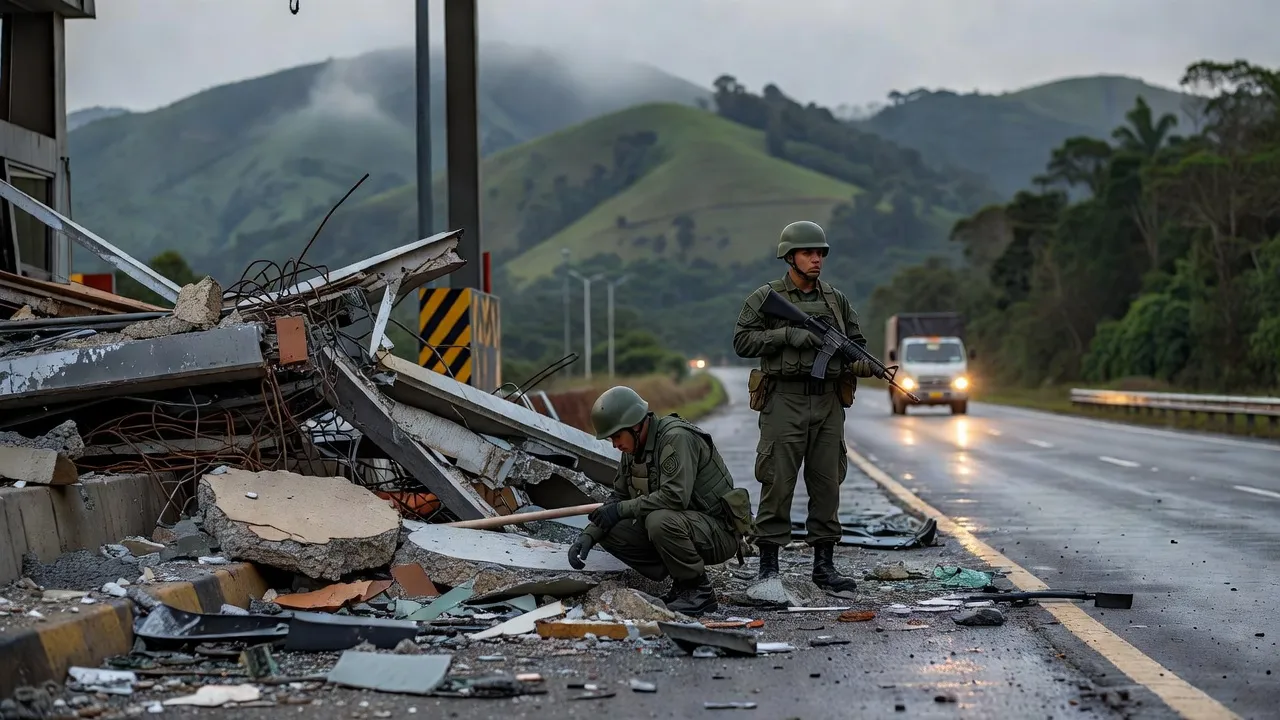
Two explosive attacks hit Colombia on Saturday, August 8: explosive-laden drones targeted a police substation in San Roque (Cesar), killing one officer, and a toll booth under construction was destroyed in Cauca, slightly injuring two security agents.
Abelardo de la Espriella was sworn in as president on Friday, August 7, during an unusual military ceremony held in Cali, rather than Bogotá.
The new president promised on X that there would be « no refuge, no leniency, no impunity » for those responsible for the attacks and framed dialogue with armed groups as an exhausted option.
Argentine and Venezuelan media view the inauguration as a broader regional political signal, echoing Argentina's liberal shift and the Venezuelan opposition's hopes for change, while Brazilian, Ecuadorian, Mexican, and French media primarily focus on the domestic security implications related to the attacks.
Brazilian, Mexican, Ecuadorian, and French media present the firm stance doctrine (end of dialogue with armed groups, transfer of detainees) without noting internal resistance, whereas Colombian media also highlight the institutional frictions faced by the new government: setbacks in the Senate, left-wing opposition, and the JEP's response on judicial independence.
Venezuelan media interpret the $1 billion US security aid package as an unprecedented diplomatic signal in the bilateral rapprochement between Colombia and Venezuela, while Brazilian media mainly link it to Colombia's announced membership in the US-led 'Escudo das Américas' security alliance.
This grouping describes the publications analysed, not the position of these countries’ populations or of their governments.
What the coverage of each country leaves aside, while others put it forward.
Colombia
Argentina
Venezuela
Preview: 3 of 7 media perspectives. Syntheses of the media analysed — not direct quotations. Method & limitations
Bogotá is deciphering an inauguration that breaks with its own codes: Cali rather than the Presidential Palace, mega-prisons before laws, a Senate already resistant to the new power.
5 sources · View sources
Caracas takes note of Abelardo de la Espriella's inauguration, focusing less on the wave of attacks in Colombia and more on what it promises for Venezuela: the ratification of a fraternity hailed by María Corina Machado and a $1 billion US package presented as an unthinkable signal just a few months ago.
5 sources · View sources
Quito is closely watching the security situation at its northern border, where attacks by FARC dissidents against the new Colombian government are reviving fears of a spillover of narcotics trafficking into Ecuadorian territory.
4 sources · View sources
DOMINANT ANGLE
Bogotá is deciphering an inauguration that breaks with its own codes: Cali rather than the Presidential Palace, mega-prisons before laws, a Senate already resistant to the new power.
ANALYSIS
Bogotá, August 10, 2026.
DOMINANT ANGLE
Caracas takes note of Abelardo de la Espriella's inauguration, focusing less on the wave of attacks in Colombia and more on what it promises for Venezuela: the ratification of a fraternity hailed by María Corina Machado and a $1 billion US package presented as an unthinkable signal just a few months ago.
ANALYSIS
Caracas, August 10, 2026.
DOMINANT ANGLE
Quito is closely watching the security situation at its northern border, where attacks by FARC dissidents against the new Colombian government are reviving fears of a spillover of narcotics trafficking into Ecuadorian territory.
ANALYSIS
Quito, August 10, 2026.
DOMINANT ANGLE
Mexico City views Abelardo de la Espriella's trial by fire in security as the start of a "tough approach" era with uncertain immediate results
ANALYSIS
Mexico, August 10, 2026.
DOMINANT ANGLE
Buenos Aires sees in Abelardo de la Espriella's first steps a reflection of its own liberal shift, marked by the elimination of the wealth tax, swift expropriation, and a publicly declared alliance with María Corina Machado.
ANALYSIS
Buenos Aires, August 10, 2026.
DOMINANT ANGLE
Brasília sees Abelardo de la Espriella's inauguration as a immediate shift in security, between attacks and a pro-Washington turn.
ANALYSIS
Brasília, August 10, 2026.
DOMINANT ANGLE
France is assessing the cost of the Colombian security shift, marked by deadly attacks and the abandonment of the dialogue initiated in 2016.
ANALYSIS
Paris, August 10, 2026.
Explore every perspective on this subject across 7 countries.
Compare viewpoints and see where they diverge.
published on
countries
sources
articles
gap
On August 7, 2026, Abelardo de la Espriella, an attorney backed by Donald Trump, was sworn in as president of Colombia during a military ceremony at the Cantón Militar Nápoles in Cali. The following day, two explosive attacks struck the country: drones targeted a police station in Cesar, killing Deputy Superintendent Argemiro Rodelo Canchila, and a construction toll booth was destroyed in Cauca, slightly injuring two officers. By August 9, the Defensoría del Pueblo called for a state response after repeated attacks in eleven departments.
Measured with the previous method (distance between texts), on a different scale.