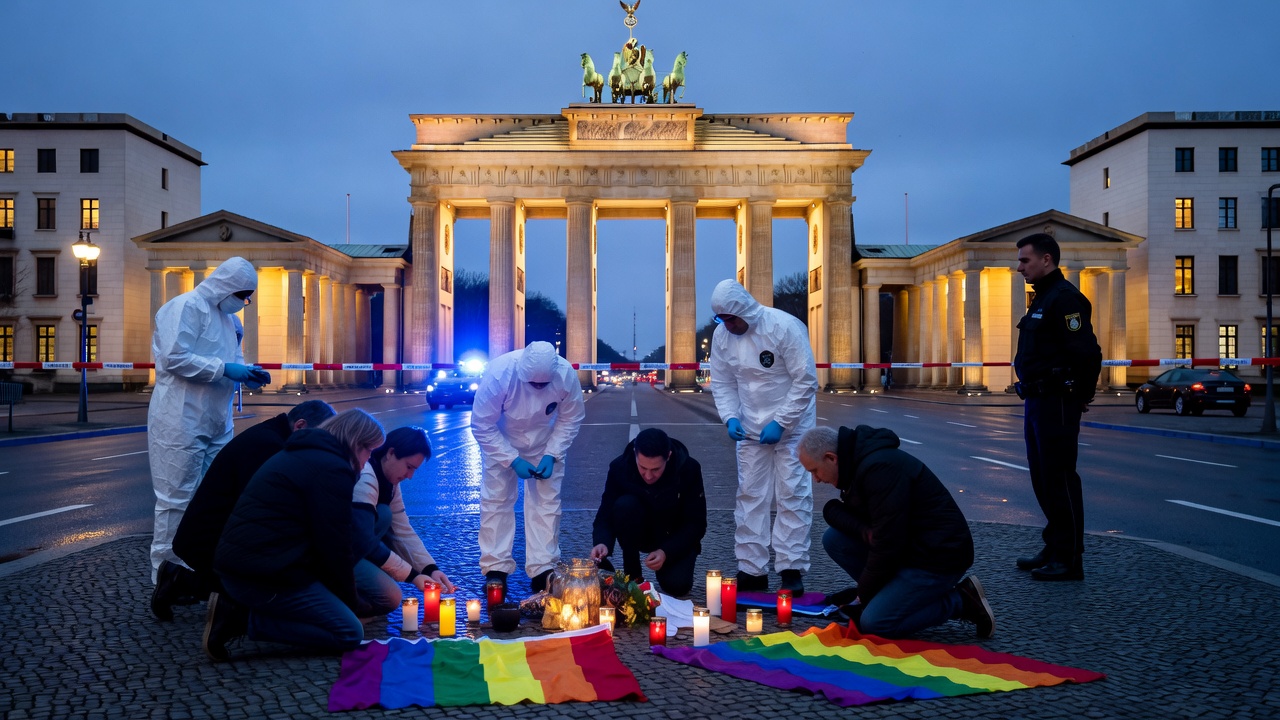
SUSPECTED BERLIN PRIDE ATTACKER SHOT DEAD BY POLICE
July 27, 2026·11 COUNTRIES
11countries·36sources·40articles
Europe (4)
Americas (2)
Other (1)
Oceania (1)
Middle East (1)
Africa (1)
Asia (1)
Europe
Americas
Other
Oceania
Middle East
Africa
Asia
EXPLORE THIS STORY
SHARE THIS COMPARISON
Show your friends how the world sees the same news differently.
German police on 26 July 2026 shot dead in Spandau 21-year-old Abdul Ballout, the suspected perpetrator of the previous day's vehicle-ramming attack on Berlin's Pride march (one woman killed, up to 29 injured). The interior minister called it an Islamist attack; the suspect's death revives debate over lethal force, his earlier release, and the security of large gatherings.
FRAMING GAP
4/100LOW
Coverages are relatively similar
Here are the main framing differences identified between media coverages.
ANALYSIS BY COUNTRY
 AUSTRALIA
DOMINANT ANGLE
Australian media examines the rapid police operation by Berlin's special forces while raising questions about the suspect's exact involvement in the attack.
Dominant angle identified — does not reflect unanimity of this country’s media
KEY POINTS
- •Abdul B., a 21-year-old German of Lebanese origin, was shot by Berlin's SEK tactical unit in Spandau after allegedly rushing toward officers with a bladed weapon, according to police cited by SBS News and ABC.
- •The suspect had prior convictions for assault and extortion in 2019 and theft in 2020, and reportedly expressed support for the Islamic State online in 2024, per PerthNow.
- •Key details remain unconfirmed: whether the suspect was the actual van driver, the vehicle's legal ownership, and how many attackers were involved in the assault, Australian outlets note.
BIASES
Security-focused framing: Coverage emphasizes the police operation and suspect profiling rather than victim experiences and community impact.Reliance on official sources: Heavy attribution to Berlin Police and government officials with minimal inclusion of direct eyewitness or community perspectives.Limited LGBTQ+ community voices: Australian coverage provides minimal coverage of reactions and concerns from Berlin's LGBTQ+ community directly affected by the incident.
 CANADA
DOMINANT ANGLE
Canadian media examines the speed of Germany's police response, balancing relief in LGBTQ+ communities against scrutiny of how the suspect became radicalized.
Dominant angle identified — does not reflect unanimity of this country’s media
KEY POINTS
- •Abdul Ballout, 21, was shot by police in Spandau on Sunday after running toward officers armed with a sharp object (Global News).
- •Interior Minister Alexander Dobrindt reported 29 injured and characterized the attack as an Islamist terror attack (National Post).
- •Ballout traveled to Lebanon in 2025 with the intention of joining the Islamic State in Syria, according to Berlin prosecutors (Global News).
BIASES
German security framing: Canadian coverage largely adopts the official narrative of German authorities (interior minister, chancellor) without substantial critical counterpoint.Reliance on official dispatches and statements: Canadian articles draw heavily on German government sources rather than on-the-ground analysis or independent reporting.Thin Canadian angle: limited connection drawn to Canada's own security or immigration policy debates, despite the scale of coverage.
 FRANCE
DOMINANT ANGLE
Paris reads the swift close of the Berlin manhunt, balancing security reassurance against ongoing scrutiny of the assailant's documented radicalization.
Dominant angle identified — does not reflect unanimity of this country’s media
KEY POINTS
- •The attack death toll was revised upward Sunday to one confirmed death and 29 wounded, including three in critical condition
- •Suspect Abdul Ballout, age 21, was killed by the SEK special operations unit in the Spandau district after advancing toward officers wielding an edged weapon
- •According to the Berlin prosecutor's office, the suspect had been sentenced in May 2026 for preparation of a serious violent act following an attempted journey to join ISIS in Syria, without serving imprisonment
BIASES
Security-operations framing: emphasis on police timeline and SEK intervention rather than the LGBTQ+ community context and significance of the Pride marchOfficial German sources privileged (police, Interior Ministry) over direct victim testimony or eyewitness accounts from march participantsLimited coverage of French LGBTQ+ organizations' responses and impact on Berlin's affected LGBTQ+ community
 GERMANYincl. 1 state outlet
DOMINANT ANGLE
Berlin closes its manhunt with the suspect's death, but Germany now questions failures in its deradicalization monitoring and scrutinizes the legitimacy of the SEK's lethal force.
Dominant angle identified — does not reflect unanimity of this country’s media
KEY POINTS
- •Abdul Ballout, 21, was shot dead by Berlin's SEK Sunday around 6 p.m. in an allotment garden area in Spandau after charging armed officers with a blade.
- •The toll from Saturday night's ramming attack was revised to 29 injured, plus one woman killed, according to authorities.
- •Sentenced in May to one year and ten months in prison with probation for preparing a terrorist act, the suspect was enrolled in a deradicalization program where he reportedly gave evasive responses, FAZ reports.
BIASES
Security-institutional framing: prominent coverage given to official statements from police and the federal Interior Ministry.Reliance on German government and police sources, with limited space for accounts from the LGBTQ+ community targeted by the attack.Limited coverage of potential critiques regarding the SEK's use of lethal force, not substantially explored in available reporting.
 INDIA
INDIADOMINANT ANGLE
New Delhi tracked the Berlin manhunt after the Pride attack, following police pursuit of the suspected attacker from initial identification through the fatal police response.
Dominant angle identified — does not reflect unanimity of this country’s media
KEY POINTS
- •One death and 16 injured, including 8 seriously wounded and 3 in critical condition, after a vehicle rammed the crowd near Christopher Street Day in Berlin
- •The identified suspect, Abdul B., 21, was already known to authorities as connected to 'Islamist circles' and described as 'armed and dangerous'
- •The white Citroen Space Tourer came to a stop after striking a tree in the Tiergarten; police did not rule out that multiple people had exited the vehicle
BIASES
Security-focused framing centered on the suspect's profile and police pursuit, with limited context about the German LGBT+ movement and community impactReliance on international wire reports reprinted as distributed, rather than original Indian reporting or independent analysis of the eventLimited coverage of the incident's conclusion—the suspect's death under police fire—with Indian outlets focusing primarily on the initial manhunt phase
 ITALY
ITALYDOMINANT ANGLE
Rome presents unified support for Berlin following the suspect's death, yet Italian political rifts emerge between calls for European solidarity and security-centered discourse on Islamism.
Dominant angle identified — does not reflect unanimity of this country’s media
KEY POINTS
- •Abdul Ballout, 21, was killed by a special police unit in a garden shed in the Spandau district around 6:34 p.m. Sunday after confronting officers with a blade weapon (Adnkronos).
- •A second suspect of Iranian nationality has been arrested; investigators are determining whether he was aboard the van used in the attack (ANSA).
- •Prime Minister Giorgia Meloni and Foreign Minister Antonio Tajani expressed Italy's solidarity with Germany, while Deputy PM Matteo Salvini condemned Islamic fanaticism (La Repubblica).
BIASES
Security-focused framing: heavy emphasis on the tactical details of the police operation that killed the suspect.Preference for Italian political reactions: Italian leadership statements from Meloni, Tajani, and Salvini given primacy over Berlin voices or LGBTQ+ perspectives.Limited coverage of attack victims: minimal detail on the identity of the woman killed or accounts from the injured.
 POLAND
DOMINANT ANGLE
Warsaw examines the swiftness of German police response following the death of the suspected Berlin Pride attack perpetrator, while questioning monitoring gaps for an individual previously known to security services.
Dominant angle identified — does not reflect unanimity of this country’s media
KEY POINTS
- •The suspect, Abdul B., age 21, was shot dead by police during a Spandau operation on Sunday after lunging at officers with a knife, according to Berlin police as reported by RMF24.
- •Born in Germany in 2005 to Lebanese parents, he had attempted to join ISIS, traveled to Lebanon in 2025, then served detention until May and was ordered into deradicalization, per Dziennik.pl.
- •Saturday's vehicle-ramming attack at Tiergarten Park killed one person and injured between 16 and 29 others, several critically, according to RMF24 and Gazeta Prawna.
BIASES
Security-focused framing: emphasis on police operations and the fatal outcome rather than on victim accounts and the broader impact from the attack.Reliance on official German police and government sources at the expense of local LGBTQ+ advocacy voices and community perspectives.Limited coverage of ongoing judicial proceedings and investigation into potential accomplices that remained unresolved at publication.
 SOUTH AFRICA
DOMINANT ANGLE
South Africa reads the shooting death of the Berlin Pride suspect as swift closure, yet shadowed by unanswered questions about an attack that devastated the German capital's LGBTQI+ community.
Dominant angle identified — does not reflect unanimity of this country’s media
KEY POINTS
- •Suspect Abdul B., age 21, a German citizen of Lebanese descent born in 2005, was shot dead Sunday at approximately 6 p.m. in an allotment garden complex in Spandau after running toward officers with a blade.
- •Interior Minister Alexander Dobrindt characterized the suspect as previously known for infractions, radicalization, and Islamist affiliations, with official sources setting the attack toll at 1 dead and 29 wounded.
- •Chancellor Friedrich Merz called for Germany to defend "freedom, openness, and liberal values" during remarks at St. Mary's Church in Berlin, speaking to broader national concerns.
BIASES
Security-focused framing: emphasis on police chronology (localization, confrontation, shooting) rather than on judicial proceedings or deeper threat assessment and prevention frameworks.Preference for official German and community voices (minister, police, LGBTQI+ witnesses) over independent South African analysis, international expert perspective, or critical examination of security response.Limited engagement with German debates on immigration and far-right politics—mentioned in passing without substantive development, contradictory voices, or structural analysis.
 TURKEYincl. 1 state outlet
DOMINANT ANGLE
Ankara examines Berlin's handling of the attack, balancing rapid suspect neutralization against lingering questions about gaps in early radicalization monitoring.
Dominant angle identified — does not reflect unanimity of this country’s media
KEY POINTS
- •Abdul Ballout, 21, a German citizen born in Berlin to a mother naturalized in 2002, was shot Sunday afternoon in an allotment garden in Spandau as he approached emergency responders carrying a knife.
- •Interior Minister Alexander Dobrindt raised the casualty count to 29 wounded and characterized the attack as Islamist terrorism, citing prior criminal records and radicalization already known to security services.
- •Chancellor Friedrich Merz called the attack abominable and assured that Germany would not be intimidated or divided, after the abrupt halting of Christopher Street Day celebrations near the Brandenburg Gate.
BIASES
German security framing: substantial space given to official statements (Interior Minister, Chancellor) qualifying the attack as terrorism.Emphasis on investigative uncertainties: Bianet highlights ambiguities surrounding the location and police operation rather than detailed suspect profiling.Limited victim coverage: few individual details about the deceased and injured appear in available Turkish press articles.
 UNITED KINGDOM
DOMINANT ANGLE
London weighs troubling parallels between Abdul Ballout's death and its own track record of convicted radicals released from prison who later carried out attacks.
Dominant angle identified — does not reflect unanimity of this country’s media
KEY POINTS
- •Abdul Ballout, 21, shot by German police Sunday in a Spandau community garden after lunging at officers with a blade
- •Sentenced in May 2026 to one year and ten months for planning serious violence with a suspended sentence and deradicalization program before carrying out the attack
- •Interior Minister Alexander Dobrindt called the attack 'Islamist' and did not rule out further incidents; Chancellor Friedrich Merz condemned it as 'contemptible'
BIASES
Security-focused framing: emphasis on the suspect's criminal and judicial history rather than on victims' experiencesReliance on German official sources (Interior Ministry, prosecutor's office) over firsthand accounts from Berlin's LGBTQ+ communityLimited coverage of detailed hospital records and medical follow-up for the injured in the days after the attack
 UNITED STATES
DOMINANT ANGLE
Washington views the swift death of the Berlin Pride attack suspect as confirmation of an Islamist threat openly acknowledged by Berlin, while drawing parallels to vehicle-ramming attacks familiar on American soil.
Dominant angle identified — does not reflect unanimity of this country’s media
KEY POINTS
- •Abdul Ballout, 21, a German citizen of Lebanese origin, was shot dead on Sunday around 6 p.m. after charging police with a knife, according to Berlin authorities.
- •Interior Minister Alexander Dobrindt asserts that all evidence points to an Islamist attack and that the suspect had sought to join the Islamic State.
- •U.S. media sources report casualty figures ranging from 16 to 29 injured and one confirmed dead, with the attack occurring near the Tiergarten on Saturday around 10 p.m.
BIASES
Security-focused framing: emphasis on police neutralization and terrorist classification rather than individual victims and their experiencesPreference for official German statements (minister, chancellor, Berlin mayor) over testimony from local LGBTQ+ community membersLimited coverage of judicial proceedings and investigation of potential accomplices, with attention concentrated on the suspect's death itself
AUSTRALIADOMINANT ANGLE
Australian media examines the rapid police operation by Berlin's special forces while raising questions about the suspect's exact involvement in the attack.
Dominant angle identified — does not reflect unanimity of this country’s media
KEY POINTS
- •Abdul B., a 21-year-old German of Lebanese origin, was shot by Berlin's SEK tactical unit in Spandau after allegedly rushing toward officers with a bladed weapon, according to police cited by SBS News and ABC.
- •The suspect had prior convictions for assault and extortion in 2019 and theft in 2020, and reportedly expressed support for the Islamic State online in 2024, per PerthNow.
- •Key details remain unconfirmed: whether the suspect was the actual van driver, the vehicle's legal ownership, and how many attackers were involved in the assault, Australian outlets note.
BIASES
Security-focused framing: Coverage emphasizes the police operation and suspect profiling rather than victim experiences and community impact.Reliance on official sources: Heavy attribution to Berlin Police and government officials with minimal inclusion of direct eyewitness or community perspectives.Limited LGBTQ+ community voices: Australian coverage provides minimal coverage of reactions and concerns from Berlin's LGBTQ+ community directly affected by the incident.
CANADADOMINANT ANGLE
Canadian media examines the speed of Germany's police response, balancing relief in LGBTQ+ communities against scrutiny of how the suspect became radicalized.
Dominant angle identified — does not reflect unanimity of this country’s media
KEY POINTS
- •Abdul Ballout, 21, was shot by police in Spandau on Sunday after running toward officers armed with a sharp object (Global News).
- •Interior Minister Alexander Dobrindt reported 29 injured and characterized the attack as an Islamist terror attack (National Post).
- •Ballout traveled to Lebanon in 2025 with the intention of joining the Islamic State in Syria, according to Berlin prosecutors (Global News).
BIASES
German security framing: Canadian coverage largely adopts the official narrative of German authorities (interior minister, chancellor) without substantial critical counterpoint.Reliance on official dispatches and statements: Canadian articles draw heavily on German government sources rather than on-the-ground analysis or independent reporting.Thin Canadian angle: limited connection drawn to Canada's own security or immigration policy debates, despite the scale of coverage.
FRANCEDOMINANT ANGLE
Paris reads the swift close of the Berlin manhunt, balancing security reassurance against ongoing scrutiny of the assailant's documented radicalization.
Dominant angle identified — does not reflect unanimity of this country’s media
KEY POINTS
- •The attack death toll was revised upward Sunday to one confirmed death and 29 wounded, including three in critical condition
- •Suspect Abdul Ballout, age 21, was killed by the SEK special operations unit in the Spandau district after advancing toward officers wielding an edged weapon
- •According to the Berlin prosecutor's office, the suspect had been sentenced in May 2026 for preparation of a serious violent act following an attempted journey to join ISIS in Syria, without serving imprisonment
BIASES
Security-operations framing: emphasis on police timeline and SEK intervention rather than the LGBTQ+ community context and significance of the Pride marchOfficial German sources privileged (police, Interior Ministry) over direct victim testimony or eyewitness accounts from march participantsLimited coverage of French LGBTQ+ organizations' responses and impact on Berlin's affected LGBTQ+ community
GERMANYincl. 1 state outletDOMINANT ANGLE
Berlin closes its manhunt with the suspect's death, but Germany now questions failures in its deradicalization monitoring and scrutinizes the legitimacy of the SEK's lethal force.
Dominant angle identified — does not reflect unanimity of this country’s media
KEY POINTS
- •Abdul Ballout, 21, was shot dead by Berlin's SEK Sunday around 6 p.m. in an allotment garden area in Spandau after charging armed officers with a blade.
- •The toll from Saturday night's ramming attack was revised to 29 injured, plus one woman killed, according to authorities.
- •Sentenced in May to one year and ten months in prison with probation for preparing a terrorist act, the suspect was enrolled in a deradicalization program where he reportedly gave evasive responses, FAZ reports.
BIASES
Security-institutional framing: prominent coverage given to official statements from police and the federal Interior Ministry.Reliance on German government and police sources, with limited space for accounts from the LGBTQ+ community targeted by the attack.Limited coverage of potential critiques regarding the SEK's use of lethal force, not substantially explored in available reporting.
INDIADOMINANT ANGLE
New Delhi tracked the Berlin manhunt after the Pride attack, following police pursuit of the suspected attacker from initial identification through the fatal police response.
Dominant angle identified — does not reflect unanimity of this country’s media
KEY POINTS
- •One death and 16 injured, including 8 seriously wounded and 3 in critical condition, after a vehicle rammed the crowd near Christopher Street Day in Berlin
- •The identified suspect, Abdul B., 21, was already known to authorities as connected to 'Islamist circles' and described as 'armed and dangerous'
- •The white Citroen Space Tourer came to a stop after striking a tree in the Tiergarten; police did not rule out that multiple people had exited the vehicle
BIASES
Security-focused framing centered on the suspect's profile and police pursuit, with limited context about the German LGBT+ movement and community impactReliance on international wire reports reprinted as distributed, rather than original Indian reporting or independent analysis of the eventLimited coverage of the incident's conclusion—the suspect's death under police fire—with Indian outlets focusing primarily on the initial manhunt phase
ITALYDOMINANT ANGLE
Rome presents unified support for Berlin following the suspect's death, yet Italian political rifts emerge between calls for European solidarity and security-centered discourse on Islamism.
Dominant angle identified — does not reflect unanimity of this country’s media
KEY POINTS
- •Abdul Ballout, 21, was killed by a special police unit in a garden shed in the Spandau district around 6:34 p.m. Sunday after confronting officers with a blade weapon (Adnkronos).
- •A second suspect of Iranian nationality has been arrested; investigators are determining whether he was aboard the van used in the attack (ANSA).
- •Prime Minister Giorgia Meloni and Foreign Minister Antonio Tajani expressed Italy's solidarity with Germany, while Deputy PM Matteo Salvini condemned Islamic fanaticism (La Repubblica).
BIASES
Security-focused framing: heavy emphasis on the tactical details of the police operation that killed the suspect.Preference for Italian political reactions: Italian leadership statements from Meloni, Tajani, and Salvini given primacy over Berlin voices or LGBTQ+ perspectives.Limited coverage of attack victims: minimal detail on the identity of the woman killed or accounts from the injured.
POLANDDOMINANT ANGLE
Warsaw examines the swiftness of German police response following the death of the suspected Berlin Pride attack perpetrator, while questioning monitoring gaps for an individual previously known to security services.
Dominant angle identified — does not reflect unanimity of this country’s media
KEY POINTS
- •The suspect, Abdul B., age 21, was shot dead by police during a Spandau operation on Sunday after lunging at officers with a knife, according to Berlin police as reported by RMF24.
- •Born in Germany in 2005 to Lebanese parents, he had attempted to join ISIS, traveled to Lebanon in 2025, then served detention until May and was ordered into deradicalization, per Dziennik.pl.
- •Saturday's vehicle-ramming attack at Tiergarten Park killed one person and injured between 16 and 29 others, several critically, according to RMF24 and Gazeta Prawna.
BIASES
Security-focused framing: emphasis on police operations and the fatal outcome rather than on victim accounts and the broader impact from the attack.Reliance on official German police and government sources at the expense of local LGBTQ+ advocacy voices and community perspectives.Limited coverage of ongoing judicial proceedings and investigation into potential accomplices that remained unresolved at publication.
SOUTH AFRICADOMINANT ANGLE
South Africa reads the shooting death of the Berlin Pride suspect as swift closure, yet shadowed by unanswered questions about an attack that devastated the German capital's LGBTQI+ community.
Dominant angle identified — does not reflect unanimity of this country’s media
KEY POINTS
- •Suspect Abdul B., age 21, a German citizen of Lebanese descent born in 2005, was shot dead Sunday at approximately 6 p.m. in an allotment garden complex in Spandau after running toward officers with a blade.
- •Interior Minister Alexander Dobrindt characterized the suspect as previously known for infractions, radicalization, and Islamist affiliations, with official sources setting the attack toll at 1 dead and 29 wounded.
- •Chancellor Friedrich Merz called for Germany to defend "freedom, openness, and liberal values" during remarks at St. Mary's Church in Berlin, speaking to broader national concerns.
BIASES
Security-focused framing: emphasis on police chronology (localization, confrontation, shooting) rather than on judicial proceedings or deeper threat assessment and prevention frameworks.Preference for official German and community voices (minister, police, LGBTQI+ witnesses) over independent South African analysis, international expert perspective, or critical examination of security response.Limited engagement with German debates on immigration and far-right politics—mentioned in passing without substantive development, contradictory voices, or structural analysis.
TURKEYincl. 1 state outletDOMINANT ANGLE
Ankara examines Berlin's handling of the attack, balancing rapid suspect neutralization against lingering questions about gaps in early radicalization monitoring.
Dominant angle identified — does not reflect unanimity of this country’s media
KEY POINTS
- •Abdul Ballout, 21, a German citizen born in Berlin to a mother naturalized in 2002, was shot Sunday afternoon in an allotment garden in Spandau as he approached emergency responders carrying a knife.
- •Interior Minister Alexander Dobrindt raised the casualty count to 29 wounded and characterized the attack as Islamist terrorism, citing prior criminal records and radicalization already known to security services.
- •Chancellor Friedrich Merz called the attack abominable and assured that Germany would not be intimidated or divided, after the abrupt halting of Christopher Street Day celebrations near the Brandenburg Gate.
BIASES
German security framing: substantial space given to official statements (Interior Minister, Chancellor) qualifying the attack as terrorism.Emphasis on investigative uncertainties: Bianet highlights ambiguities surrounding the location and police operation rather than detailed suspect profiling.Limited victim coverage: few individual details about the deceased and injured appear in available Turkish press articles.
UNITED KINGDOMDOMINANT ANGLE
London weighs troubling parallels between Abdul Ballout's death and its own track record of convicted radicals released from prison who later carried out attacks.
Dominant angle identified — does not reflect unanimity of this country’s media
KEY POINTS
- •Abdul Ballout, 21, shot by German police Sunday in a Spandau community garden after lunging at officers with a blade
- •Sentenced in May 2026 to one year and ten months for planning serious violence with a suspended sentence and deradicalization program before carrying out the attack
- •Interior Minister Alexander Dobrindt called the attack 'Islamist' and did not rule out further incidents; Chancellor Friedrich Merz condemned it as 'contemptible'
BIASES
Security-focused framing: emphasis on the suspect's criminal and judicial history rather than on victims' experiencesReliance on German official sources (Interior Ministry, prosecutor's office) over firsthand accounts from Berlin's LGBTQ+ communityLimited coverage of detailed hospital records and medical follow-up for the injured in the days after the attack
UNITED STATESDOMINANT ANGLE
Washington views the swift death of the Berlin Pride attack suspect as confirmation of an Islamist threat openly acknowledged by Berlin, while drawing parallels to vehicle-ramming attacks familiar on American soil.
Dominant angle identified — does not reflect unanimity of this country’s media
KEY POINTS
- •Abdul Ballout, 21, a German citizen of Lebanese origin, was shot dead on Sunday around 6 p.m. after charging police with a knife, according to Berlin authorities.
- •Interior Minister Alexander Dobrindt asserts that all evidence points to an Islamist attack and that the suspect had sought to join the Islamic State.
- •U.S. media sources report casualty figures ranging from 16 to 29 injured and one confirmed dead, with the attack occurring near the Tiergarten on Saturday around 10 p.m.
BIASES
Security-focused framing: emphasis on police neutralization and terrorist classification rather than individual victims and their experiencesPreference for official German statements (minister, chancellor, Berlin mayor) over testimony from local LGBTQ+ community membersLimited coverage of judicial proceedings and investigation of potential accomplices, with attention concentrated on the suspect's death itself
CROSS-PERSPECTIVE ANALYSIS
CROSS-ANALYSIS
CONSENSUS POINTS
- 1The suspect, Abdul B. (Ballout), 21, a German citizen of Lebanese descent born in Berlin, was shot dead on Sunday around 6 p.m. by a special police unit (SEK) in an allotment garden complex in Spandau after charging armed officers with a blade.
- 2The suspect had been sentenced in May 2026 for preparing a serious act of violence linked to an attempted crossing to join the Islamic State in Syria via Lebanon, and was enrolled in a judicial deradicalization program at the time of the attack.
- 3German authorities, notably Interior Minister Alexander Dobrindt and Chancellor Friedrich Merz, characterized the attack as Islamic terrorism and reported the toll at approximately 29 injured, plus one woman killed.
- 4The ramming attack targeted Berlin's Pride march (Christopher Street Day) on Saturday evening near the Tiergarten, causing the celebrations to be interrupted.
FRAMING DIFFERENCES
Counter-terrorism monitoring and use of force
Most national coverage reports without question the official account of the police operation that killed the suspect, while the British press adopts a more critical tone by questioning gaps in the deradicalization monitoring and drawing parallels to its own cases of convicted terrorists who were released before reoffending.
Frame this way

Frame the opposite
Scope of investigation into potential accomplices
Italian press reports the arrest of a second suspect of Iranian nationality whose connection to the vehicle used remains to be established, while most other national coverage presents the death of the main suspect as case closure, without mentioning possible accomplices.
Frame this way
Frame the opposite
Political framing of the attack
Nearly all international official reactions limit themselves to consensual messages of solidarity with Germany, whereas in Italy the political class divides between calls for European unity led by Giorgia Meloni and Antonio Tajani and Matteo Salvini's more aggressive rhetoric denouncing 'Islamic fanaticism'.
Frame this way
Frame the opposite
GEOPOLITICAL CLUSTERS
Alignment with German official narrative
Shared narrative
These countries largely relay the version of German authorities (police, Interior Ministry, chancellery), characterizing the attack as Islamic terrorism and detailing the suspect's judicial record without substantial questioning of security handling.
Critical reading and security comparison
Shared narrative
The United Kingdom questions the failures in German deradicalization monitoring by drawing on its own precedents of convicted terrorists who were released before reoffending.
Internal political divide over European solidarity
Shared narrative
Italy displays official solidarity with Berlin while revealing an internal political divide between European unitary discourse and security-focused anti-Islamist rhetoric, as well as an expanded investigation into a second suspect.
Partial coverage centered on the hunt phase
Shared narrative
India focused primarily on the manhunt phase launched after the attack, with more limited coverage of the fatal outcome and the suspect's detailed profile.
OMISSIONS ANALYSIS
AustraliaOmitted topics
Reactions from Berlin's LGBTQ+ community
Highlighted by
CanadaOmitted topics
Perspective on Canadian security and immigration policies
Highlighted by
GermanyOmitted topics
Developed critique of SEK's use of lethal force
Highlighted by
FranceOmitted topics
Reactions from French LGBT+ associations and Berlin community
Highlighted by
GreeceOmitted topics
Reactions from Pride organizers and participants
Highlighted by
IndiaOmitted topics
Case conclusion and suspect's death under police fire
Highlighted by
ItalyOmitted topics
Details on the identity of the killed victim and the accounts of the injured
Highlighted by
PolandOmitted topics
Judicial follow-up and investigation into potential accomplices
Highlighted by
TurkeyOmitted topics
Individual details on the deceased victim and the injured
Highlighted by
United KingdomOmitted topics
Detailed hospital count and follow-up on the injured
Highlighted by
United StatesOmitted topics
Judicial follow-up and investigation into potential accomplices
Highlighted by
South AfricaOmitted topics
German debates on immigration and far-right politics
Highlighted by
GEOPOLITICAL CONTEXT
The Berlin Pride attack is part of a series of ramming attacks targeting public gatherings in Europe in recent years, reigniting debate over surveillance of radicalized individuals already known to intelligence services and the effectiveness of judicial deradicalization programs. The swift death of the suspect, presented as linked to Islamic extremist circles following an attempted crossing to join the Islamic State in Syria, prompted nearly unanimous expressions of solidarity from Western governments to Germany, while reviving questions about the use of lethal force by special units and the safety of LGBTQ+ events in European public spaces.
AI-powered analysis