Common ground and differences in coverage across the media analysed.
Official converging report: one person killed and approximately fifteen seriously injured after a vehicle drove into the crowd at the Christopher Street Day march in Berlin's Tiergarten on Saturday evening.
Suspect identification: a 21-year-old man, designated 'Abdul B.', described by Berlin police as known to authorities and linked to local Islamist circles, still at large at the time of the articles.
Massive security deployment: more than 2,000 to 2,200 police officers were already deployed to secure the march before the attack, subsequently reinforced by active search efforts, including helicopters.
Some coverage situates the attack within a series of vehicle-ramming attacks that have occurred in Germany since 2016 (Magdeburg, Munich), while others treat the event as an isolated incident without comparable historical perspective.
Coverage aligned with this reading
Coverage that diverges
French coverage explicitly frames the attack as targeting the LGBTQ+ community, a more victimizing framing than other perspectives, which describe the event as a generic threat against open society or public gatherings.
Coverage aligned with this reading
Coverage that diverges
Several perspectives report, via witnesses cited by Bild, a possible second phase of the attack involving a sharp object wielded by the suspect before his escape on foot, information absent from coverage in other countries.
Coverage aligned with this reading
Coverage that diverges
This grouping describes the publications analysed, not the position of these countries’ populations or of their governments.
What the coverage of each country leaves aside, while others put it forward.
Germany
Philippines
Australia
Preview: 3 of 9 media perspectives. Syntheses of the media analysed — not direct quotations. Method & limitations
Sydney observes from Berlin a phrase echoed across Australian newsrooms, 'our freedom has been attacked', and measures the enduring vulnerability of LGBTQI+ gatherings facing vehicle-ramming attacks.
4 sources · View sources
Berlin assesses the shock of another vehicle ramming attack, this time striking the Pride march, and reignites debate over security measures for major public gatherings.
4 sources · View sources
Paris condemns an attack targeting the LGBT+ community and questions the recurring pattern of vehicle-ramming attacks striking Germany since 2016.
4 sources · View sources
DOMINANT ANGLE
Sydney observes from Berlin a phrase echoed across Australian newsrooms, 'our freedom has been attacked', and measures the enduring vulnerability of LGBTQI+ gatherings facing vehicle-ramming attacks.
ANALYSIS
Canberra, 26 July 2026.
DOMINANT ANGLE
Berlin assesses the shock of another vehicle ramming attack, this time striking the Pride march, and reignites debate over security measures for major public gatherings.
ANALYSIS
Berlin, July 26, 2026.
DOMINANT ANGLE
Paris condemns an attack targeting the LGBT+ community and questions the recurring pattern of vehicle-ramming attacks striking Germany since 2016.
ANALYSIS
Paris, July 26, 2026.
DOMINANT ANGLE
Rome tracks Saturday's vehicle-ramming attack on Berlin's Christopher Street Day parade, anchoring it within the broader cycle of such assaults across Europe since 2016.
ANALYSIS
Rome, July 26, 2026.
DOMINANT ANGLE
Ottawa views the Berlin attack as a fresh security alert for Western LGBTQ+ gatherings, balancing community solidarity with concerns about Islamist threats.
ANALYSIS
Toronto, July 26, 2026.
DOMINANT ANGLE
Washington connects the Berlin attack to a succession of vehicle-ramming attacks that have struck Europe since 2016, identifying a resurgent Islamist threat during Pride celebrations.
ANALYSIS
Washington, July 26, 2026.
DOMINANT ANGLE
Singapore frames the Berlin vehicle-ramming attack within Germany's recurring series of vehicle-ramming incidents since 2016, rather than treating it as an isolated event.
ANALYSIS
Singapore, July 26, 2026.
DOMINANT ANGLE
Manila's press treats the Berlin Pride attack as a distant foreign incident—a stark reminder of public gathering vulnerability—rather than a catalyst for domestic policy discussion on assembly security.
ANALYSIS
Manila, July 26, 2026.
DOMINANT ANGLE
Athens watches with concern Berlin's latest vehicle-ramming attack, a symptom of Europe struggling to secure its major public gatherings
ANALYSIS
Athens, July 26, 2026.
Explore every perspective on this subject across 9 countries.
Compare viewpoints and see where they diverge.
published on
countries
sources
articles
gap
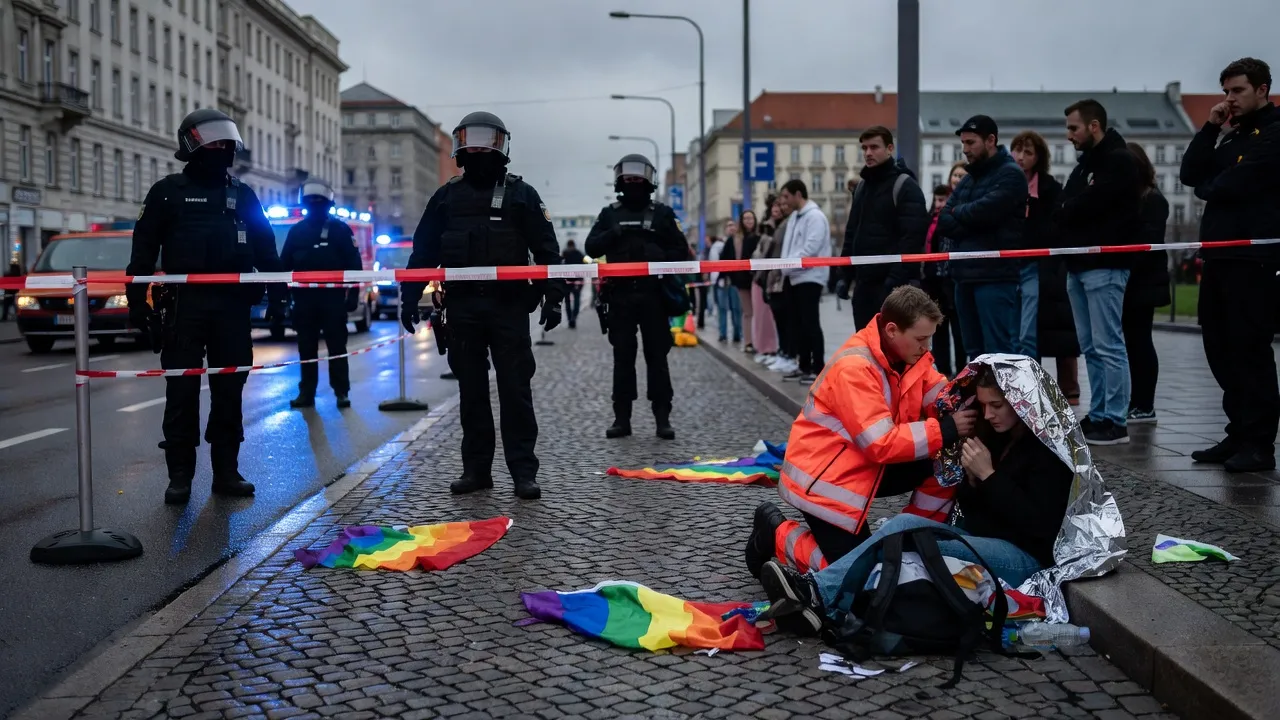
On Saturday 25 July 2026, shortly before 10 p.m., a utility vehicle plowed into the crowd gathered at Berlin's Tiergarten on the sidelines of Christopher Street Day (the Pride march) before hitting a tree. One woman was killed and sixteen people were injured, several of them seriously, according to Berlin firefighters. Police are searching for a 21-year-old suspect, identified as Abdul B. and described as known to the authorities and linked to Berlin's Islamist scene, who is reported to have been released from a juvenile detention center in May 2026. More than 2,200 police officers, backed by helicopters, had been deployed to secure the event, which drew several hundred thousand participants near the Brandenburg Gate.
Measured with the previous method (distance between texts), on a different scale.