Common ground and differences in coverage across the media analysed.
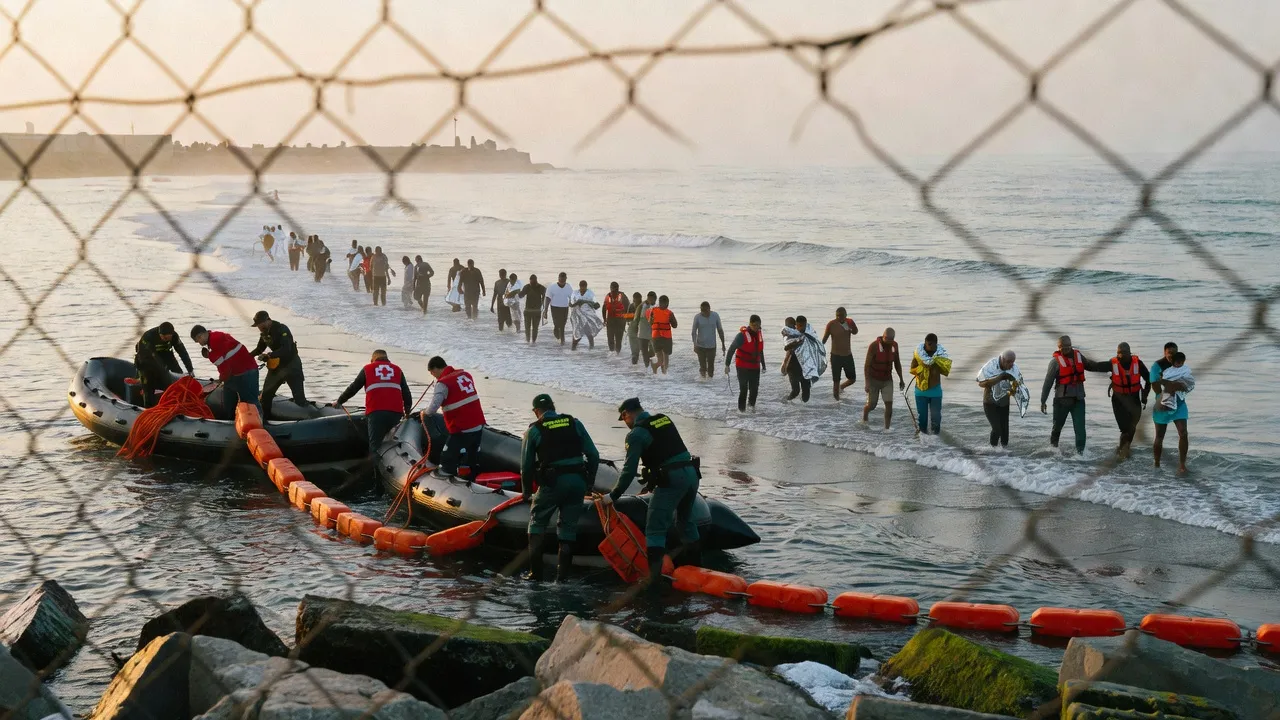
Around 60,000 people crossed the Morocco-Spain border into Ceuta over a few days in late July, almost all of whom returned or were sent back to Morocco within 24 to 48 hours.
The human toll rose steadily (from 43 to 67 dead according to most sources, and as high as 77 for The Independent), with no definitive figure settled.
Spain installed a 500-metre floating barrier off the Tarajal breakwater at Ceuta at 7.50am on Saturday.
Rome and Washington point to Pedro Sánchez's migration management as the cause of the crisis, while Berlin refuses the "anti-Spanish bashing" and Madrid denounces the "selfishness" of several European capitals.
Coverage that diverges
Italy justifies suspending Schengen with Spain on security grounds, while the Turkish press notes that crossings from Ceuta to the mainland already fell outside that regime, and Germany prefers reinforcing the EU's external borders to suspending free movement.
Washington and part of the European far right mobilise the crisis to illustrate an anti-immigration message, an appropriation the Russian press denounces as a cynicism shared by Western leaders.
Coverage aligned with this reading
Coverage that diverges
This grouping describes the publications analysed, not the position of these countries’ populations or of their governments.
What the coverage of each country leaves aside, while others put it forward.
Italy
Spain
Nigeria
Preview: 3 of 10 media perspectives. Syntheses of the media analysed — not direct quotations. Method & limitations
Madrid grapples with a double shock at Ceuta: a humanitarian toll mounting by the hour, and a far-right European offensive seizing the crisis to attack the Sanchez government.
3 sources · View sources
Rome denounces Madrid's migrant management while tightening its own borders, suspending Schengen with Spain at the first signs of the Ceuta crisis.
2 sources · View sources
Paris reads the human toll of Ceuta's migration crisis amid its appropriation as a transatlantic political flashpoint.
2 sources · View sources
DOMINANT ANGLE
Madrid grapples with a double shock at Ceuta: a humanitarian toll mounting by the hour, and a far-right European offensive seizing the crisis to attack the Sanchez government.
ANALYSIS
Madrid, 2 August 2026.
DOMINANT ANGLE
Rome denounces Madrid's migrant management while tightening its own borders, suspending Schengen with Spain at the first signs of the Ceuta crisis.
ANALYSIS
Rome, 2 August 2026.
DOMINANT ANGLE
Paris reads the human toll of Ceuta's migration crisis amid its appropriation as a transatlantic political flashpoint.
ANALYSIS
Paris, 2 August 2026.
DOMINANT ANGLE
Berlin demands structural reinforcement of EU external borders, praising Spain's crisis management rather than blaming Madrid, while joining calls for an emergency meeting of Interior Ministers.
ANALYSIS
Berlin, 2 August 2026.
DOMINANT ANGLE
London gauges its room for maneuver from outside the Schengen zone, caught between displaying solidarity with Madrid and navigating direct echoes within its own post-Brexit migration debate.
ANALYSIS
London, 2 August 2026.
DOMINANT ANGLE
Moscow assesses the Ceuta crisis as a window into Western political divisions, highlighting what it characterizes as 'selfishness' among European capitals, Spanish military deployment, and responses from Trump, Musk, and far-right European figures to the situation.
ANALYSIS
Moscow, 2 August 2026.
DOMINANT ANGLE
Washington leverages the Ceuta crisis to validate its immigration narrative, with Donald Trump calling the entry of tens of thousands of migrants an "invasion" and the State Department directly targeting Pedro Sánchez's "permissive" laws.
ANALYSIS
Washington, 2 August 2026.
DOMINANT ANGLE
Ankara reads two intertwined crises: the desperation of Moroccan youth seeking passage at Ceuta, and what Turkish media identify as Rome's domestic political calculus in suspending Schengen.
ANALYSIS
Ankara, 2 August 2026.
DOMINANT ANGLE
Abuja contrasts the swift European diplomatic response to 60,000 crossings already resolved at Ceuta with the far more muted mobilization typically called for by African migration routes to the Mediterranean.
ANALYSIS
Abuja, 2 August 2026.
DOMINANT ANGLE
Canberra measures the Ceuta crisis against its own maritime border doctrine, in which physical barriers and diplomatic firmness go hand in hand.
ANALYSIS
Canberra, 2 August 2026.
Explore every perspective on this subject across 10 countries.
Compare viewpoints and see where they diverge.
published on
countries
sources
articles
gap
Since Thursday 30 July, roughly 60,000 people have crossed the border between Morocco and the Spanish enclave of Ceuta, an unprecedented influx into a city of about 80,000 inhabitants. The provisional death toll stands at at least 67 according to the Spanish government, a figure that has risen since Friday and varies between sources. More than 48,000 migrants have already returned to Morocco. On Saturday 1 August, Spain began installing a 500-metre floating barrier off the Tarajal breakwater. Twenty-two European Union member states have called for an emergency meeting of interior ministers, while Italy has suspended its Schengen arrangements with Spain.
Measured with the previous method (distance between texts), on a different scale.