Common ground and differences in coverage across the media analysed.
Pedro Sánchez told Congress that no 'solid evidence' exists to prove that Morocco planned or orchestrated the massive influx of migrants to Ceuta in late July.
However, he acknowledged that the Moroccan gendarmerie allowed the border to be crossed for about ten hours on July 30, before regaining more effective control in the following days.
A report by the Spanish police (Cenif), made public in early September, documents Moroccan permissiveness that partially contradicts the government's official narrative.
Some accounts largely echo parliamentary accusations that Morocco bears direct responsibility for the influx, while others are more cautious and highlight the lack of evidence of intent, mirroring Sánchez's position.
Coverage aligned with this reading
The narratives differ on the presence of a direct Moroccan statement: some cite an official denial from Rabat, while most report no such statement.
Coverage aligned with this reading
Coverage that diverges
Most perspectives center the narrative on the parliamentary crisis and Sánchez's isolation in Madrid, while three presses prefer an alternative framework: street scenes in Brazil, the closed borders doctrine in Hungary, and unequal migrant treatment in Mexico.
Coverage aligned with this reading
This grouping describes the publications analysed, not the position of these countries’ populations or of their governments.
What the coverage of each country leaves aside, while others put it forward.
Argentina
Belgium
Brazil
Switzerland
Preview: 3 of 12 media perspectives. Syntheses of the media analysed — not direct quotations. Method & limitations
Budapest sees the Ceuta crisis as confirmation of its own doctrine: an external border without fencing or firmness can be crossed in just a few hours, regardless of who opens the passage.
3 sources · View sources
Switzerland is primarily focused on the political isolation of Pedro Sánchez in Congress, rather than the issue of Moroccan orchestration itself: his own police report contradicts it, the opposition accuses him of lying, and tens of thousands of people are protesting against his handling of the crisis.
2 sources · View sources
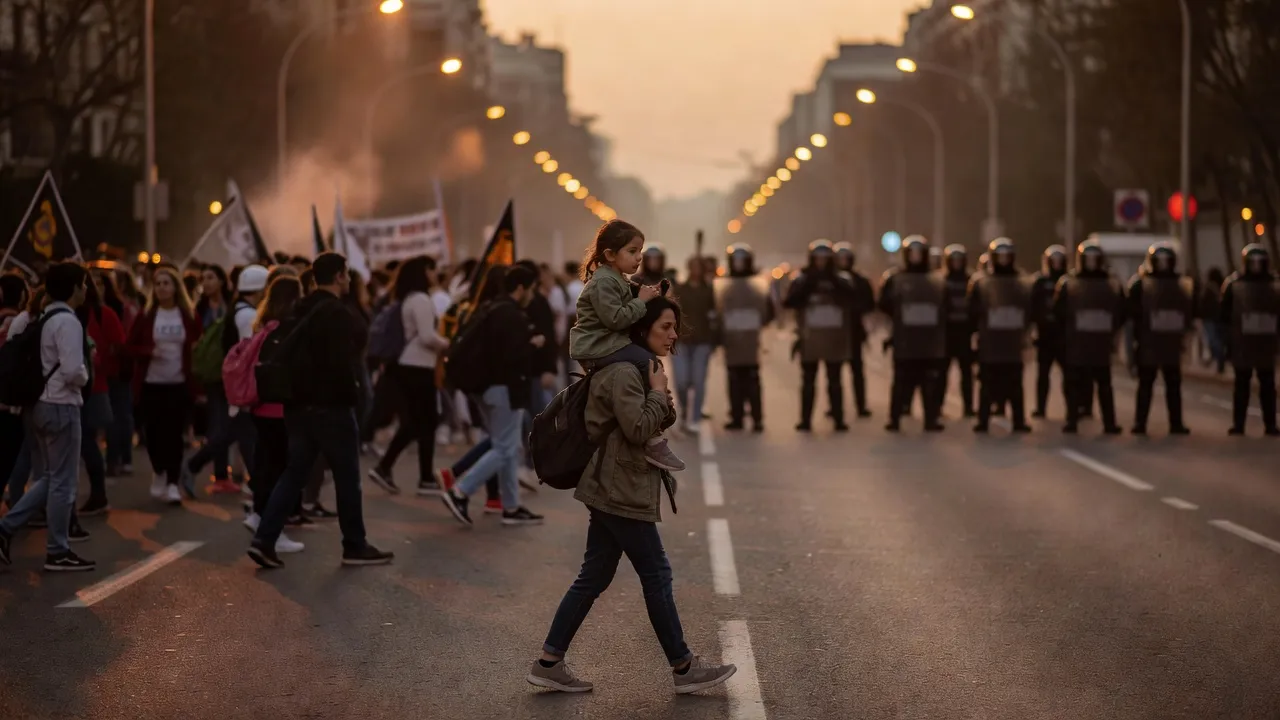
Brazil is examining the Ceuta crisis through its street images - "Make Ceuta Great Again" caps, anti-migrant signs, counter-demonstrations - more so than the content of the police report that Sánchez partially acknowledges without using it to frame accusations against Rabat.
3 sources · View sources
DOMINANT ANGLE
Budapest sees the Ceuta crisis as confirmation of its own doctrine: an external border without fencing or firmness can be crossed in just a few hours, regardless of who opens the passage.
ANALYSIS
Budapest, Friday, September 4, 2026.
DOMINANT ANGLE
Switzerland is primarily focused on the political isolation of Pedro Sánchez in Congress, rather than the issue of Moroccan orchestration itself: his own police report contradicts it, the opposition accuses him of lying, and tens of thousands of people are protesting against his handling of the crisis.
ANALYSIS
Berne, September 4, 2026.
DOMINANT ANGLE
Brazil is examining the Ceuta crisis through its street images - "Make Ceuta Great Again" caps, anti-migrant signs, counter-demonstrations - more so than the content of the police report that Sánchez partially acknowledges without using it to frame accusations against Rabat.
ANALYSIS
Brasília, September 4, 2026.
DOMINANT ANGLE
Spain's capital, Madrid, is at odds with its own report: Spanish Prime Minister Sánchez told Congress that there is no solid evidence to implicate Rabat, even as police cited a Moroccan gendarmerie that allegedly allowed something to happen for ten hours - and found himself virtually alone in his stance, facing a unanimous chamber, including his own allies.
ANALYSIS
Madrid, September 4, 2026.
DOMINANT ANGLE
France is gauging Pedro Sánchez's isolation in Congress: the head of the Spanish government is maintaining the lack of "solid evidence" against Morocco despite his own police report, and is being criticized even within his own ranks.
ANALYSIS
Paris, September 4, 2026.
DOMINANT ANGLE
Buenos Aires sees the situation as less of a diplomatic crisis with Morocco than an internal divide within the Spanish state, pitting an isolated head of government in Congress against a police report that his own administration appears to have handled clumsily.
ANALYSIS
Buenos Aires, September 4, 2026.
DOMINANT ANGLE
Brussels is deciphering Pedro Sánchez's isolation in Madrid, where he has been abandoned even by his own majority, as a police report documents ten hours of facilitated passage on the Moroccan side, which the Prime Minister refuses to qualify as a responsibility.
ANALYSIS
Brussels, September 4, 2026.
DOMINANT ANGLE
London is more focused on the political isolation of Pedro Sánchez than the Moroccan orchestration itself: the British capital is witnessing a Prime Minister who denies any solid evidence while conceding ten hours of inaction, cornered by his own Congress and the streets.
ANALYSIS
London, September 4, 2026.
DOMINANT ANGLE
The Dutch government in Amsterdam views the isolation of Sánchez in Congress as the political cost of a diplomatic choice in favor of Rabat, rather than as clear evidence of a Moroccan-backed effort.
ANALYSIS
Amsterdam, September 4, 2026.
DOMINANT ANGLE
Lisbon is gauging the isolation of Sánchez: its own socialist mayors are taking to the streets while he refuses to hold Morocco responsible.
ANALYSIS
Lisbon, September 4, 2026.
DOMINANT ANGLE
Mexico City views the Ceuta crisis through the lens of a double standard: the fate of African migrants compared to that of Ukrainian and Venezuelan refugees welcomed by Spain.
ANALYSIS
Mexico, September 4, 2026.
DOMINANT ANGLE
Bucharest is primarily focused on the domestic political crisis in Madrid, rather than the diplomatic dispute with Rabat, and is echoing the accusations of concealment leveled by the Spanish opposition against Pedro Sánchez.
ANALYSIS
Bucharest, September 4, 2026.
Explore every perspective on this subject across 12 countries.
Compare viewpoints and see where they diverge.
published on
countries
sources
articles
gap
Before the Congress of Deputies on Thursday, September 3, 2026, Spanish Prime Minister Pedro Sánchez stated that no solid evidence establishes that Morocco planned or orchestrated the entry of tens of thousands of migrants to Ceuta, the Spanish enclave in North Africa, in late July.
The report was forwarded to the Spanish justice system; Madrid still does not attribute any responsibility to Morocco, which has remained silent in the consulted sources.
A 55-page Cenif report, submitted to Judge Tardón (Audiencia Nacional), cites a situation of "total permissiveness"
The Moroccan press has no usable feed in our collection; this silence is a gap in our collection, not an actual response from Rabat.
The PP has recorded 1,996 gatherings in Spain, including 72 in municipalities run by Sánchez's own party.
Vox took the case to its peak in Chile, where Argentine leader Javier Milei criticized Sánchez's management.
More divergent than 26% of recent comparable stories (reference: 91 recent stories measured with the same method).