Common ground and differences in coverage across the media analysed.
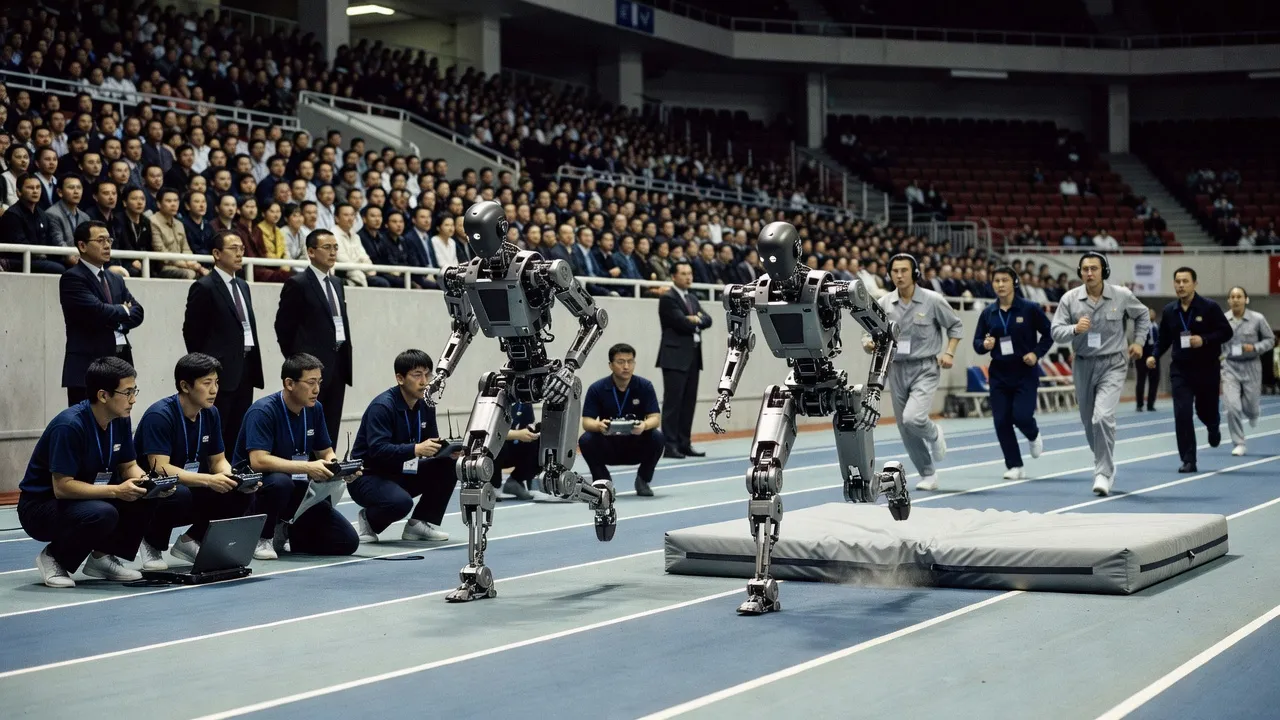
A Chinese humanoid robot ran the 100m under the human world record held by Usain Bolt (9.58s, Berlin 2009) at the second World Humanoid Robot Games in Beijing.
The Tiangong Ultra robot won the official 100m race in 9.39 seconds.
The Lightning robot, manufactured by Honor, also ran under Bolt's mark, with times reported differently by various sources (9.32s to 9.47s).
Some news outlets make a clear distinction between the 9.32 s time achieved by Lightning in a preparatory trial and the time recorded in the official race (9.39-9.47 s), while others report the 9.32 s figure without specifying this distinction.
Coverage aligned with this reading
Chinese and Danish media frame the record as a demonstration of a mature and commercialized robotics industry, while several other countries focus on the spectacular athletic achievement and its technical limitations, including the falls and incidents that occurred during the events.
Italian media explicitly note that some speed and jump figures come from Chinese manufacturers without independent verification, while other countries report these figures without equivalent reservations.
Coverage aligned with this reading
Coverage that diverges
This grouping describes the publications analysed, not the position of these countries’ populations or of their governments.
What the coverage of each country leaves aside, while others put it forward.
Poland
Italy
Australia
Preview: 3 of 10 media perspectives. Syntheses of the media analysed — not direct quotations. Method & limitations
Canberra is measuring the technological gap revealed by these Games, more than it is celebrating the athletic feat of a robot
4 sources · View sources
Beijing is leveraging time as an industrial argument: beyond the speed record, the capital is highlighting a robotic sector that is already commercialized, from the 10,000 m² shopping street to domestic and logistical uses.
3 sources · View sources
Copenhagen is gauging the industrial impact of the record rather than its spectacular side, seeing it as a signal for the global robotics industry
2 sources · View sources
DOMINANT ANGLE
Canberra is measuring the technological gap revealed by these Games, more than it is celebrating the athletic feat of a robot
ANALYSIS
Canberra, August 24, 2026.
DOMINANT ANGLE
Beijing is leveraging time as an industrial argument: beyond the speed record, the capital is highlighting a robotic sector that is already commercialized, from the 10,000 m² shopping street to domestic and logistical uses.
ANALYSIS
Beijing, August 24, 2026.
DOMINANT ANGLE
Copenhagen is gauging the industrial impact of the record rather than its spectacular side, seeing it as a signal for the global robotics industry
ANALYSIS
Copenhagen, August 24, 2026.
DOMINANT ANGLE
France views Beijing's achievement as an industrial showcase as much as a sporting one, highlighting the numerous setbacks that temper the narrative of technological maturity.
ANALYSIS
Paris, August 24, 2026.
DOMINANT ANGLE
Budapest notes a numerical discrepancy in its own figures before marveling at China's robotic achievement.
ANALYSIS
Budapest, August 24, 2026.
DOMINANT ANGLE
Italy questions the reliability of unverified figures while highlighting China's industrial acceleration behind Beijing's performance.
ANALYSIS
Rome, August 24, 2026.
DOMINANT ANGLE
Tokyo is gauging the technological gap exposed by Beijing's global humanoid robot games, where its own representative relied on a Chinese Unitree platform rather than homegrown Japanese technology.
ANALYSIS
Tokyo, August 24, 2026.
DOMINANT ANGLE
Islamabad carefully distinguishes between the technical feat and the official sports performance, noting that the timing of the Lightning robot remains a preparatory trial, unlike the record set in competition by Tiangong Ultra.
ANALYSIS
Islamabad, August 24, 2026.
DOMINANT ANGLE
Warsaw is particularly impressed by the timing performance of the Chinese robot, which is viewed as a spectacular sports achievement rather than an industrial demonstration.
ANALYSIS
Warsaw, August 24, 2026.
DOMINANT ANGLE
South Africa sticks to the wire story and CCTV figures, without a national angle: its two headlines mainly retain that the manner of robots is not worth that of Bolt.
ANALYSIS
Johannesburg, August 24, 2026.
Explore every perspective on this subject across 10 countries.
Compare viewpoints and see where they diverge.
published on
countries
sources
articles
gap
At the second World Humanoid Robot Games, held in Beijing in August 2026, the Chinese robot Tiangong Ultra ran the 100 meters in 9.39 seconds in an official race, under the human world record set by Usain Bolt (9.58 s, Berlin 2009). The robot Lightning, designed by manufacturer Honor, finished just behind in 9.47 seconds, after a time of 9.32 seconds achieved during a preparatory trial. Other robots beat human marks in the 400 meters and high jump during the competition, which brought together over 2,000 robots and about 660 teams from 16 countries.
The times announced by the Chinese organizers and manufacturers have not received any official sports certification or confirmed independent verification to date.
Lightning, from manufacturer Honor, had already run a half-marathon in Beijing in 50 min 26 s in April 2026.
The sole Japanese competitor in the 400m collapsed after 1 min 55 s and was stretchered off.
666 teams competed this year, compared to 280 in the first edition, according to Politiken.
Measured with the previous method (distance between texts), on a different scale.