
Common ground and differences in coverage across the media analysed.
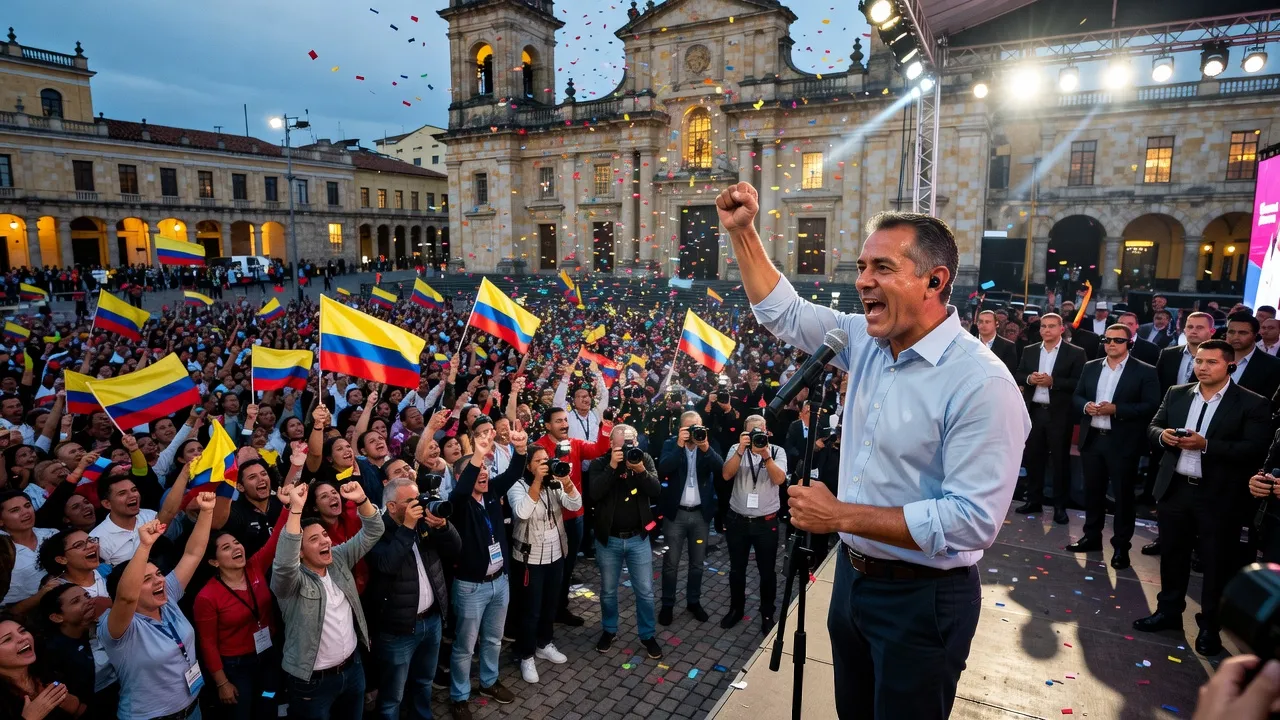
Abelardo de la Espriella wins the second round of Colombia's presidential election with approximately 49.66-49.7% of votes against 48.7% for Ivan Cepeda, a margin of roughly 250,000 votes out of over 26 million voters.
Voter turnout reached a record level of approximately 63%, unprecedented in Colombian electoral history.
Donald Trump publicly endorsed de la Espriella and immediately celebrated his victory on Truth Social; Secretary of State Marco Rubio contacted the president-elect before official validation of results.
Mexico and, to a lesser extent, Brazil and France frame Trump's public support as concerning interference in Colombian electoral sovereignty; the United States and Argentina treat this support as ordinary political fact without viewing it as a democratic concern.
Coverage aligned with this reading
France, Germany, Brazil, and Argentina place the victory within a sustained regional conservative wave; Colombia itself focuses on domestic dynamics and calls for unity, downplaying the regional interpretation.
Germany and Argentina emphasize that the historical gap between preliminary count and official result is less than 0.11%, making a reversal unlikely and implicitly validating the process; Mexico and Spain place greater emphasis on allegations of irregularities and Cepeda's contest as serious concerns.
This grouping describes the publications analysed, not the position of these countries’ populations or of their governments.
What the coverage of each country leaves aside, while others put it forward.
Colombia
United States
Germany
Preview: 3 of 11 media perspectives. Syntheses of the media analysed — not direct quotations. Method & limitations
Buenos Aires reads De la Espriella's victory in Colombia as a reflection of a familiar dynamic: a right-wing outsider defeats a left-wing heir in a country fractured by polarization into two camps, following an election night held in suspense.
3 sources · View sources
Brasilia views Espriella's victory as a significant indicator of Latin America's rightward shift, one that aligns regional politics more closely with Washington while marginalizing progressive governments across South America.
4 sources · View sources
Bogota marks a sharp political shift: Colombia swings right with the election of Abelardo de la Espriella, nicknamed 'El Tiger,' in a razor-thin contest that breaks with four years of leftist governance under Gustavo Petro.
2 sources · View sources
DOMINANT ANGLE
Buenos Aires reads De la Espriella's victory in Colombia as a reflection of a familiar dynamic: a right-wing outsider defeats a left-wing heir in a country fractured by polarization into two camps, following an election night held in suspense.
ANALYSIS
Buenos Aires, June 22, 2026.
DOMINANT ANGLE
Brasilia views Espriella's victory as a significant indicator of Latin America's rightward shift, one that aligns regional politics more closely with Washington while marginalizing progressive governments across South America.
ANALYSIS
Brasília, June 21, 2026.
DOMINANT ANGLE
Bogota marks a sharp political shift: Colombia swings right with the election of Abelardo de la Espriella, nicknamed 'El Tiger,' in a razor-thin contest that breaks with four years of leftist governance under Gustavo Petro.
ANALYSIS
Bogota, June 22, 2026.
DOMINANT ANGLE
Berlin reads de la Espriella's victory in Colombia as a decisive geopolitical realignment: the hard-right lawyer's narrow win over left-wing senator Ivan Cepeda signals the end of Gustavo Petro's leftist experiment and a dramatic pivot toward Washington, marking a potential inflection point in Latin American politics.
ANALYSIS
Berlin, June 22, 2026.
DOMINANT ANGLE
Madrid closely analyzes De la Espriella's victory in Colombia: a sharp rightward turn in a neighboring Spanish-speaking nation, decided by razor-thin margins, amid contested proceedings and swift congratulations from Washington.
ANALYSIS
Madrid, June 22, 2026.
DOMINANT ANGLE
Paris reads Colombia's turn rightward as a sign of profound realignment in Latin America, driven by security promises and alignment with Washington, in a nation exhausted by armed group violence.
ANALYSIS
Paris, June 22, 2026.
DOMINANT ANGLE
Mexico City watches Colombia's rightward shift with unease: Mexican media frames Abelardo de la Espriella's victory as a real-world test of Trump's influence over Latin American democracies, raising direct questions about regional electoral sovereignty and Washington's expanding role in shaping leadership choices across the continent.
ANALYSIS
Mexico City, June 22, 2026.
DOMINANT ANGLE
Washington celebrates El Tigre's victory in Colombia as confirmation of a regional pro-MAGA shift, while underscoring the razor-thin margin and ongoing electoral challenges.
ANALYSIS
Washington, June 22, 2026.
DOMINANT ANGLE
Moscow frames the Colombian election victory as a geopolitical tilt in Latin America orchestrated from Washington: de la Espriella's narrow win is read not as a Colombian sovereign choice but as Trump's strategic success in the hemisphere.
ANALYSIS
Moscow, June 22, 2026.
DOMINANT ANGLE
Ankara reads Abelardo de la Espriella's victory in Colombia as a signal of geopolitical realignment in Latin America, where the right-leaning, Washington-aligned faction regains ground against the leftist agenda of President Petro.
ANALYSIS
Ankara, June 22, 2026.
DOMINANT ANGLE
Beijing watches with measured vigilance the consolidation of a Washington-aligned rightward wave across a Latin America where China has become the top trading partner of several economies, reading El Tiger's win as a potential setback to its regional influence.
ANALYSIS
Beijing, June 22, 2026.
Explore every perspective on this subject across 11 countries.
Compare viewpoints and see where they diverge.
published on
countries
sources
articles
gap
The 21-22 June 2026 runoff of Colombia's presidential election ended in victory for Abelardo de la Espriella, credited with roughly 49.66% of the vote against 48.70% for Iván Cepeda — a margin of barely 250,000 ballots out of more than 26 million voters. It was the closest contest in the country's electoral history, marked by a record turnout of about 63%. The inauguration is set for 7 August 2026, the day commemorating the Battle of Boyacá, ending four years of Gustavo Petro's progressive government.
Donald Trump had publicly backed de la Espriella during the campaign and welcomed his win as soon as preliminary results were announced; Secretary of State Marco Rubio contacted the president-elect even before the official validation. For his part, Iván Cepeda refused to recognize the provisional figures and said he would challenge some 33,000 polling stations pending the final count.
The outcome fits within a cycle of conservative shifts across Latin America, where several countries have changed direction since 2023. South America's second most populous country, bordering Venezuela and Panama, Colombia holds a strategic place in narcotics flows and maintains long and complex ties with Washington. The announcement of deeper military cooperation and the break with Petro's "total peace" policy could reshape regional balances.
Several points remain disputed. The president-elect's profile — a naturalized U.S. citizen and registered Republican voter in the United States — fuels disagreement over the line between diplomatic alignment and sovereignty: some actors see a worrying interference, others an ordinary diplomatic fact. The reliability of the process also divides observers, between those who deem a reversal unlikely and those who give weight to the challenges. With 676,000 null or blank ballots, exceeding the final margin, the vote reveals a deeply polarized society.
Measured with the previous method (distance between texts), on a different scale.