EXPLORE THIS STORY

SPAIN PERSPECTIVE
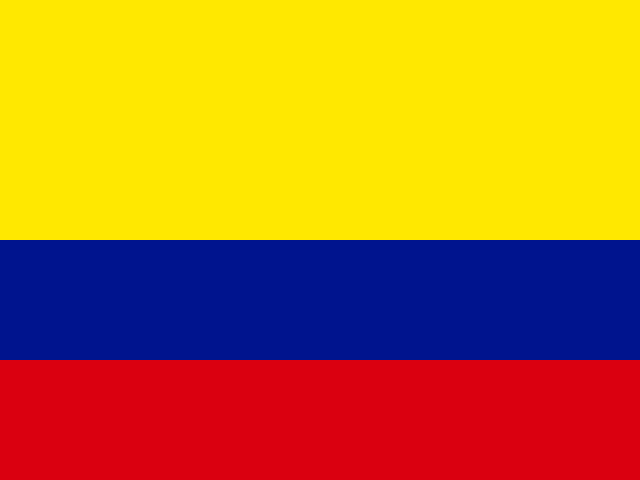
COLOMBIE : « EL TIGER », SOUTENU PAR TRUMP, REMPORTE LA PRÉSIDENTIELLE
DOMINANT ANGLE
Madrid closely analyzes De la Espriella's victory in Colombia: a sharp rightward turn in a neighboring Spanish-speaking nation, decided by razor-thin margins, amid contested proceedings and swift congratulations from Washington.
Dominant angle identified — does not reflect unanimity of this country’s media
ANALYSIS
Madrid, June 22, 2026. For Spanish media outlets, Colombia's presidential election on June 21 stands as one of the narrowest contested races in the country's recent history. Abelardo de la Espriella, a 47-year-old criminal defense attorney, co-founder of the Defensores de la Patria movement, and self-declared admirer of Donald Trump and Javier Milei, captured the presidency with 49.66 percent of the vote against 48.70 percent for the official-backed candidate Ivan Cepeda—a margin of 250,830 ballots across more than 26.3 million voters. Turnout reached a historic high of 63.59 percent, according to Expansión.
ElDiario.es, a left-leaning daily, highlighted the particularly uncertain conditions surrounding this outcome: 377,076 blank ballots exceeded the margin separating the two finalists, making the final tally decisive. The paper also noted that De la Espriella assumes office "with no prior public service experience" and holding only four senators in a 103-seat Congress, forcing him to negotiate with politically diverse parties including Centro Democrático, Cambio Radical, and the Liberal and Conservative parties.
Washington's reaction came nearly immediately. According to HuffPost España, Donald Trump posted a terse message on Truth Social: "He won, BIG TIME!" The US president had previously spoken by phone with De la Espriella to express his personal "support and recognition." Secretary of State Marco Rubio also called the victor to convey Washington's desire to "work closely" with him, pending official confirmation of the results.
Yet election night was not without political turbulence. Outgoing president Gustavo Petro publicly denounced irregularities on social media, demanding the invalidation of voting tables lacking signed attestations from poll judges and insisting that only the official count would settle the matter. "We cannot yet know who is president, and there are many irregularities," he wrote, according to HuffPost España.
De la Espriella, in turn, delivered his first victory speech before thousands of supporters gathered in Barranquilla, pledging a government "absolutely democratic and guarantor of freedom and institutional order." "From this moment forward, the campaign, divisions, and political confrontations come to an end," he declared, cited by Expansión. He is scheduled to take office on August 7.
El País, in its English-language edition, noted in the days before the vote that polls gave the far-right candidate an 80 percent likelihood of victory, yet the mood on the ground felt "quite different" and his first-round lead of 632,222 votes appeared less secure than anticipated. The mobilization of scattered votes from first-round eliminated candidates left the outcome uncertain until the very end.
KEY POINTS
- De la Espriella wins the presidency with 49.66 percent of votes against Cepeda's 48.70 percent—a 250,830-ballot margin on a historic 63.59 percent turnout (Expansión)
- Trump posted on Truth Social 'He won, BIG TIME!' and Secretary of State Marco Rubio telephoned the victor pledging close cooperation (HuffPost España)
- Outgoing president Petro publicly challenged the election results, demanding invalidation of voting tables missing signed poll judge attestations pending the official count (HuffPost España)
COGNITIVE BIASES IDENTIFIED
Ideological framing disparity: ElDiario.es consistently labels De la Espriella as 'ultra' or 'ultraderechista,' while Expansión adopts a more neutral register of 'far-right candidate'
Preference for institutional lens: Spanish press emphasizes the fragility of the incoming government's Congressional position and risks of legislative gridlock rather than the president-elect's economic program
Limited coverage of Latin American reactions: Spanish media concentrate on the Washington-Bogota axis and devote little space to positions of neighboring nations (Venezuela, Brazil, Mexico)
SOURCES (4)
El Pais English
MEDIUM
HuffPost España
MEDIUM
ElDiario.es
MEDIUM
Does this analysis seem accurate?
AI-generated content — Analyses are produced by artificial intelligence from press articles. They may contain errors or biases. Learn more