SHARE THIS COMPARISON
Show your friends how the world sees the same news differently.
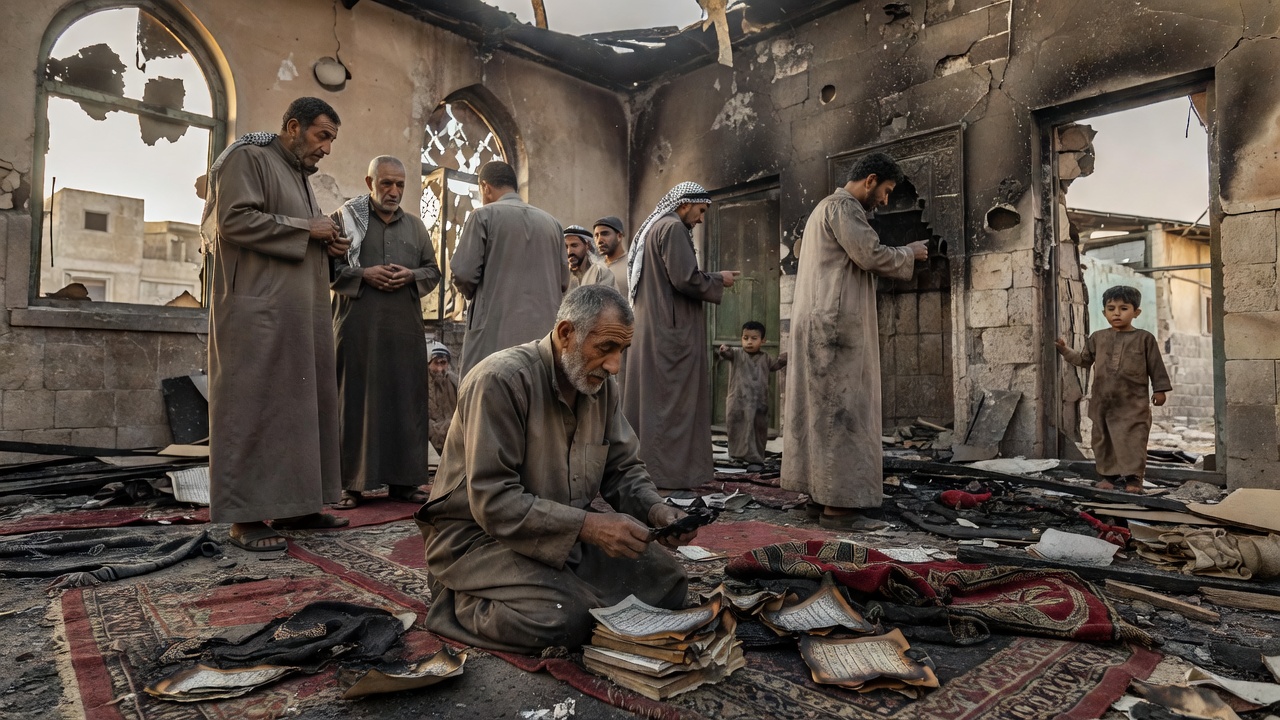
Overnight from 25 to 26 July 2026, Israeli settlers set fire to two mosques in the occupied West Bank and attacked villages, a day after a deadly clash (six killed). The army carried out a wave of arrests. The escalation of settler violence drew Arab and international condemnation, against the backdrop of an Israeli election campaign.
FRAMING GAP
28/100LOW
Coverages are relatively similar
Here are the main framing differences identified between media coverages.
ANALYSIS BY COUNTRY
 AUSTRALIA
DOMINANT ANGLE
Canberra examines a cycle of retaliation where Israeli and Palestinian narratives collide as sharply as settlers and West Bank villagers.
Dominant angle identified — does not reflect unanimity of this country’s media
KEY POINTS
- •Two mosques burned in Qusra and Khour, inscribed with slogans such as 'the land of Israel is redeemed by blood'
- •Friday clash near Tell village: four Palestinians and two Israeli soldiers killed
- •Over 130 Palestinians arrested by Israeli military over the weekend, according to ABC News
BIASES
Framing centered on grassroots testimonies (villagers, mayors, council leaders) rather than Israeli government positionsPreference for direct quotes and CCTV footage as evidence elementsLimited coverage of official Australian responses or Arab capitals' statements on the incident
 CHINAincl. 1 state outlet
DOMINANT ANGLE
Beijing frames Israel's escalating violence in occupied West Bank, amid burning mosques, military closure of Nablus, and tight Israeli election calendar.
Dominant angle identified — does not reflect unanimity of this country’s media
KEY POINTS
- •Four Palestinians and two Israeli soldiers were killed Friday near Tal village, southwest of Nablus, followed by two mosques burning on Sunday.
- •Israeli military detained at least 80 Palestinians in one night, bringing arrests in West Bank to over 3,600 since the year's start, according to Palestinian Prisoners Club.
- •Prime Minister Netanyahu, campaigning for October 27 elections, announced reinforcement of military units, increased checkpoints, and new agricultural settlements in West Bank.
BIASES
Security-focused framing: emphasis on arrest statistics and Israeli military operation through CGTN and SCMP sources.Preference for Palestinian official voices: Nablus governor and NGO cited, limited direct response from settlers or Israeli government beyond official statement.Limited international reaction coverage: available articles do not mention UN, European, or Arab countries' positions on the mosque burnings.
 EGYPT
EGYPTDOMINANT ANGLE
Cairo condemns an organized colonial escalation in occupied West Bank, where settler incursions around Al-Aqsa and overnight raids confirm, in Cairo's view, a territorial fragmentation strategy threatening the two-state solution.
Dominant angle identified — does not reflect unanimity of this country’s media
KEY POINTS
- •Eight nations, including Egypt, Jordan, and Saudi Arabia, condemned on July 23 Israeli settler incursions led by Israeli ministers at the Al-Aqsa Mosque esplanade, deemed violations of international law.
- •Nearly 40 people were arrested in a single West Bank village during Israeli raids, while a new settler outpost was established north of Nablus.
- •Egyptian Foreign Minister Badr Abdelatty called during a Manila meeting with his Dutch counterpart to end Israeli violations in West Bank.
BIASES
Diplomatic-centric framing: Egyptian coverage privileges official Arab and UN declarations over direct testimony from residents of attacked villages.Preference for institutional voice: cited sources (joint statement, ministries, UN) dominate, overshadowing ground-level organizations like Al-Baidar.Limited coverage of Israeli accounts: articles do not report explanations or denials from Israeli authorities or settlers facing accusations.
 ISRAEL
DOMINANT ANGLE
Israel's press splinters over settler violence in the West Bank following a deadly attack on Israelis—one camp condemns what they frame as a breakdown of law and order, while the other reads the incidents through a security lens shaped by prior Palestinian attacks.
Dominant angle identified — does not reflect unanimity of this country’s media
KEY POINTS
- •A mosque burned in Kusra bore the inscription 'revenge for Benayahu,' referring to Benayahu Melet, who was killed along with Major Yuval Ezra near Gilad Farm.
- •Haaretz quotes a reserve officer saying the military 'simply watches' settler violence due to insufficient personnel, and reports graffiti such as 'Jewish blood is not permissible.'
- •The Jerusalem Post reports the arrest of a 39-year-old man for online incitement and General Avi Bluth's temporary ban on Palestinian workers' access to Israeli settlements.
BIASES
Security-framing bias: Jerusalem Post articles consistently situate the mosque burnings within the context of prior Palestinian attacks on Israelis.Editorial-line preference: Haaretz emphasizes government accountability and executive responsibility over sequential security narratives.Limited Palestinian voice: Direct testimony from residents of affected villages appears only through institutional intermediaries, not as primary sources.
 PAKISTAN
DOMINANT ANGLE
Islamabad condemns the burning of two mosques in the West Bank as a direct assault on Muslim holy sites, amid escalating settler colonization.
Dominant angle identified — does not reflect unanimity of this country’s media
KEY POINTS
- •Two mosques burned in the West Bank on Sunday night in Qusra and Kour village near Tulkarem, according to Palestinian authorities
- •Qusra Mayor Abdel Azim Wadi reported Hebrew graffiti bearing the word 'revenge' on walls of the burned mosque
- •Friday clashes in Tel left four Palestinians and two Israelis dead, followed by Israeli military detention of dozens of Palestinians
BIASES
Sacred sites framing: the coverage emphasizes the religious dimension of the mosque burnings rather than the broader political and military contextPreference for Palestinian official statements (Qusra municipality, Palestinian Waqfs ministry) over independent Israeli sourcesLimited coverage of international diplomatic reactions or Israeli government position beyond military statements
 QATARincl. 1 state outlet
DOMINANT ANGLE
Doha reads Israeli settler attacks in the West Bank as flagrant violations of international law calling for urgent international intervention and accountability.
Dominant angle identified — does not reflect unanimity of this country’s media
KEY POINTS
- •Qatar's Foreign Ministry describes the settler attacks as 'flagrant violations of international law and international resolutions'
- •Two mosques burned: Al-Rahma in Qusra with 'Jewish revenge' graffiti before it was engulfed in flames, and a mosque in Kour near Tulkarem where worshippers extinguished the fire before reaching the main prayer hall
- •The Palestinian Health Ministry records at least 87 Palestinians killed by Israelis in the West Bank since the start of the year, including 21 killed by settlers
BIASES
Coverage centered on Qatar's official condemnation: the Foreign Ministry statement structures the core narrative, to the detriment of Israeli positionsHeavy reliance on Al Jazeera as a source, a media outlet based in Doha, which provides most factual details and ground testimony reproduced in the coverageLimited coverage of security justifications advanced by Israel following the shooting that killed two soldiers near the Havat Gilad settlement
AUSTRALIADOMINANT ANGLE
Canberra examines a cycle of retaliation where Israeli and Palestinian narratives collide as sharply as settlers and West Bank villagers.
Dominant angle identified — does not reflect unanimity of this country’s media
KEY POINTS
- •Two mosques burned in Qusra and Khour, inscribed with slogans such as 'the land of Israel is redeemed by blood'
- •Friday clash near Tell village: four Palestinians and two Israeli soldiers killed
- •Over 130 Palestinians arrested by Israeli military over the weekend, according to ABC News
BIASES
Framing centered on grassroots testimonies (villagers, mayors, council leaders) rather than Israeli government positionsPreference for direct quotes and CCTV footage as evidence elementsLimited coverage of official Australian responses or Arab capitals' statements on the incident
CHINAincl. 1 state outletDOMINANT ANGLE
Beijing frames Israel's escalating violence in occupied West Bank, amid burning mosques, military closure of Nablus, and tight Israeli election calendar.
Dominant angle identified — does not reflect unanimity of this country’s media
KEY POINTS
- •Four Palestinians and two Israeli soldiers were killed Friday near Tal village, southwest of Nablus, followed by two mosques burning on Sunday.
- •Israeli military detained at least 80 Palestinians in one night, bringing arrests in West Bank to over 3,600 since the year's start, according to Palestinian Prisoners Club.
- •Prime Minister Netanyahu, campaigning for October 27 elections, announced reinforcement of military units, increased checkpoints, and new agricultural settlements in West Bank.
BIASES
Security-focused framing: emphasis on arrest statistics and Israeli military operation through CGTN and SCMP sources.Preference for Palestinian official voices: Nablus governor and NGO cited, limited direct response from settlers or Israeli government beyond official statement.Limited international reaction coverage: available articles do not mention UN, European, or Arab countries' positions on the mosque burnings.
EGYPTDOMINANT ANGLE
Cairo condemns an organized colonial escalation in occupied West Bank, where settler incursions around Al-Aqsa and overnight raids confirm, in Cairo's view, a territorial fragmentation strategy threatening the two-state solution.
Dominant angle identified — does not reflect unanimity of this country’s media
KEY POINTS
- •Eight nations, including Egypt, Jordan, and Saudi Arabia, condemned on July 23 Israeli settler incursions led by Israeli ministers at the Al-Aqsa Mosque esplanade, deemed violations of international law.
- •Nearly 40 people were arrested in a single West Bank village during Israeli raids, while a new settler outpost was established north of Nablus.
- •Egyptian Foreign Minister Badr Abdelatty called during a Manila meeting with his Dutch counterpart to end Israeli violations in West Bank.
BIASES
Diplomatic-centric framing: Egyptian coverage privileges official Arab and UN declarations over direct testimony from residents of attacked villages.Preference for institutional voice: cited sources (joint statement, ministries, UN) dominate, overshadowing ground-level organizations like Al-Baidar.Limited coverage of Israeli accounts: articles do not report explanations or denials from Israeli authorities or settlers facing accusations.
ISRAELDOMINANT ANGLE
Israel's press splinters over settler violence in the West Bank following a deadly attack on Israelis—one camp condemns what they frame as a breakdown of law and order, while the other reads the incidents through a security lens shaped by prior Palestinian attacks.
Dominant angle identified — does not reflect unanimity of this country’s media
KEY POINTS
- •A mosque burned in Kusra bore the inscription 'revenge for Benayahu,' referring to Benayahu Melet, who was killed along with Major Yuval Ezra near Gilad Farm.
- •Haaretz quotes a reserve officer saying the military 'simply watches' settler violence due to insufficient personnel, and reports graffiti such as 'Jewish blood is not permissible.'
- •The Jerusalem Post reports the arrest of a 39-year-old man for online incitement and General Avi Bluth's temporary ban on Palestinian workers' access to Israeli settlements.
BIASES
Security-framing bias: Jerusalem Post articles consistently situate the mosque burnings within the context of prior Palestinian attacks on Israelis.Editorial-line preference: Haaretz emphasizes government accountability and executive responsibility over sequential security narratives.Limited Palestinian voice: Direct testimony from residents of affected villages appears only through institutional intermediaries, not as primary sources.
PAKISTANDOMINANT ANGLE
Islamabad condemns the burning of two mosques in the West Bank as a direct assault on Muslim holy sites, amid escalating settler colonization.
Dominant angle identified — does not reflect unanimity of this country’s media
KEY POINTS
- •Two mosques burned in the West Bank on Sunday night in Qusra and Kour village near Tulkarem, according to Palestinian authorities
- •Qusra Mayor Abdel Azim Wadi reported Hebrew graffiti bearing the word 'revenge' on walls of the burned mosque
- •Friday clashes in Tel left four Palestinians and two Israelis dead, followed by Israeli military detention of dozens of Palestinians
BIASES
Sacred sites framing: the coverage emphasizes the religious dimension of the mosque burnings rather than the broader political and military contextPreference for Palestinian official statements (Qusra municipality, Palestinian Waqfs ministry) over independent Israeli sourcesLimited coverage of international diplomatic reactions or Israeli government position beyond military statements
QATARincl. 1 state outletDOMINANT ANGLE
Doha reads Israeli settler attacks in the West Bank as flagrant violations of international law calling for urgent international intervention and accountability.
Dominant angle identified — does not reflect unanimity of this country’s media
KEY POINTS
- •Qatar's Foreign Ministry describes the settler attacks as 'flagrant violations of international law and international resolutions'
- •Two mosques burned: Al-Rahma in Qusra with 'Jewish revenge' graffiti before it was engulfed in flames, and a mosque in Kour near Tulkarem where worshippers extinguished the fire before reaching the main prayer hall
- •The Palestinian Health Ministry records at least 87 Palestinians killed by Israelis in the West Bank since the start of the year, including 21 killed by settlers
BIASES
Coverage centered on Qatar's official condemnation: the Foreign Ministry statement structures the core narrative, to the detriment of Israeli positionsHeavy reliance on Al Jazeera as a source, a media outlet based in Doha, which provides most factual details and ground testimony reproduced in the coverageLimited coverage of security justifications advanced by Israel following the shooting that killed two soldiers near the Havat Gilad settlement
CROSS-PERSPECTIVE ANALYSIS
CROSS-ANALYSIS
CONSENSUS POINTS
- 1Two mosques were set on fire during the night of Sunday in the occupied West Bank, in Qusra and in Kur near Tulkarem, with inscriptions evoking revenge.
- 2These fires followed a deadly confrontation that occurred Friday near the village of Tell/Tal, which killed four Palestinians and two Israeli soldiers.
- 3The Israeli military conducted dozens of arrests of Palestinians in the West Bank in the days following the incidents.
- 4The burned mosques bore Hebrew graffiti mentioning revenge, attributed by several sources to soldiers and settlers killed in Friday's attack.
FRAMING DIFFERENCES
Nature of settler violence
Perspectives diverge on how to characterize the fires: for some, a retaliatory act inserted into a security context, or for others, a manifestation of an organized and unpunished colonial policy.
Frame this way
Frame the opposite
Responsibility of the Israeli state
Part of the Israeli press evokes inaction or tolerance by the military toward settler violence, while the Arab press sees a direct government responsibility, contested by articles focused on the security context.
Frame this way
Frame the opposite
Religious vs security framing
Pakistan and the Arab world emphasize the religious dimension of the attack on Muslim places of worship, while other perspectives prioritize a security framing linked to the escalation of violence.
Frame this way
Frame the opposite
GEOPOLITICAL CLUSTERS
Arab-Muslim Condemnation Camp
Shared narrative
These perspectives condemn the mosque fires as a violation of international law and an attack on Muslim holy sites, drawing on official statements and calling for international action against settler impunity.
Factual and Distant Press
Shared narrative
These perspectives report the facts and statistics of the weekend (fires, arrests, toll) with limited accusatory tone, without developing international diplomatic reactions.
Divided Israeli Press
Shared narrative
The Israeli press is internally divided between a critical reading condemning the inaction of authorities in the face of settler violence and a security context framing centered on prior attacks against Israelis.
OMISSIONS ANALYSIS
AustraliaOmitted topics
Arab and UN diplomatic reactionsofficial position of the Israeli government
Highlighted by
ChinaOmitted topics
reactions from the UN and European countriesdirect voice of settlers or the Israeli government
Highlighted by
EgyptOmitted topics
explanations or denials from Israeli authorities and settlers targeted
Highlighted by
IsraelOmitted topics
direct testimonies from Palestinian residents of the targeted villages
Highlighted by
PakistanOmitted topics
detailed international diplomatic reactionsposition of the Israeli government beyond the military statement
Highlighted by
QatarOmitted topics
Israeli security justifications following the shooting that killed two soldiers
Highlighted by
GEOPOLITICAL CONTEXT
These mosque fires occur in a context of growing tensions in the occupied West Bank, where settler violence is part of a documented escalation over several months, marked by thousands of arrests and new settlements. Arab and Muslim coverage links the event to a broader contestation of incursions around the Al-Aqsa esplanade and the future of the two-state solution, while the Israeli press oscillates between self-criticism and security framing related to the deadly attack that preceded the fires. The Israeli electoral calendar, with elections announced for October, adds a domestic political dimension to security management in the West Bank. International reactions, notably from a group of Arab and Muslim countries, illustrate the diplomatic scope of the incident beyond the local theater.
AI-powered analysis