Common ground and differences in coverage across the media analysed.
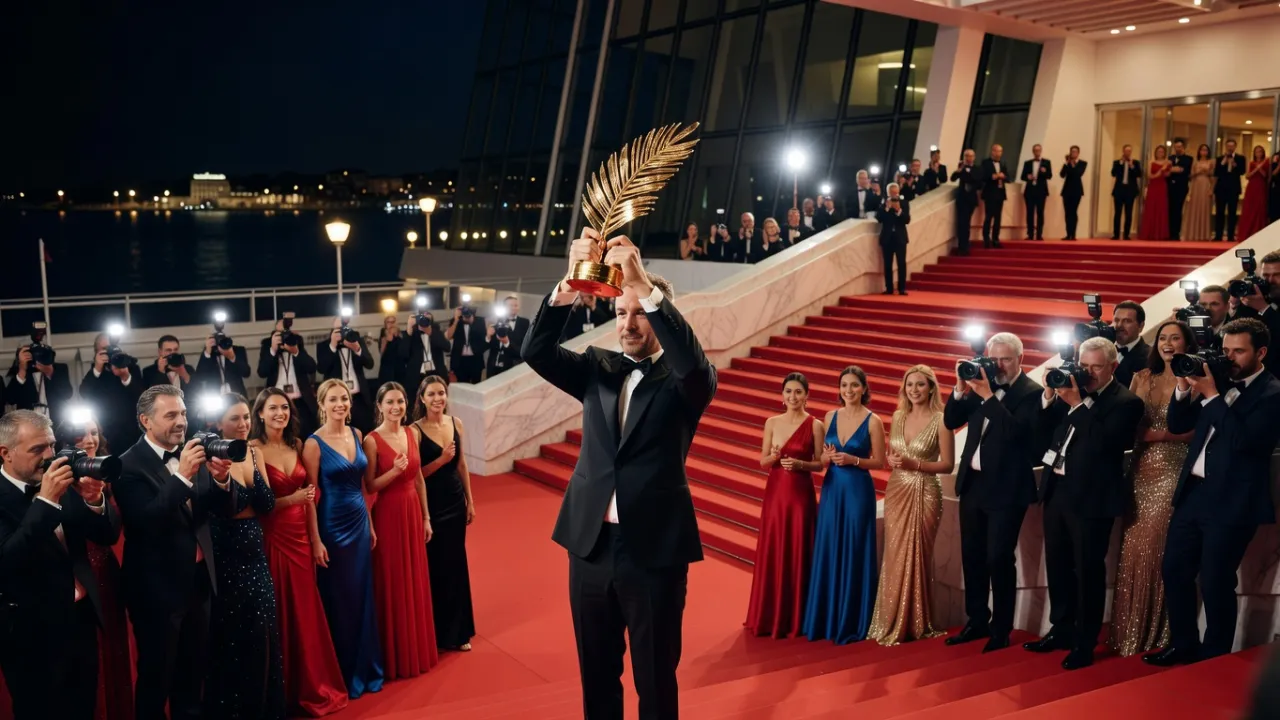
Cristian Mungiu wins the Palme d'Or at Cannes for 'Fjord', becoming the 10th filmmaker in the festival's history to receive the prize twice, nineteen years after '4 Months, 3 Weeks, 2 Days' (2007).
The film 'Fjord' depicts a Romanian-Norwegian family confronted by Norwegian social services after injuries are discovered on a child, addressing tolerance and fundamentalism.
In his speech, Mungiu stated that contemporary societies are 'fractured and radicalized' and presented the film as a commitment against all forms of fundamentalism.
Romania and Germany interpret the awards primarily through the lens of their respective national achievements, while France, Italy, and Portugal see it as a collective consecration of European auteur cinema.
Preview: 3 of 6 media perspectives. Syntheses of the media analysed — not direct quotations.
Paris frames Cannes' second Palme d'Or for Romanian director Cristian Mungiu as vindication that European auteur cinema resists market logic, despite a ceremony darkened by global fractures and internal French media tensions.
4 sources ·
Bucharest celebrates a historic triumph: with five honors at Cannes and an automatic entry into the 2027 Oscars race, Cristian Mungiu and "Fjord" establish Romanian cinema as a major force in world cinema.
2 sources ·
Rome celebrates a deeply political awards slate: the Palme d'Or to Mungiu consecrates engaged European cinema, resolutely oriented against fundamentalism and fractured societies.
3 sources ·

French press addresses the tension surrounding creative freedom and the Canal+/Bollore affair as a contextual element of the ceremony; this dimension is absent from German, Portuguese, Brazilian, and Romanian coverage.
Romanian press highlights the American Academy rule granting the Palme d'Or automatic eligibility for the 2027 Oscars; this point is ignored by all other perspectives.
This grouping describes the publications analysed, not the position of these countries’ populations or of their governments.
What the coverage of each country leaves aside, while others put it forward.
France
Germany
Brazil
published on
countries
sources
articles
gap
Romanian director Cristian Mungiu won the Palme d'Or at the 79th Cannes Film Festival for "Fjord." With this prize, he becomes the tenth filmmaker in the festival's history to receive it twice, nineteen years after "4 Months, 3 Weeks and 2 Days" was honored in 2007. The film follows a Romanian-Norwegian family confronted by Norwegian social services after injuries are discovered on a child, and explores the line between tolerance and fundamentalism.
In his speech, Mungiu described contemporary societies as "fractured and radicalized" and presented the film as a stand against all forms of fundamentalism. The 2026 awards were dominated by non-English-language cinema, with no American winner in the main competition. The Grand Jury Prize went to exiled Russian director Andrei Zvyagintsev for "Minotaur"; from the stage, he addressed Vladimir Putin directly, calling for an end to the killing.
The ceremony took place against the backdrop of several active armed conflicts, including the war in Ukraine, which weighed on the mood of the closing event. The presence of a dissident filmmaker illustrates the festival's enduring role as an international platform, while the prominence of Central and Eastern European cinema reflects its growing assertion at major global gatherings.
Several readings coexist. Some actors interpret the awards primarily through their own national honors, while others see a collective recognition of European auteur cinema. The exact scope of "Fjord"'s haul is also debated: one count cites five separate awards beyond the Palme d'Or itself, while other accounts mention only the main prize. Still contested are the effect of automatic eligibility for the 2027 Oscars and the place, within the story of the ceremony, of tensions over creative freedom raised in France.
DOMINANT ANGLE
Paris frames Cannes' second Palme d'Or for Romanian director Cristian Mungiu as vindication that European auteur cinema resists market logic, despite a ceremony darkened by global fractures and internal French media tensions.
ANALYSIS
Paris, May 23, 2026.
DOMINANT ANGLE
Bucharest celebrates a historic triumph: with five honors at Cannes and an automatic entry into the 2027 Oscars race, Cristian Mungiu and "Fjord" establish Romanian cinema as a major force in world cinema.
ANALYSIS
Bucharest, May 23, 2026.
DOMINANT ANGLE
Rome celebrates a deeply political awards slate: the Palme d'Or to Mungiu consecrates engaged European cinema, resolutely oriented against fundamentalism and fractured societies.
ANALYSIS
Rome, May 23, 2026.
DOMINANT ANGLE
Berlin reads Cannes 2026 as a double national pride: filmmaker Valeska Grisebach awarded the Jury Prize, and Sandra Hüller featured in a prize-winning film about postwar Germany.
ANALYSIS
Berlin, May 23, 2026.
DOMINANT ANGLE
Brasília reads Cannes 2026 through Brazil's dual imprint: the Palme d'Or awarded to a film on societal polarization, and Brazilian presence anchored by a prize-winning co-production in an out-of-competition section and actor Selton Mello honored at the Palm Dog awards.
ANALYSIS
Brasília, May 23, 2026.
DOMINANT ANGLE
Lisbon celebrates a well-deserved consecration: for Portuguese media, Cristian Mungiu's second Palme d'Or confirms the vitality of a European auteur cinema that speaks to the fractures of our time.
ANALYSIS
Lisbon celebrates, with undisguised admiration, Cristian Mungiu's second Palme d'Or for 'Fjord' at the 79th Cannes Film Festival.
Explore every perspective on this subject across 6 countries.
Compare viewpoints and see where they diverge.
Measured with the previous method (distance between texts), on a different scale.



