
Common ground and differences in coverage across the media analysed.
Nikol Pashinyan's Civil Contract leads in Armenia per all exit polls published, ranging between 32% (IRI polls) and 56.7% (civic.am).
Albin Kurti's Vetevendosje wins the Kosovo vote but at 43.1-43.2% (down 8 points since December), third election in sixteen months with turnout at 33%.
Both votes are read as a test of the pro-European pivot against Russian influence.
For France, Germany and Romania, it is Moscow that orchestrates disinformation campaigns against Pashinyan. For Russia, it is French intelligence that 'blocks online criticism' against Pashinyan. Each sees the other.
Germany, Italy, France and Qatar treat the Kosovar vote as a legitimate vote of a sovereign state. Russia keeps the adjective 'unrecognized' in each dispatch. Serbia avoids the state qualification.
Argentina and France privilege the identity reading (Armenian diaspora) over the institutional one. Germany and Italy prioritize the numerical and budgetary reading.
This grouping describes the publications analysed, not the position of these countries’ populations or of their governments.
What the coverage of each country leaves aside, while others put it forward.
Russia
Serbia
China
Preview: 3 of 9 media perspectives. Syntheses of the media analysed — not direct quotations. Method & limitations
Paris sees the double vote as a test of its own post-Karabakh influence and confirms a Mediterranean-Caucasian geopolitical alignment
4 sources · View sources
Berlin reads the two votes as two successive tests of European enlargement attractiveness — and the grade is mixed
3 sources · View sources
Rome finds its own angle: Yerevan plays the Russia-Europe match while Karapetyan, the oligarch from Moscow, is credited with only 17%
3 sources · View sources
DOMINANT ANGLE
Paris sees the double vote as a test of its own post-Karabakh influence and confirms a Mediterranean-Caucasian geopolitical alignment
ANALYSIS
Paris, June 7.
DOMINANT ANGLE
Berlin reads the two votes as two successive tests of European enlargement attractiveness — and the grade is mixed
ANALYSIS
Berlin, June 7.
DOMINANT ANGLE
Rome finds its own angle: Yerevan plays the Russia-Europe match while Karapetyan, the oligarch from Moscow, is credited with only 17%
ANALYSIS
Rome, June 7.
DOMINANT ANGLE
Bucharest reads the Armenian vote as a mirror of its own presidential election and documents Russian orchestration with unique precision
ANALYSIS
Bucharest, June 7.
DOMINANT ANGLE
Belgrade observes Pristina with cautious distance: Kurti loses but stays, and Vjosa Osmani is not forgiven for her selfie with Trump
ANALYSIS
Belgrade, June 7.
DOMINANT ANGLE
Moscow already prepares delegitimization: CIS observers deployed, economic restrictions imposed, and a narrative on 'French interference' undoing Pashinyan
ANALYSIS
Moscow, June 7.
DOMINANT ANGLE
Buenos Aires reads the Armenian vote as a case study of an unexpected Trump-EU alignment — a sign that the Milei doctrine could also align with Washington
ANALYSIS
Buenos Aires, June 7.
DOMINANT ANGLE
Ankara watches Yerevan vote as a test of its own Armenian-Turkish normalization: Erdogan and Pashinyan already spoke by phone on June 3
ANALYSIS
Ankara, June 7.
DOMINANT ANGLE
Beijing reads the Armenian vote as a Russian humiliation and watches the opportunity to occupy the strategic void without frontally challenging Moscow
ANALYSIS
Beijing, June 7.
Explore every perspective on this subject across 9 countries.
Compare viewpoints and see where they diverge.
published on
countries
sources
articles
gap
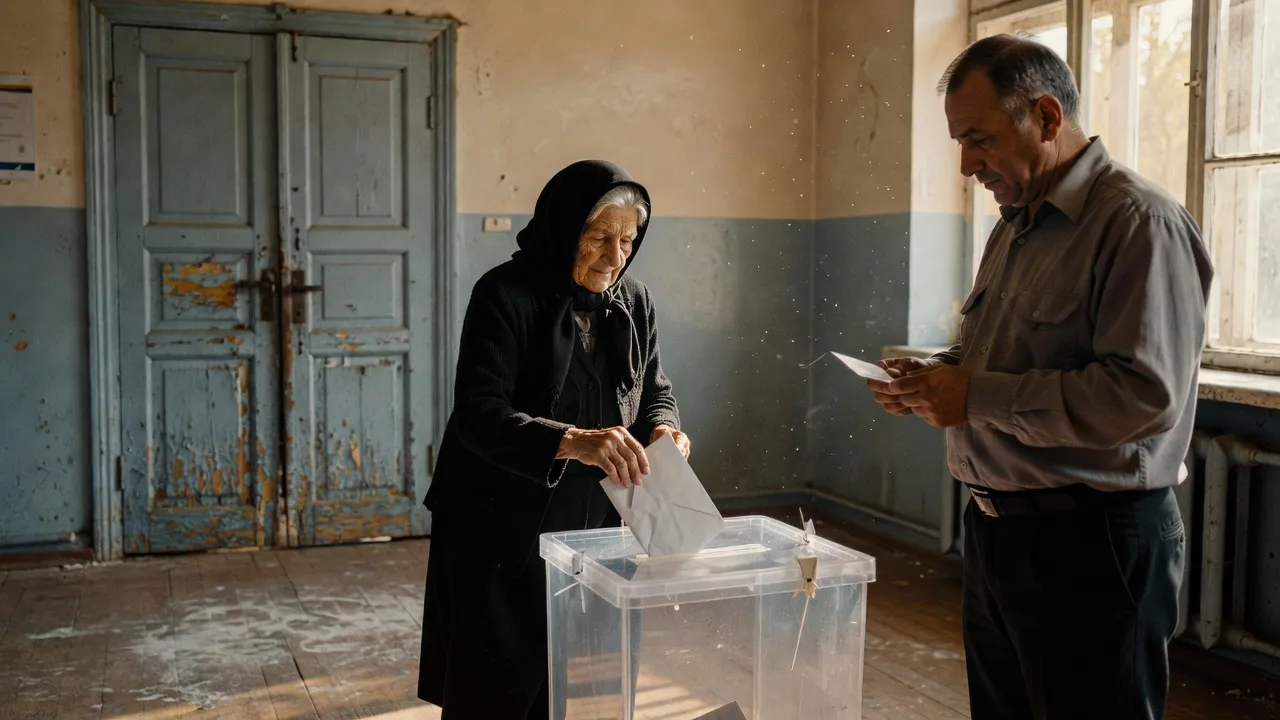
On Sunday 7 June 2026, two states of fewer than four million people, Armenia and Kosovo, held parliamentary elections on the same day, both read as a test of a shift toward the European Union against Russian influence.
In Armenia, Nikol Pashinyan's Civil Contract party came first according to every published exit poll, though with widely scattered figures, ranging from 32 % to 56.7 % depending on the pollster. The pro-Russian opposition led by Russian-Armenian billionaire Samvel Karapetyan (Armenia Forte) stood at around 17.5 %. Moscow imposed new restrictions on Armenian exports and issued veiled threats comparing Yerevan to Ukraine.
In Kosovo, Albin Kurti's Vetevendosje party won the vote with 43.1-43.2 %, down about eight points since December 2025, without an absolute majority. It was the third election in sixteen months, and turnout fell to 33 %, a figure read as a sign of democratic fatigue.
The stakes reach beyond the two countries. For Armenia: the Zangezur corridor linking Azerbaijan to Turkey, the weight of an active diaspora notably in France and Argentina, and ties with Russia. For Kosovo: a legal status still not recognised by five EU members, cooperation with Serbia, and the election of a president requiring a two-thirds majority. In the background, the European enlargement window is being tested and the appeal of the Western model no longer appears automatic.
The interpretation remains disputed. Several European capitals attribute disinformation campaigns targeting Pashinyan to Moscow, while Russia accuses French services of censoring online criticism. Kosovo's status divides in the same way: treated as a sovereign state by some, labelled "unrecognised" by others.
Measured with the previous method (distance between texts), on a different scale.