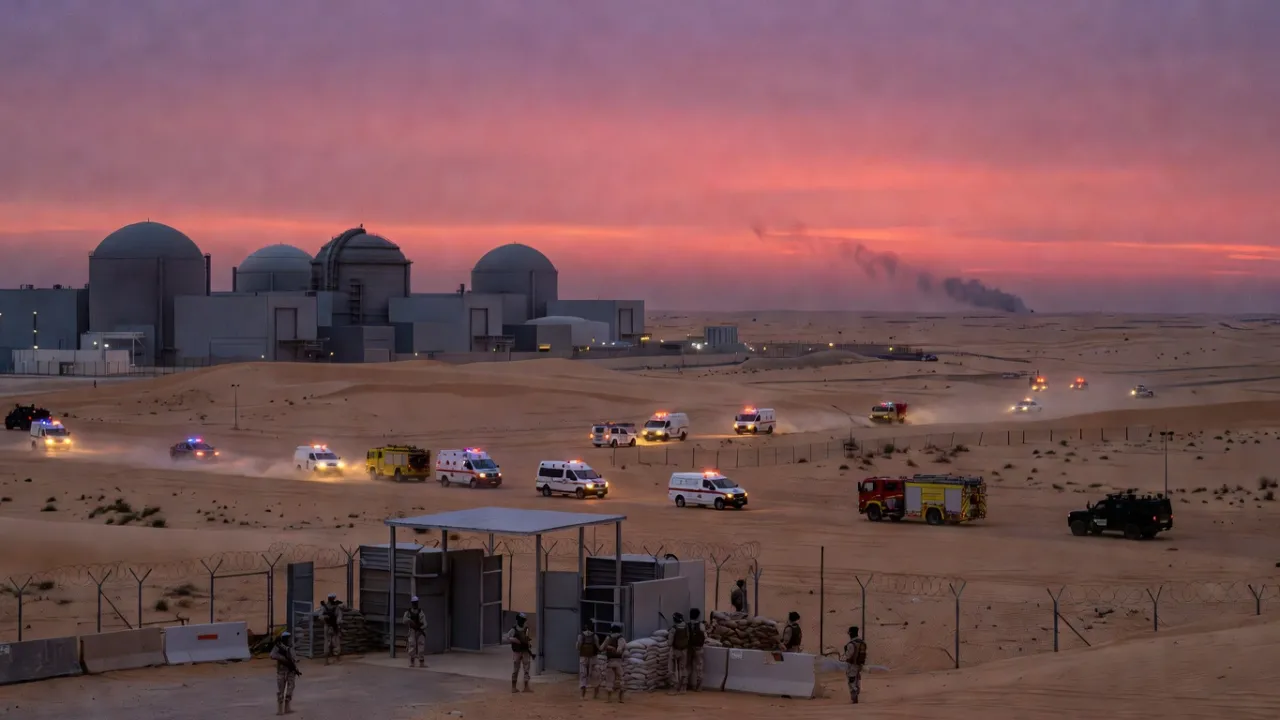
Drone strike causes fire near Barakah nuclear plant in UAE
published on
countries
sources
articles
Measured with the previous method (distance between texts), on a different scale.
On 17 May 2026, a drone struck an electrical generator located outside the inner perimeter of the Barakah nuclear power plant, in the Al Dhafra region of Abu Dhabi. Two other aircraft were intercepted by Emirati air defences. The incident caused no casualties and led to no radiological release. The UAE's Federal Authority for Nuclear Regulation confirmed that all reactors continued to operate normally.
Barakah is the first civilian nuclear power plant in the Arab world. Built by a South Korean consortium led by KEPCO at a cost of 20 billion dollars, it supplies up to 25 percent of the country's electricity needs. The director general of the International Atomic Energy Agency voiced grave concern, stating that any military activity threatening nuclear safety is unacceptable.
The strike comes 79 days after the outbreak, on 28 February 2026, of open conflict between the United States, Israel and Iran, and five weeks after a ceasefire reached on 8 April. That agreement remains fragile: sporadic strikes against Emirati infrastructure continue, and talks between Washington and Tehran are stalled over Iran's nuclear programme, control of the Strait of Hormuz and the lifting of the blockade. The targeting of a civilian nuclear site fits a broader pattern that is steadily eroding the norms protecting such facilities.
Several points remain disputed. No organisation has claimed the attack and Emirati authorities have formally attributed no responsibility; some actors point implicitly at Iran or its regional allies, while others stick strictly to the facts. Analyses also diverge on the dominant lens — regional security escalation for some, the consequences for hydrocarbon supply routes and the stability of Hormuz for others — and on the level of nuclear alarm, with some reporting that one reactor switched to backup generators.
What the comparison reveals
Common ground and differences in coverage across the media analysed.
What the media report in common
A drone struck a power generator located outside the inner perimeter of the Barakah nuclear facility (Al Dhafra region, Abu Dhabi) on May 17, 2026; two additional aircraft were intercepted by UAE air defenses.
No casualties or radiological impact have been reported; the UAE Federal Nuclear Regulatory Authority (FANR) confirmed that all reactors continued operating normally.
The IAEA expressed grave concern through its Director General Rafael Grossi, stating that any military activity threatening nuclear safety is unacceptable.
Where media coverage diverges
Attribution of the attack
Several English-language and Gulf perspectives implicitly point toward Iran or its proxies, while Russian, Egyptian, and Japanese coverage remains strictly factual without speculating on attribution.
Coverage that diverges
Dominant analytical framework
Asian perspectives (Japan, Singapore, China, South Korea) and Canada prioritize energy supply disruptions and impact on supply routes, while Western and Gulf perspectives emphasize regional security escalation and ceasefire fragility.
Level of nuclear alarm
Australia, Qatar, Turkey, and Ukraine report that the IAEA confirmed one reactor switched to backup power generators, amplifying perceived risk, while other perspectives (Egypt, Nigeria, Russia) stick to confirming normal facility operations.
This grouping describes the publications analysed, not the position of these countries’ populations or of their governments.
Blind spots
What the coverage of each country leaves aside, while others put it forward.
 Egypt
- Attribution of the attack or Iranian leads
- Context of the Iran-US-Israel conflict since February 2026
- Trump statements and status of peace negotiations
 Russia
- Attribution hypotheses for the strike
- Regional geopolitical context (Iran-UAE tensions, April ceasefire)
- Trump statements on possible resumption of strikes
 Nigeria
- Technical characteristics of the Barakah facility (KEPCO, 4 reactors, share of electricity needs)
- IAEA reaction and implications for nuclear safety
- African or Nigerian angle on energy implications
How each country reads it
Preview: 3 of 16 media perspectives. Syntheses of the media analysed — not direct quotations. Method & limitations
 Australia
Sydney watches with sharp concern as the escalation around Barakah nuclear facility threatens broader Middle East stability, viewing the incident as a turning point that extends beyond Iran-UAE frictions to signal fundamental regional instability.
2 sources · View sources
 Canada
Ottawa watches with concern as tensions escalate around Barakah, viewing the incident as a critical warning sign about the fragility of the Iran ceasefire and the cascading global energy risks it poses.
3 sources · View sources
 China
Beijing watches with concern as a drone strike on the Barakah nuclear power plant threatens regional stability in the Gulf, with direct consequences for global energy supply routes and Asian supply chains.
1 source · View sources
The full text, country by country
Australia
DOMINANT ANGLE
Sydney watches with sharp concern as the escalation around Barakah nuclear facility threatens broader Middle East stability, viewing the incident as a turning point that extends beyond Iran-UAE frictions to signal fundamental regional instability.
ANALYSIS
Canberra, May 18, 2026.
Canada
DOMINANT ANGLE
Ottawa watches with concern as tensions escalate around Barakah, viewing the incident as a critical warning sign about the fragility of the Iran ceasefire and the cascading global energy risks it poses.
ANALYSIS
Ottawa, May 18, 2026.
China
DOMINANT ANGLE
Beijing watches with concern as a drone strike on the Barakah nuclear power plant threatens regional stability in the Gulf, with direct consequences for global energy supply routes and Asian supply chains.
ANALYSIS
Beijing, May 18, 2026.
Egypt
DOMINANT ANGLE
Cairo closely monitors the incident at the Barakah nuclear facility, an event that resonates in a region marked by persistent tensions and shared civil nuclear ambitions.
ANALYSIS
Cairo, May 17, 2026.
 France
DOMINANT ANGLE
Paris frames the incident as a major regional escalation deliberately targeting civilian nuclear infrastructure, with an implicit designation of Iran and its regional proxies as presumed responsible actors.
ANALYSIS
Paris, May 17, 2026.
 Israel
DOMINANT ANGLE
Jerusalem interprets the drone strike on the Barakah nuclear plant as evidence that Iran is escalating reprisals against regional partners of the US and Israel, amid a fragile ceasefire.
ANALYSIS
Jerusalem, May 17, 2026.
 India
DOMINANT ANGLE
New Delhi closely monitors the drone strike on the Barakah nuclear facility in the UAE, viewing it as a dangerous precedent for civil infrastructure security in conflict zones.
ANALYSIS
New Delhi, May 18, 2026.
 Japan
DOMINANT ANGLE
Tokyo closely monitors the incident at the Barakah nuclear facility in the United Arab Emirates, reading it as a signal of instability threatening critical energy infrastructure in the Gulf region—an area upon which Japan depends heavily for hydrocarbon imports.
ANALYSIS
Tokyo, May 17, 2026.
 South Korea
DOMINANT ANGLE
Seoul tracks the Barakah incident with particular concern: the targeted nuclear power plant is a flagship of Korean industry abroad, built by a KEPCO-led consortium, and its exposure to drone attack raises questions about the security of South Korea's strategic investments in an increasingly unstable region.
ANALYSIS
Seoul, May 17, 2026.
Nigeria
DOMINANT ANGLE
Abuja reads the drone strike near the UAE nuclear facility through Saudi Arabia's response, emphasizing regional concern for Gulf stability and the implications for energy infrastructure security in a strategically important zone for Nigerian economic interests.
ANALYSIS
Abuja, May 18, 2026.
 Qatar
DOMINANT ANGLE
Doha closely monitors the Barakah incident, with the nuclear facility adjacent to Qatari borders, and relays IAEA warnings about risks posed by drone strikes near civilian nuclear installations in an still-unstable regional context.
ANALYSIS
Doha, May 17, 2026.
Russia
DOMINANT ANGLE
Moscow frames the drone attack on Barakah nuclear facility as a serious violation of international law, emphasizing the absence of radiological impact and the firm diplomatic response from UAE authorities.
ANALYSIS
Moscow, May 17, 2026.
 Singapore
DOMINANT ANGLE
Singapore places the Barakah incident at the center of a global energy and maritime crisis, emphasizing persistent diplomatic paralysis and risks to the Strait of Hormuz.
ANALYSIS
Singapore, May 17, 2026.
 Turkey
DOMINANT ANGLE
Ankara closely tracks the escalating situation around the Barakah nuclear facility, aware that any destabilization of the Gulf directly impacts its energy supplies and regional diplomatic balances.
ANALYSIS
Ankara, May 18, 2026.
 Ukraine
DOMINANT ANGLE
Kyiv frames the May 17 drone incident at Barakah nuclear facility in the UAE as a universal test case for nuclear site protection, drawing explicit parallels to Russia's years-long campaign against Ukrainian energy and nuclear infrastructure to establish an international principle of unconditional safeguarding.
ANALYSIS
Kyiv, May 17, 2026.
 United Kingdom
DOMINANT ANGLE
London monitors with concern the escalating situation around the Barakah nuclear facility, emphasizing the risks to nuclear safety and the fragility of the April US-Iran ceasefire.
ANALYSIS
London, May 18, 2026.
Explore every perspective on this subject across 16 countries.
Compare viewpoints and see where they diverge.