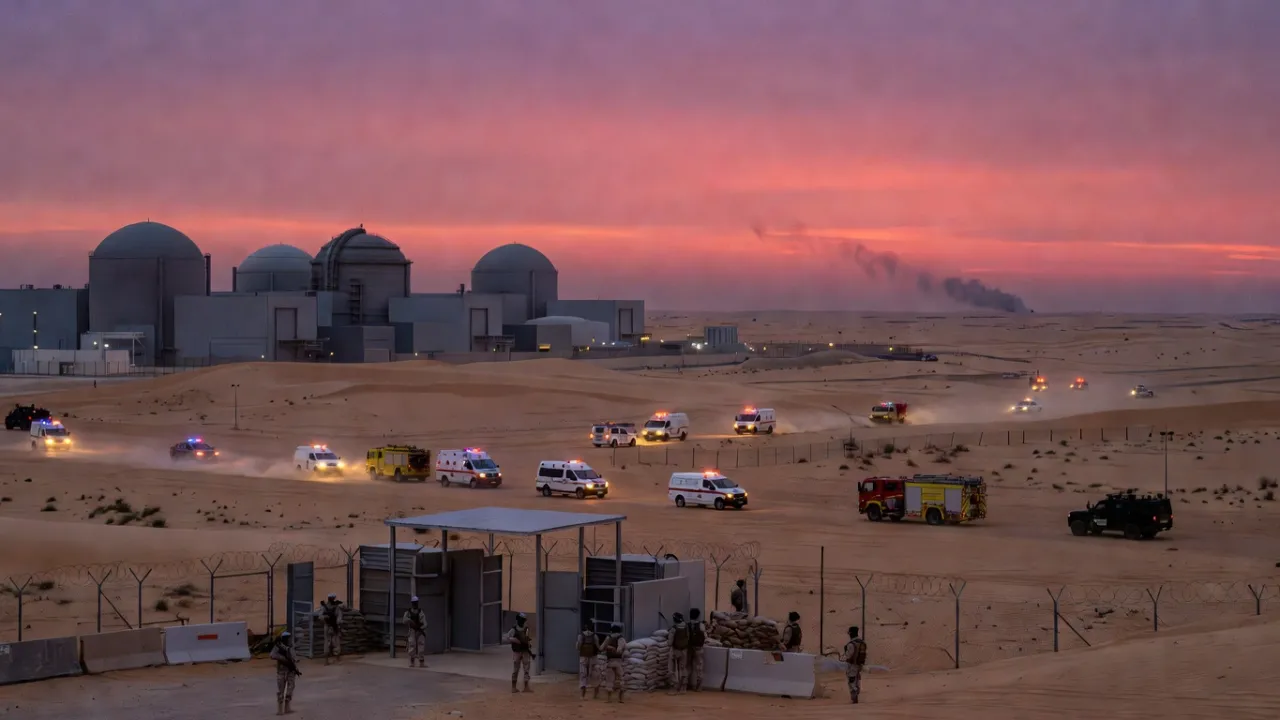
On 17 May 2026, a drone struck an electrical generator located outside the inner perimeter of the Barakah nuclear power plant, in the Al Dhafra region of Abu Dhabi. Two other aircraft were intercepted by Emirati air defences. The incident caused no casualties and led to no radiological release. The UAE's Federal Authority for Nuclear Regulation confirmed that all reactors continued to operate normally.
Barakah is the first civilian nuclear power plant in the Arab world. Built by a South Korean consortium led by KEPCO at a cost of 20 billion dollars, it supplies up to 25 percent of the country's electricity needs. The director general of the International Atomic Energy Agency voiced grave concern, stating that any military activity threatening nuclear safety is unacceptable.
The strike comes 79 days after the outbreak, on 28 February 2026, of open conflict between the United States, Israel and Iran, and five weeks after a ceasefire reached on 8 April. That agreement remains fragile: sporadic strikes against Emirati infrastructure continue, and talks between Washington and Tehran are stalled over Iran's nuclear programme, control of the Strait of Hormuz and the lifting of the blockade. The targeting of a civilian nuclear site fits a broader pattern that is steadily eroding the norms protecting such facilities.
Several points remain disputed. No organisation has claimed the attack and Emirati authorities have formally attributed no responsibility; some actors point implicitly at Iran or its regional allies, while others stick strictly to the facts. Analyses also diverge on the dominant lens — regional security escalation for some, the consequences for hydrocarbon supply routes and the stability of Hormuz for others — and on the level of nuclear alarm, with some reporting that one reactor switched to backup generators.