
Common ground and differences in coverage across the media analysed.
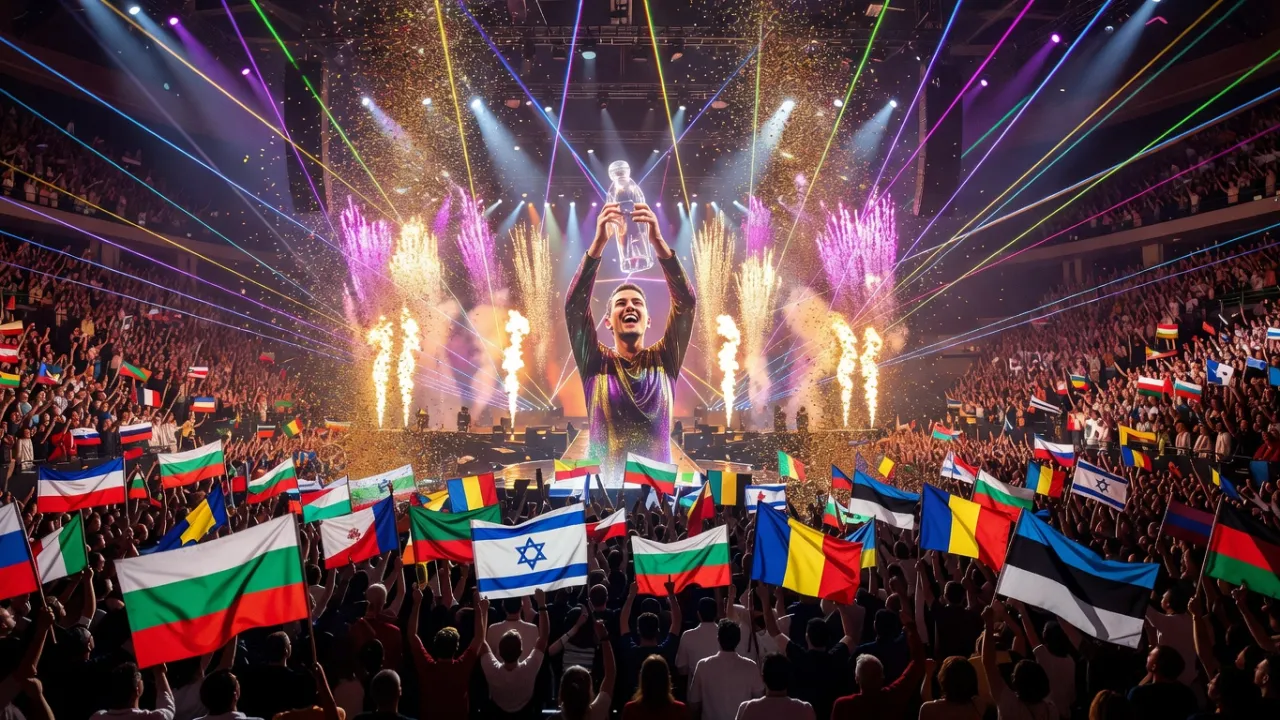
Bulgarian singer Dara wins Eurovision 2026 in Vienna with 516 points and the song 'Bangaranga', Bulgaria's first-ever victory in the history of the contest.
Israel, represented by Noam Bettan and the song 'Michelle', finishes in second place with 343 points for the second consecutive year.
Five countries — Spain, Netherlands, Ireland, Iceland and Slovenia — declined to participate in the final due to Israel's presence, constituting the largest collective boycott in the contest's history.
Some perspectives view the 2026 edition primarily as a musical and cultural event (Bulgarian victory at the forefront), while others treat it above all as an episode of the Israeli-Palestinian conflict where the Bulgarian victory remains secondary.
The EBU's justification (editorial independence of KAN, as distinct from VGTRK for Russia) is explicitly stated and debated in some coverage, absent or unchallenged in others.
Al Jazeera characterizes the war in Gaza as 'genocidal' and advances a death toll exceeding 72,740 Palestinians. Other perspectives address the conflict without this characterization, or in more measured terms.
This grouping describes the publications analysed, not the position of these countries’ populations or of their governments.
What the coverage of each country leaves aside, while others put it forward.
Russia
Greece
Pakistan
Preview: 3 of 13 media perspectives. Syntheses of the media analysed — not direct quotations. Method & limitations
Ottawa closely follows the 70th edition of Eurovision, where Bulgaria claims its first-ever victory in the contest amid heightened political tensions surrounding Israel's participation.
1 source · View sources
Berlin draws two lessons from the 70th Eurovision: a near-ritual athletic disappointment for Germany, and a record boycott that undermines the contest's legitimacy.
3 sources · View sources
Madrid focuses on its own decisive move: Spain led the largest political boycott in Eurovision history, refusing to vote in solidarity with Gaza, while Bulgaria claimed the contest for the first time.
1 source · View sources
DOMINANT ANGLE
Ottawa closely follows the 70th edition of Eurovision, where Bulgaria claims its first-ever victory in the contest amid heightened political tensions surrounding Israel's participation.
ANALYSIS
Ottawa, May 18, 2026.
DOMINANT ANGLE
Berlin draws two lessons from the 70th Eurovision: a near-ritual athletic disappointment for Germany, and a record boycott that undermines the contest's legitimacy.
ANALYSIS
Berlin, May 17, 2026.
DOMINANT ANGLE
Madrid focuses on its own decisive move: Spain led the largest political boycott in Eurovision history, refusing to vote in solidarity with Gaza, while Bulgaria claimed the contest for the first time.
ANALYSIS
Madrid, May 18, 2026.
DOMINANT ANGLE
Paris reads Bulgaria's surprise Eurovision 2026 victory and France's disappointing 11th-place finish, while emphasizing political tensions surrounding Israel's participation that marked this 70th edition.
ANALYSIS
Paris, May 17, 2026.
DOMINANT ANGLE
Athens celebrates a victory bearing Greek colors: composer Dimitrios Kontopoulos is among the authors of Bangaranga, Bulgaria's winning Eurovision 2026 entry, even though Akylas and his Ferto claimed only 10th place despite favorable forecasts.
ANALYSIS
Athens, May 18, 2026.
DOMINANT ANGLE
Rome observes Bulgaria's Eurovision 2026 victory with measured attention, Italy having placed fifth with 281 points, while the boycott by five nations over Israel's participation shapes broader Italian commentary on the contest.
ANALYSIS
Rome, May 18, 2026.
DOMINANT ANGLE
Islamabad watches Bulgaria's Eurovision 2026 upset victory with keen interest, viewing it as a triumph of popular spectacle over predictions, in a competition marked by political tensions but dominated by cultural energy.
ANALYSIS
Islamabad, May 17, 2026.
DOMINANT ANGLE
Doha reads the Eurovision 2026 contest through the lens of Israel's second-place finish and the historic boycott by five European nations, positioning the Bulgarian victory as secondary to a geopolitical narrative centered on the Gaza conflict.
ANALYSIS
Doha, May 17, 2026.
DOMINANT ANGLE
Moscow observes Bulgaria's Eurovision 2026 victory with measured restraint, reporting facts through the state TASS agency without editorial commentary, in a context where Russia remains excluded from the competition since 2022.
ANALYSIS
Moscow, May 17, 2026.
DOMINANT ANGLE
Stockholm observes Bulgaria's surprise Eurovision 2026 victory with keen attention, in a context where Finland, the clear favorite, finishes sixth and where public voting transforms a Vienna evening into a lesson in musical realpolitik.
ANALYSIS
Stockholm, May 18, 2026.
DOMINANT ANGLE
Singapore tracks Bulgaria's Eurovision 2026 victory as a global pop phenomenon coupled with persistent geopolitical tensions over Israel's participation.
ANALYSIS
Singapore, May 18, 2026.
DOMINANT ANGLE
Kyiv hails a creditable ninth-place finish and emphasizes the cultural dimension of its delegation — the bandura, ethno-jazz, and Jamala's production — as a reflection of a musical identity asserting itself beyond the context of war.
ANALYSIS
Kyiv, May 18, 2026.
DOMINANT ANGLE
Washington views Eurovision 2026 as a global cultural phenomenon marked by deep geopolitical tensions, where Bulgaria's surprise victory struggles to overshadow debate over Israel's place in the competition.
ANALYSIS
Washington, May 18, 2026.
Explore every perspective on this subject across 13 countries.
Compare viewpoints and see where they diverge.
published on
countries
sources
articles
gap
The 2026 Eurovision Song Contest, held in Vienna, was won by Bulgarian singer Dara with the song “Bangaranga” and a total of 516 points. It is Bulgaria's first victory in the history of the contest, and Dara became the first performer since 2017 to top both the professional jury vote and the public televote at the same time. Israel, represented by Noam Bettan with “Michelle,” finished second with 343 points, its second consecutive year in that position. Sofia will host the 71st edition in 2027.
The final was marked by the withdrawal of five countries — Spain, the Netherlands, Ireland, Iceland and Slovenia — which declined to take part because of Israel's presence. It is the largest collective boycott in the event's history.
This backdrop relates to tensions surrounding the armed conflict between Israel and Gaza, ongoing since October 2023. Israeli participation crystallized a debate among members of the organizing body over inclusion criteria: Russia had been excluded in 2022 after its invasion of Ukraine, on the grounds that its public broadcaster lacked independence, while Israel was retained on the basis of the editorial independence of its broadcaster KAN.
Actors diverge on how to read the edition. Some frame it first as a musical and cultural event, with the Bulgarian win in the foreground; others treat it chiefly as an episode of the conflict, with the contest result a secondary matter. The significance of the boycott is likewise disputed: praised by some as an unprecedented collective stance, it is presented elsewhere as a mere contextual detail. Also still debated is the consistency of the rules applied to Russia and then to Israel, a point stressed by several actors and left unmentioned by others.
Measured with the previous method (distance between texts), on a different scale.