Common ground and differences in coverage across the media analysed.
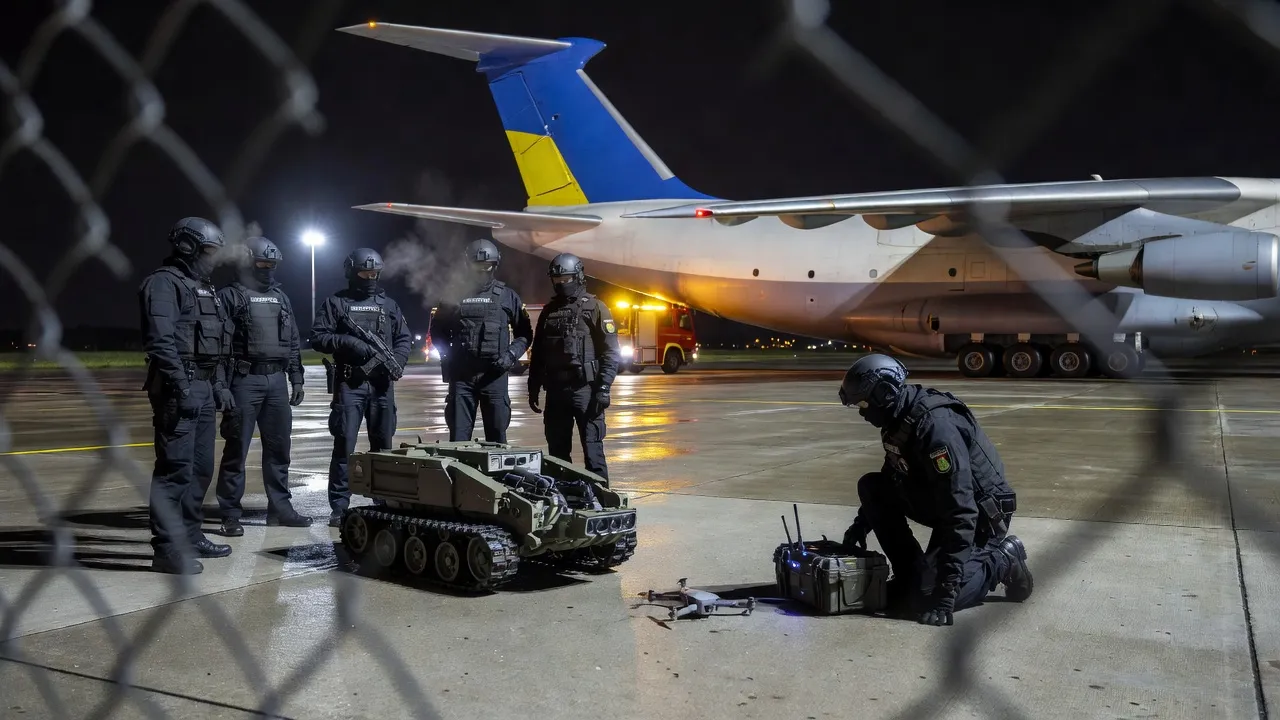
A drone carrying an explosive device equipped with a detonator was discovered around 11:40 p.m. on the south runway of Leipzig/Halle Airport, in the immediate vicinity of a Ukrainian cargo aircraft of the Antonov type.
A bomb disposal robot from federal police removed the detonator, while a second incident occurred the same night: a DHL cargo aircraft struck an unidentified flying object before landing with minor damage at Hanover.
Federal Interior Minister Alexander Dobrindt called the incident a 'new quality of danger' and evoked a possible 'hybrid attack scenario'.
The Ukrainian ambassador to Germany directly identifies Moscow as the only plausible responsible party, while Germany and several Western media outlets relay the accusation without confirming it, in the absence of formal proof or reaction from Moscow.
Coverage aligned with this reading
Coverage that diverges
Romania and Belgium read the incident as evidence of professional hybrid escalation threatening all of Europe, while Brazil, South Africa, and the United States place it with greater distance within their own national air and security frameworks.
Coverage that diverges
This grouping describes the publications analysed, not the position of these countries’ populations or of their governments.
What the coverage of each country leaves aside, while others put it forward.
Russia
Germany
Portugal
Preview: 3 of 10 media perspectives. Syntheses of the media analysed — not direct quotations. Method & limitations
Berlin escalates rhetoric following discovery of explosive-rigged drone at Leipzig/Halle airport, labeling the incident a "new quality of threat" and a possible hybrid attack scenario targeting critical infrastructure tied to Ukraine's war effort.
4 sources · View sources
Kyiv points the finger squarely at Moscow: for Ukraine's ambassador to Germany, the booby-trapped drone discovered near an Antonov in Leipzig can only have one source, and the war is now extending to German soil itself.
2 sources · View sources
Paris examines Berlin's measured response to an unprecedented hybrid attack near a Ukrainian cargo plane, while refraining from endorsing accusations directed at Moscow.
7 sources · View sources
DOMINANT ANGLE
Berlin escalates rhetoric following discovery of explosive-rigged drone at Leipzig/Halle airport, labeling the incident a "new quality of threat" and a possible hybrid attack scenario targeting critical infrastructure tied to Ukraine's war effort.
ANALYSIS
Berlin, August 6, 2026.
DOMINANT ANGLE
Kyiv points the finger squarely at Moscow: for Ukraine's ambassador to Germany, the booby-trapped drone discovered near an Antonov in Leipzig can only have one source, and the war is now extending to German soil itself.
ANALYSIS
Kyiv, August 6, 2026.
DOMINANT ANGLE
Paris examines Berlin's measured response to an unprecedented hybrid attack near a Ukrainian cargo plane, while refraining from endorsing accusations directed at Moscow.
ANALYSIS
Paris, August 6, 2026.
DOMINANT ANGLE
London reads the German airport incident as part of a recurring pattern: the 2024 parcel bombs already targeted UK and EU infrastructure, attributed to Moscow.
ANALYSIS
London, August 6, 2026.
DOMINANT ANGLE
Brussels gauges the scale of an incident branded a 'new dimension' in hybrid threats—a bomb-laden drone discovered near a Ukrainian cargo plane at Leipzig/Halle, NATO's critical logistics hub.
ANALYSIS
Brussels, August 6, 2026.
DOMINANT ANGLE
Bucharest assesses the Leipzig incident as a watershed moment: the explosive device recovered near the Ukrainian Antonov was not an amateur's failure but a designed system—built to function, not to be discovered—signaling dangerous escalation for all NATO-bordering Europe.
ANALYSIS
Bucharest, August 6, 2026.
DOMINANT ANGLE
Lisbon adheres to the official German account of a hybrid threat, without adopting Ukraine's direct accusation against Moscow.
ANALYSIS
Lisbon, August 6, 2026.
DOMINANT ANGLE
Washington measures the scope of a European aviation incident by linking it to its own concerns about drones near domestic airports.
ANALYSIS
Washington, August 6, 2026.
DOMINANT ANGLE
Brasilia measures the German incident against its own aerial experience: where bird collisions are routine, an onboard explosive fundamentally transforms the nature of the threat.
ANALYSIS
Brasilia, August 6, 2026.
DOMINANT ANGLE
Pretoria observes hybrid escalation unfolding across Europe from a distance, cautious about Ukrainian accusations targeting Moscow without formal evidence.
ANALYSIS
Pretoria, August 6, 2026.
Explore every perspective on this subject across 10 countries.
Compare viewpoints and see where they diverge.
published on
countries
sources
articles
gap
During the night of August 4-5, 2026, around 11:40 p.m., an employee at Leipzig/Halle Airport (Germany) discovers a drone carrying an explosive device equipped with a detonator, near a Ukrainian Antonov cargo aircraft, on the south runway. A demolition robot removes the detonator. The same night, a DHL cargo aircraft, forced to apply throttle, collides with an unidentified flying object and lands in Hanover with minor damage. The airport closes and flights are diverted for several hours. The Dresde prosecutor's office and the antiterrorism center PTAZ open an investigation, with a political motive not being ruled out. Approximately 24 hours later, Interior Minister Alexander Dobrindt refers to a "new level of danger" and a "hybrid attack scenario".
Measured with the previous method (distance between texts), on a different scale.