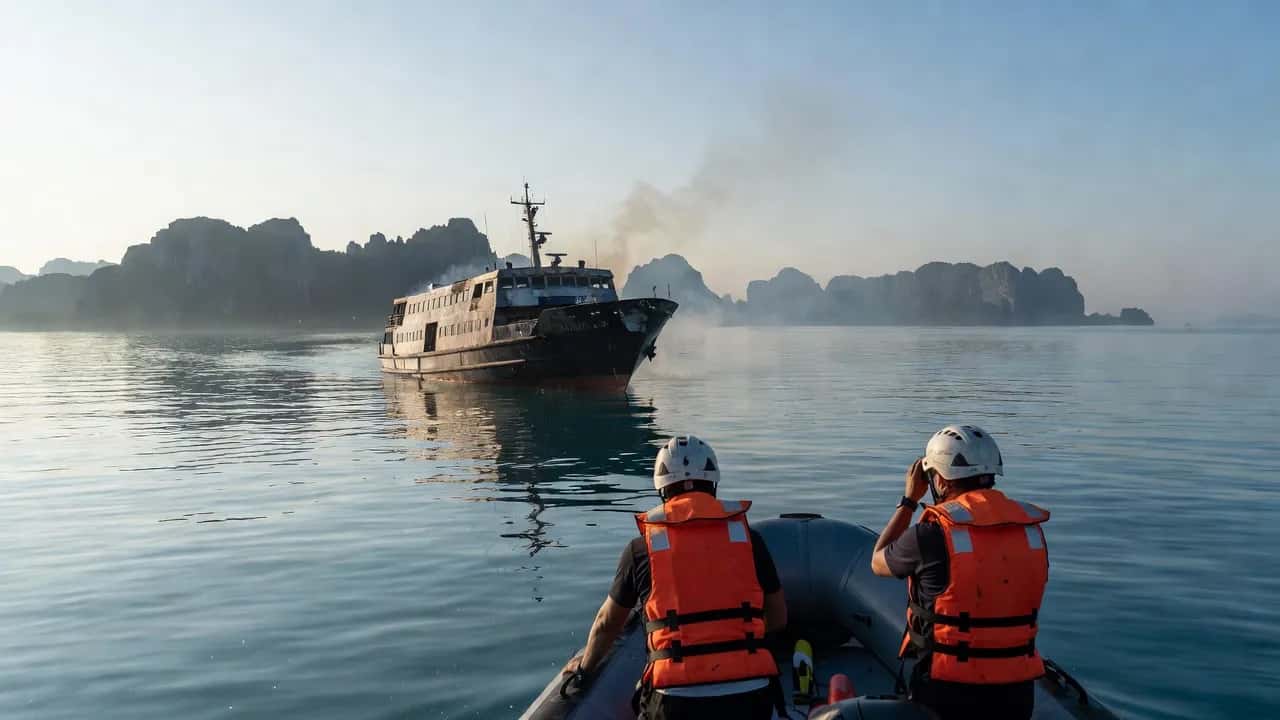
Fire on the ferry MV June Aster in the Philippines: death toll rises to 35, dozens missing
published on
countries
sources
articles
More divergent than 44% of recent comparable stories (reference: 99 recent stories measured with the same method).
The Philippine ferry MV June Aster, which departed from the port of Baseco in Manila on Tuesday, September 8, 2026, bound for Coron in the province of Palawan, caught fire on the evening of Wednesday, September 9, 2026, after a reported explosion in the hold. According to the manifest, 134 people were on board, including 117 passengers and 17 crew members. Rescue teams were only able to board the ship on Friday, September 11, 2026, nearly 40 hours after the fire started, where they found charred bodies. As of the latest update released by the Philippine Coast Guard on Saturday, September 12, 2026, 35 bodies have been recovered, 43 people have survived, and 54 remain missing.
The cause of the fire remains undetermined and the investigation has not begun, pending the captain's interrogation.
Roel Sarmiento, deemed responsible by the coast guard, remains unaccounted for and has not been questioned.
Built in 2002, it held valid safety certificates and had been inspected in March.
The coast guards say they want to first complete the recovery of the bodies before the investigation.
Its authorized capacity was 306 passengers and 27 crew members, much higher than the actual number on board.
Key figures
- 134People listed on the manifest, 117 passengers and 17 crew members
7 sources
Basis of comparison: Total number of people registered on the manifest of the MV June Aster (passengers and crew), as reported by the Philippine coast guard.
The seven perspectives cite the same figure of 134 people registered on the manifest (117 passengers, 17 crew members): this fact is consensus within the corpus.
Where this figure comes from
… and give her a proper burial. But now we can't recognise or hug her." According to the ferry's manifest, 134 people were on board, 117 of them passengers and 17 crew. The 53m …
Source: PerthNow Exact passage from the article, in its original language, where this number was found during the pre-publication check.
- 35Confirmed deaths according to the latest coast guard update
6 sources
Basis of comparison: Number of confirmed deaths reported by the Philippine coast guard in the latest known update from the corpus, Saturday, September 12, 2026, for the fire on the MV June Aster ferry in Coron.
Six of the seven perspectives converge on a toll of 35 dead; the Canadian coverage, prior to this toll, only reports a provisional figure of five dead and is therefore not comparable for this period.
- 54People still missing
6 sources · figures differ
Basis of comparison: Number of people still missing in the latest known balance of the corpus for the fire on the MV June Aster, out of 134 people registered on the manifest.
Five of the seven perspectives converge on a figure of 54 missing, the United Kingdom retaining an approximate formulation ("more than 50"); Canada, whose corpus is prior to the final tally, reports a distinct provisional figure ("more than 85") that is not comparable for this period.
From 50 (United Kingdom) to 54 (United States). 1 country gives none. · see the detail
What the comparison reveals
Common ground and differences in coverage across the media analysed.
What the media report in common
According to the manifesto, 134 people were on board the MV June Aster (117 passengers, 17 crew members), for a much higher authorized capacity.
The latest known tally from the Philippine coast guard reports 35 dead and 43 survivors.
All perspectives cite the Philippine coast guard spokesperson, Commodore Noemie Cayabyab, as the institutional source of the figures.
Where media coverage diverges
Responsibility for the fire
The Philippine coast guard attributes responsibility to the captain and rules out overloading of the ship or a security control defect, while other perspectives limit themselves to noting that the cause of the fire remains undetermined or raise questions about the manifest and the loading of the cargo.
Coverage aligned with this reading
Coverage that diverges
Human vs institutional framing
The coverage oscillates between a narrative centered on the testimonies of survivors and families of missing people and a narrative organized around the official statements of the coast guard on rescue operations and responsibilities.
Coverage aligned with this reading
Coverage that diverges
This grouping describes the publications analysed, not the position of these countries’ populations or of their governments.
How each country frames the event
- humanitarian
- AustraliaUnited StatesCanadaNepalUnited Kingdom
- health and environment
- Bangladesh
- legal
- Philippines
3 different framings across 7 countries · 5 of 7 countries share the same framing
Pair by pair: same frame or different frames
Each square pairs two countries. Filled: both countries' coverage uses the same frame. Empty: their frames differ. The map describes framings without evaluating them.
Pairs with the same frame: 10 of 21
- same frame
- different frames
Blind spots
What the coverage of each country leaves aside, while others put it forward.
 Canada
- captain's responsibility
- ship's compliance with safety controls
- cause of the fire
 United States
- ship's safety inspection history
- official attribution of responsibility to the captain
 Philippines
- detailed survivor testimonies
- families' frustration with lack of information
Geopolitical context
The MV June Aster fire is part of a series of recurring maritime accidents in Southeast Asia, where inter-island connections rely on a fleet of old ferries subject to unequal safety checks, an issue that the Bangladeshi press explicitly links to its own history of ferry fires. International coverage, relayed by AP, Reuters, and AFP agencies, converges on the human toll of the victims, while the Philippine authorities alone are conducting the investigation and assigning responsibilities. The interest of Australian, Canadian, British, and American media also lies in verifying the presence of foreign nationals on board and the tourist popularity of Coron and Palawan among Western travelers.
Understand the context
- SEP 8, 2026The MV June Aster sets sail from the port of Baseco in Manila to Coron
- SEP 9, 2026A fire breaks out on board after a reported explosion in the hold
- SEP 11, 2026Rescue teams board the hull, about 40 hours after the fire started
- SEP 12, 2026The official toll stands at 35 dead, 43 rescued, and 54 missing
How each country reads it
Preview: 3 of 7 media perspectives. Syntheses of the media analysed — not direct quotations. Method & limitations
 Australia
 takes away from the sinking of the MV June Aster a human drama above all: survivors left shaken, families waiting in Turda, and the proximity to a highly popular destination for Australian travelers, Coron, in the Philippines.
2 sources · View sources
- United States
The United States is first focusing on the human face of the MV June Aster sinking, through the voices of survivors and families rather than questions of responsibility.
3 sources · View sources
 Bangladesh
Dhaka gauges the fiery sinking of the MV June Aster against its own history of ferry fires, where the same causes relentlessly recur.
2 sources · View sources
The full text, country by country
Australia
DOMINANT ANGLE
Australia takes away from the sinking of the MV June Aster a human drama above all: survivors left shaken, families waiting in Turda, and the proximity to a highly popular destination for Australian travelers, Coron, in the Philippines.
ANALYSIS
Canberra, September 12, 2026.
United States
DOMINANT ANGLE
The United States is first focusing on the human face of the MV June Aster sinking, through the voices of survivors and families rather than questions of responsibility.
ANALYSIS
Washington, September 12, 2026.
Bangladesh
DOMINANT ANGLE
Dhaka gauges the fiery sinking of the MV June Aster against its own history of ferry fires, where the same causes relentlessly recur.
ANALYSIS
Dacca, Saturday, September 12, 2026.
Canada
DOMINANT ANGLE
Canada is first mindful of the uncertainty surrounding the missing persons and the verification, still ongoing at the time of the initial reports, of the presence of foreign nationals on board the ferry.
ANALYSIS
Ottawa, Saturday, September 12, 2026.
 Nepal
DOMINANT ANGLE
Kathmandu is primarily focused on the human toll of the MV June Aster tragedy in Coron — the dead, survivors, and missing — rather than the responsibilities that still need to be determined for the captain or the owner.
ANALYSIS
Katmandou, 12 September 2026.
Philippines
DOMINANT ANGLE
Manila points to the responsibility of the captain of the MV June Aster, while ruling out that of the shipowner and the ferry's safety standards
ANALYSIS
Manille, September 12, 2026.
 United Kingdom
DOMINANT ANGLE
London is first focusing on the accounts of the survivors of the MV June Aster, before the casualty numbers and the ferry's technical shortcomings.
ANALYSIS
London, 12 September 2026.
Explore every perspective on this subject across 7 countries.
Compare viewpoints and see where they diverge.