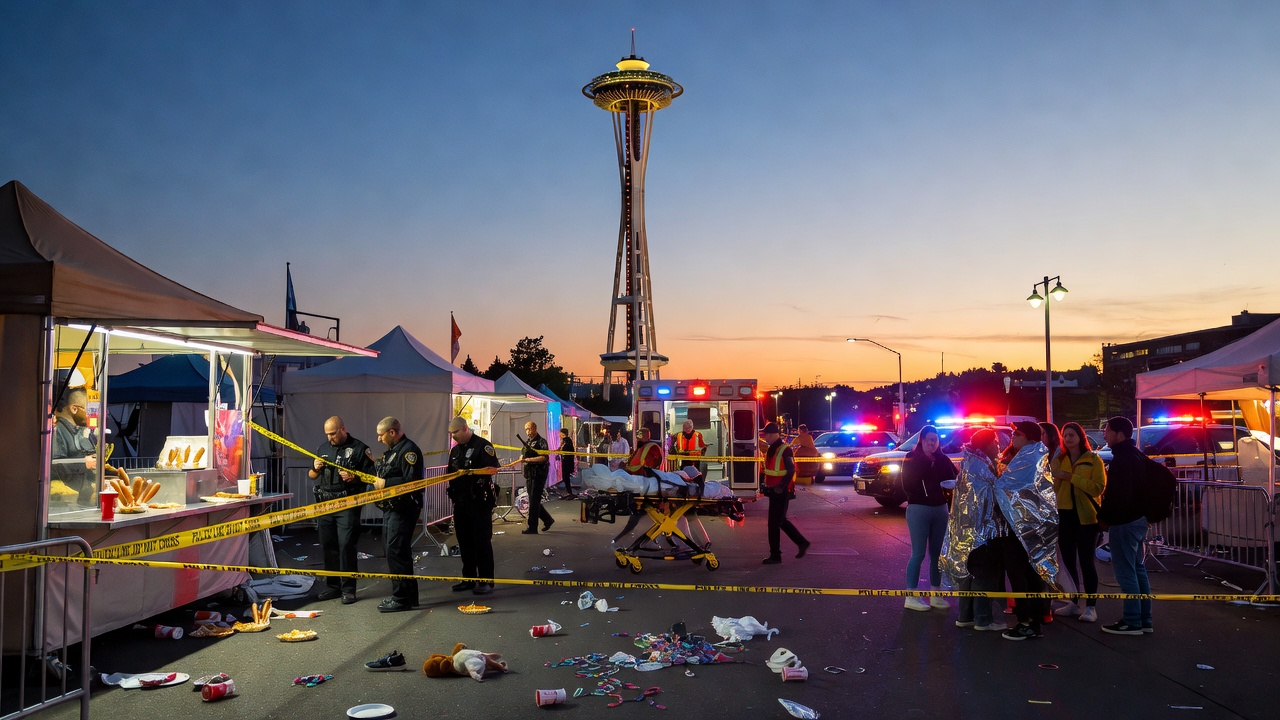
SHOOTING NEAR SEATTLE'S SPACE NEEDLE KILLS TWO AT FOOD FESTIVAL
July 27, 2026·9 COUNTRIES
9countries·20sources·20articles
Asia (4)
Americas (2)
Oceania (1)
Europe (1)
Other (1)
Asia
Americas
Oceania
Europe
Other
EXPLORE THIS STORY
SHARE THIS COMPARISON
Show your friends how the world sees the same news differently.
A shooting erupted on 26 July 2026 near Seattle's Space Needle, on the sidelines of the Bite of Seattle festival, killing two people and wounding five, including a two-year-old child. A suspect was arrested and SWAT units deployed. The attack revives the recurring US debate over firearms and the security of large public gatherings.
FRAMING GAP
4/100LOW
Coverages are relatively similar
Here are the main framing differences identified between media coverages.
ANALYSIS BY COUNTRY
 AUSTRALIA
DOMINANT ANGLE
Australia observes, from Canberra, the persistent gap between its own firearms regulatory framework and the recurring exposure of major American public gatherings to armed violence.
Dominant angle identified — does not reflect unanimity of this country’s media
KEY POINTS
- •Two dead and five wounded, including a two-year-old child, in the shooting near Seattle's Space Needle at the Bite of Seattle food festival
- •Seattle Mayor Katie Wilson announced the arrest of a suspect and described the attack as 'an act of horrific violence'
- •Washington State Governor Bob Ferguson deployed State Police SWAT units to reinforce local forces responding to the incident
BIASES
Event-focused framing centered on casualty figures and official statements, rather than placing the incident in context with Australian firearms policy debateReliance on institutional sources (mayor, governor, hospital) rather than direct witness testimony from persons present at the festivalLimited coverage of the attacker's motive and suspect identity, due to absence of confirmed information available at time of reporting
 BANGLADESH
DOMINANT ANGLE
Dhaka frames the Seattle shooting as another chapter in America's gun violence, reproduced through international wire services without local editorial context or independent analysis.
Dominant angle identified — does not reflect unanimity of this country’s media
KEY POINTS
- •Two people killed and five wounded, including a two-year-old child, in Sunday's shooting near Seattle's Space Needle during the Bite of Seattle food festival.
- •Seattle Mayor Katie Wilson announced that one suspect had been arrested, after initially stating that two suspects had been detained.
- •Harborview Medical Center's trauma unit admitted four patients, including a 23-year-old man and a 39-year-old woman, according to spokesperson Susan Gregg.
BIASES
Wire-service framing: Bangladesh outlets reproduce American news sources (NBC, CNN, Seattle Times) without original domestic reporting or alternative sourcing.Preference for immediate reporting: factual casualty figures and official statements prioritized over substantive discussion of American firearm policy.Limited political context: minimal reference to US gun legislation, historical precedent, or policy debate surrounding public safety and firearm regulation.
 FRANCE
DOMINANT ANGLE
Paris gauges, through initial reports from Seattle police and firefighters, the scale of another mass shooting occurring at a public gathering in America.
Dominant angle identified — does not reflect unanimity of this country’s media
KEY POINTS
- •Toll communicated by Seattle firefighters, cited by CNN: two dead and five hospitalized wounded, according to BFMTV
- •The youngest wounded victim is two years old and was transported to the hospital
- •20 Minutes reports a slightly different toll (four wounded including a child), indicating information still evolving
BIASES
Security-centered framing: emphasis placed on human toll and police lockdown, with limited detail on the shooter profile, still unknownPreference for American sources (police, firefighters, CNN) relayed as-is, lacking French reporters on siteLimited coverage of the local food festival context and judicial follow-up to the investigation, not yet documented
 MALAYSIA
DOMINANT ANGLE
Malaysia reads the human toll of another American mass shooting, reported with factual sobriety close to raw wire copy.
Dominant angle identified — does not reflect unanimity of this country’s media
KEY POINTS
- •Two killed and at least four wounded, including a child, near the Space Needle during the « Bite of Seattle » festival (The Sun, Malay Mail).
- •Seattle Mayor Katie Wilson announced that a suspect had been arrested, after initially citing two arrests.
- •Harborview Medical Center spokeswoman Susan Gregg stated that police did not rule out the presence of multiple shooters.
BIASES
Wire-centric framing: both outlets republished nearly verbatim the same agency dispatch, with minimal editorial analysis.Preference for immediate factual accounting: human toll and chronology of events, without commentary on the American firearms debate.Limited coverage of local political context: no Malaysian official reaction or regional perspective reported.
 MEXICO
DOMINANT ANGLE
Mexico City contextualizes the Seattle shooting within the stark statistic of 268 mass killings recorded across the United States since January, avoiding sensationalism.
Dominant angle identified — does not reflect unanimity of this country’s media
KEY POINTS
- •Confirmed death toll from firefighters: two dead and five wounded at the Bite of Seattle festival, Sunday around 6 p.m. Pacific time
- •Harborview Medical Center admitted four victims, including a child and a 23-year-old man; a fifth victim, a 40-year-old woman, suffered minor injuries (spokesperson Susan Gregg)
- •According to the Gun Violence Archive cited by El Informador, the United States had already recorded 268 mass shootings in 2026 before the Seattle incident
BIASES
Statistics-centered framing: the shooting is systematically placed within the national count of mass killings rather than treated as an isolated incidentPreference for official hospital and police sources at the expense of investigation into the profile of the suspect or suspectsLimited coverage of the American political debate on gun control, mentioned only through the Gun Violence Archive statistic
 PAKISTAN
DOMINANT ANGLE
Islamabad frames the Seattle shooting through US media wire dispatches picked up by local outlets, emphasizing the casualty toll and persistent uncertainty over the number of gunmen.
Dominant angle identified — does not reflect unanimity of this country’s media
KEY POINTS
- •Emergency services report death toll of two confirmed dead with four to five wounded, including a two-year-old child (Dawn, Geo News).
- •Seattle Mayor Katie Wilson announced one arrest following initial references to two detentions.
- •Harborview Medical Center spokeswoman Susan Gregg states police have not ruled out multiple shooters.
BIASES
US source framing: Pakistani coverage relies exclusively on wire dispatches from NBC News, CNN, and Seattle Times republished by Dawn and Geo News.Emphasis on immediate casualty accounting: focus rests on victims and hospital status rather than the wider US firearms debate context.Limited reporting on shooter motive and suspect profile: no details on attack motivations are developed at this stage.
 SINGAPORE
DOMINANT ANGLE
Singapore emphasizes the human toll and rapid suspect apprehension, rather than the political debate that typically accompanies mass shootings in the United States
Dominant angle identified — does not reflect unanimity of this country’s media
KEY POINTS
- •Two dead and five wounded, including a two-year-old child, in the July 26 shooting at the Bite of Seattle festival
- •A suspect was apprehended, according to Seattle Mayor Katie Wilson's office
- •Witness Estan Wakonabo described hearing gunfire—'pop, pop, pop'—amid a sudden crowd surge at the festival
BIASES
Event-centric framing: coverage prioritizes casualty counts and suspect arrest details, while omitting broader political contextOfficial source preference: reliance on police, municipal, and hospital statements through wire services, limiting localized investigative depthLimited engagement with the recurring U.S. firearms regulation debate, despite its implicit relevance to mass shooting incidents
 UNITED KINGDOM
DOMINANT ANGLE
London views the Seattle shooting as fresh evidence of endemic gun violence in the United States, implicitly set against Britain's stricter firearm regulations
Dominant angle identified — does not reflect unanimity of this country’s media
KEY POINTS
- •Updated death toll stands at two dead and five wounded, including a two-year-old boy, after an initial incorrect report of three deaths (Daily Mail).
- •Two firearms recovered at the scene; police suggested a possible exchange of gunfire between two suspects, one arrested and one actively searched for (Daily Mail).
- •Witnesses cited by The Independent: Estan Wakonabo, 25, described pure chaos; Paul Skinner, 47, said he first mistook gunshots for fireworks before rapid evacuation.
BIASES
News-event framing: coverage centers on witness testimony and casualty counts, with limited broader British political perspective or domestic gun-control debate.Reliance on Seattle police and medical sources, reproduced as reported without independent British verification or investigative follow-up.Limited examination of the broader US gun-policy landscape; the implicit contrast with Britain's stricter firearms law remains sketched rather than substantively developed.
 UNITED STATES
DOMINANT ANGLE
Washington views another mass shooting at a Seattle food festival as reopening the longstanding debate over firearm access and the safety of crowded public gatherings in American cities.
Dominant angle identified — does not reflect unanimity of this country’s media
KEY POINTS
- •Two people killed and five wounded, including a two-year-old hospitalized in stable condition, in the shooting at the Bite of Seattle food festival Sunday around 6 p.m.
- •Seattle Mayor Katie Wilson called the attack a 'horrific act of violence' and confirmed the arrest of a suspect.
- •Seattle police urged the public via X to avoid the Seattle Center area during the response and lockdown.
BIASES
Framing centered on local authorities: extensive coverage of Seattle Mayor Katie Wilson and police statements, limited information on the suspect's identity or motives.Emphasis on eyewitness and victim accounts (Kayla Carris, Todd Behrends) over statistical context on firearms violence across the United States.Minimal coverage of the national political debate on gun control, despite recurring mass shootings in American news cycles.
AUSTRALIADOMINANT ANGLE
Australia observes, from Canberra, the persistent gap between its own firearms regulatory framework and the recurring exposure of major American public gatherings to armed violence.
Dominant angle identified — does not reflect unanimity of this country’s media
KEY POINTS
- •Two dead and five wounded, including a two-year-old child, in the shooting near Seattle's Space Needle at the Bite of Seattle food festival
- •Seattle Mayor Katie Wilson announced the arrest of a suspect and described the attack as 'an act of horrific violence'
- •Washington State Governor Bob Ferguson deployed State Police SWAT units to reinforce local forces responding to the incident
BIASES
Event-focused framing centered on casualty figures and official statements, rather than placing the incident in context with Australian firearms policy debateReliance on institutional sources (mayor, governor, hospital) rather than direct witness testimony from persons present at the festivalLimited coverage of the attacker's motive and suspect identity, due to absence of confirmed information available at time of reporting
BANGLADESHDOMINANT ANGLE
Dhaka frames the Seattle shooting as another chapter in America's gun violence, reproduced through international wire services without local editorial context or independent analysis.
Dominant angle identified — does not reflect unanimity of this country’s media
KEY POINTS
- •Two people killed and five wounded, including a two-year-old child, in Sunday's shooting near Seattle's Space Needle during the Bite of Seattle food festival.
- •Seattle Mayor Katie Wilson announced that one suspect had been arrested, after initially stating that two suspects had been detained.
- •Harborview Medical Center's trauma unit admitted four patients, including a 23-year-old man and a 39-year-old woman, according to spokesperson Susan Gregg.
BIASES
Wire-service framing: Bangladesh outlets reproduce American news sources (NBC, CNN, Seattle Times) without original domestic reporting or alternative sourcing.Preference for immediate reporting: factual casualty figures and official statements prioritized over substantive discussion of American firearm policy.Limited political context: minimal reference to US gun legislation, historical precedent, or policy debate surrounding public safety and firearm regulation.
FRANCEDOMINANT ANGLE
Paris gauges, through initial reports from Seattle police and firefighters, the scale of another mass shooting occurring at a public gathering in America.
Dominant angle identified — does not reflect unanimity of this country’s media
KEY POINTS
- •Toll communicated by Seattle firefighters, cited by CNN: two dead and five hospitalized wounded, according to BFMTV
- •The youngest wounded victim is two years old and was transported to the hospital
- •20 Minutes reports a slightly different toll (four wounded including a child), indicating information still evolving
BIASES
Security-centered framing: emphasis placed on human toll and police lockdown, with limited detail on the shooter profile, still unknownPreference for American sources (police, firefighters, CNN) relayed as-is, lacking French reporters on siteLimited coverage of the local food festival context and judicial follow-up to the investigation, not yet documented
MALAYSIADOMINANT ANGLE
Malaysia reads the human toll of another American mass shooting, reported with factual sobriety close to raw wire copy.
Dominant angle identified — does not reflect unanimity of this country’s media
KEY POINTS
- •Two killed and at least four wounded, including a child, near the Space Needle during the « Bite of Seattle » festival (The Sun, Malay Mail).
- •Seattle Mayor Katie Wilson announced that a suspect had been arrested, after initially citing two arrests.
- •Harborview Medical Center spokeswoman Susan Gregg stated that police did not rule out the presence of multiple shooters.
BIASES
Wire-centric framing: both outlets republished nearly verbatim the same agency dispatch, with minimal editorial analysis.Preference for immediate factual accounting: human toll and chronology of events, without commentary on the American firearms debate.Limited coverage of local political context: no Malaysian official reaction or regional perspective reported.
MEXICODOMINANT ANGLE
Mexico City contextualizes the Seattle shooting within the stark statistic of 268 mass killings recorded across the United States since January, avoiding sensationalism.
Dominant angle identified — does not reflect unanimity of this country’s media
KEY POINTS
- •Confirmed death toll from firefighters: two dead and five wounded at the Bite of Seattle festival, Sunday around 6 p.m. Pacific time
- •Harborview Medical Center admitted four victims, including a child and a 23-year-old man; a fifth victim, a 40-year-old woman, suffered minor injuries (spokesperson Susan Gregg)
- •According to the Gun Violence Archive cited by El Informador, the United States had already recorded 268 mass shootings in 2026 before the Seattle incident
BIASES
Statistics-centered framing: the shooting is systematically placed within the national count of mass killings rather than treated as an isolated incidentPreference for official hospital and police sources at the expense of investigation into the profile of the suspect or suspectsLimited coverage of the American political debate on gun control, mentioned only through the Gun Violence Archive statistic
PAKISTANDOMINANT ANGLE
Islamabad frames the Seattle shooting through US media wire dispatches picked up by local outlets, emphasizing the casualty toll and persistent uncertainty over the number of gunmen.
Dominant angle identified — does not reflect unanimity of this country’s media
KEY POINTS
- •Emergency services report death toll of two confirmed dead with four to five wounded, including a two-year-old child (Dawn, Geo News).
- •Seattle Mayor Katie Wilson announced one arrest following initial references to two detentions.
- •Harborview Medical Center spokeswoman Susan Gregg states police have not ruled out multiple shooters.
BIASES
US source framing: Pakistani coverage relies exclusively on wire dispatches from NBC News, CNN, and Seattle Times republished by Dawn and Geo News.Emphasis on immediate casualty accounting: focus rests on victims and hospital status rather than the wider US firearms debate context.Limited reporting on shooter motive and suspect profile: no details on attack motivations are developed at this stage.
SINGAPOREDOMINANT ANGLE
Singapore emphasizes the human toll and rapid suspect apprehension, rather than the political debate that typically accompanies mass shootings in the United States
Dominant angle identified — does not reflect unanimity of this country’s media
KEY POINTS
- •Two dead and five wounded, including a two-year-old child, in the July 26 shooting at the Bite of Seattle festival
- •A suspect was apprehended, according to Seattle Mayor Katie Wilson's office
- •Witness Estan Wakonabo described hearing gunfire—'pop, pop, pop'—amid a sudden crowd surge at the festival
BIASES
Event-centric framing: coverage prioritizes casualty counts and suspect arrest details, while omitting broader political contextOfficial source preference: reliance on police, municipal, and hospital statements through wire services, limiting localized investigative depthLimited engagement with the recurring U.S. firearms regulation debate, despite its implicit relevance to mass shooting incidents
UNITED KINGDOMDOMINANT ANGLE
London views the Seattle shooting as fresh evidence of endemic gun violence in the United States, implicitly set against Britain's stricter firearm regulations
Dominant angle identified — does not reflect unanimity of this country’s media
KEY POINTS
- •Updated death toll stands at two dead and five wounded, including a two-year-old boy, after an initial incorrect report of three deaths (Daily Mail).
- •Two firearms recovered at the scene; police suggested a possible exchange of gunfire between two suspects, one arrested and one actively searched for (Daily Mail).
- •Witnesses cited by The Independent: Estan Wakonabo, 25, described pure chaos; Paul Skinner, 47, said he first mistook gunshots for fireworks before rapid evacuation.
BIASES
News-event framing: coverage centers on witness testimony and casualty counts, with limited broader British political perspective or domestic gun-control debate.Reliance on Seattle police and medical sources, reproduced as reported without independent British verification or investigative follow-up.Limited examination of the broader US gun-policy landscape; the implicit contrast with Britain's stricter firearms law remains sketched rather than substantively developed.
UNITED STATESDOMINANT ANGLE
Washington views another mass shooting at a Seattle food festival as reopening the longstanding debate over firearm access and the safety of crowded public gatherings in American cities.
Dominant angle identified — does not reflect unanimity of this country’s media
KEY POINTS
- •Two people killed and five wounded, including a two-year-old hospitalized in stable condition, in the shooting at the Bite of Seattle food festival Sunday around 6 p.m.
- •Seattle Mayor Katie Wilson called the attack a 'horrific act of violence' and confirmed the arrest of a suspect.
- •Seattle police urged the public via X to avoid the Seattle Center area during the response and lockdown.
BIASES
Framing centered on local authorities: extensive coverage of Seattle Mayor Katie Wilson and police statements, limited information on the suspect's identity or motives.Emphasis on eyewitness and victim accounts (Kayla Carris, Todd Behrends) over statistical context on firearms violence across the United States.Minimal coverage of the national political debate on gun control, despite recurring mass shootings in American news cycles.
CROSS-PERSPECTIVE ANALYSIS
CROSS-ANALYSIS
CONSENSUS POINTS
- 1A shooting left two dead and five wounded, including a two-year-old child, on Sunday near Seattle's Space Needle on the sidelines of the Bite of Seattle food festival
- 2Seattle Mayor Katie Wilson announced the arrest of a suspect and described the attack as a 'horrific act of violence'
- 3Harborview Medical Center treated multiple victims, including a child, according to hospital spokesperson Susan Gregg
- 4The investigation into the motive for the attack was still ongoing at the time of publication, with no confirmed profile of the suspect or suspects
FRAMING DIFFERENCES
Number of shooters
While several countries relay the version of a single suspect arrested, British, Malaysian and Pakistani press mention the possibility of a shootout between two suspects, one arrested and the other actively being sought.
Frame this way
Frame the opposite
Casualty figures
The number of wounded varied across outlets and publication times, with an initially incorrect announcement of three deaths in the United Kingdom and a count of four wounded (instead of five) reported by part of the French press, a sign of still-evolving information.
Frame this way
Frame the opposite
Debate over firearms
Mexico and the United States explicitly place the event within the structural debate over gun control and national mass shooting statistics, while several other countries remain strictly factual without developing this dimension.
Frame this way
Frame the opposite
GEOPOLITICAL CLUSTERS
Factual relay without editorial framing
Shared narrative
These countries report the casualty toll and official statements via wire services and American media, without developing their own editorial analysis or political framing.
Implicit contrast with national firearms legislation
Shared narrative
Australian and British press report the facts while allowing an implicit, though not fully developed, contrast with national legal frameworks that are more restrictive on firearms.
Statistical framing
Shared narrative
Mexican press situates the shooting within the national tally of mass killings in the United States, drawing on Gun Violence Archive data.
Domestic debate reignited
Shared narrative
American press treats the event as a new episode reigniting the national debate over gun control and the safety of large public gatherings.
OMISSIONS ANALYSIS
BangladeshOmitted topics
debate over gun controlmotive for the attackprofile of the suspect or suspects
Highlighted by
PakistanOmitted topics
American debate over gun controlmotive for the attack
Highlighted by
SingaporeOmitted topics
recurring debate over gun controlnational statistical context
Highlighted by
GEOPOLITICAL CONTEXT
This shooting near an iconic Seattle tourist site is part of a long series of armed incidents at American public gatherings, a phenomenon regularly documented by organizations like the Gun Violence Archive. International coverage remains largely dependent on wire services and American media, with most outlets limiting themselves to relaying the casualty toll and statements from local authorities without developing political analysis. Only Mexico, citing national statistical data, and the United States, where the event reignites domestic debate over gun control, explicitly situate the incident within a broader framework. Persistent uncertainty about the number of shooters and the motive for the attack illustrates the difficulty news organizations face in covering an event still under investigation at the time of publication.
AI-powered analysis