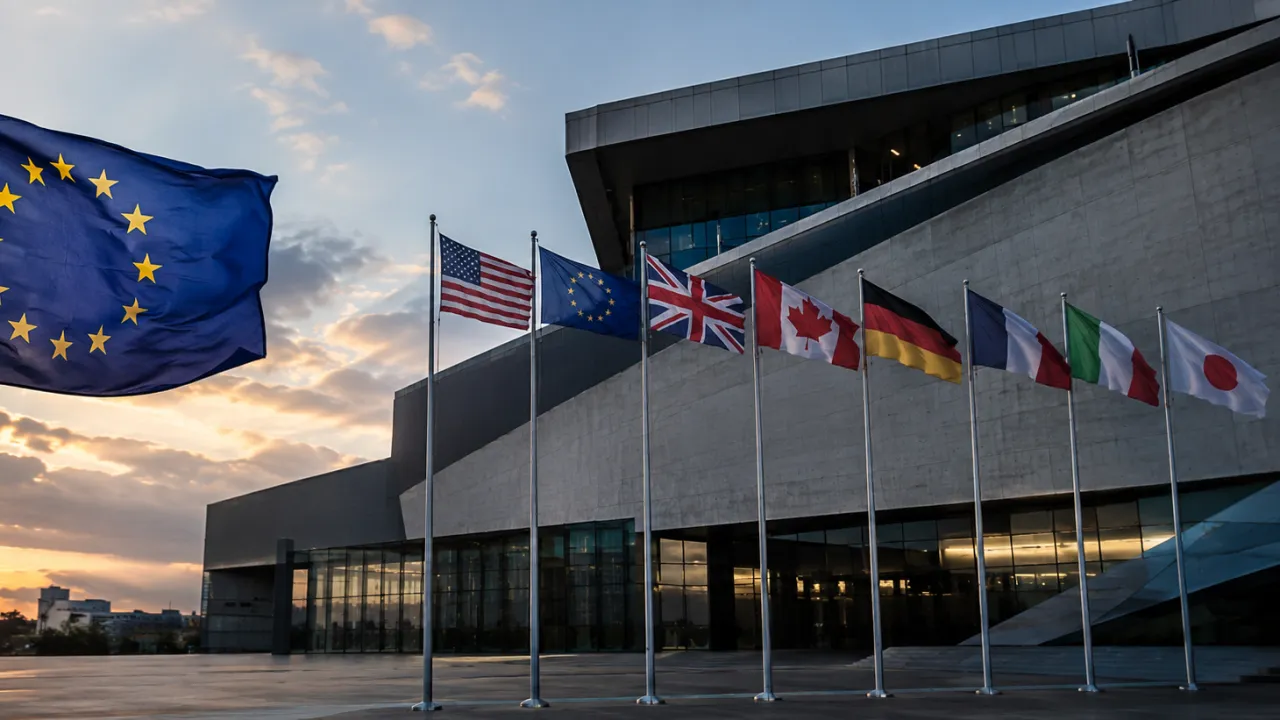
G7 Paris under pressure: Europe pushes back against Trump's car tariffs
published on
countries
sources
articles
Measured with the previous method (distance between texts), on a different scale.
The G7 trade ministers met in Paris on 5 and 6 May 2026 in an effort to coordinate their positions, notably on access to critical minerals. The meeting ended without an agreement capable of healing the trade rift between the United States and the European Union, even as the seven partners sought to present a united front.
At the center of the tensions is the threat, renewed by the US administration, to raise tariffs on cars imported from Europe to 25%. Brussels points to an agreement already reached and argues that its terms must be honored, while Washington suggests it can still alter those conditions.
In parallel, official sources indicated that the United States and India were very close to signing a bilateral trade deal. This rapprochement fuels questions about the approach favored by Washington, with some seeing it as a sign of a preference for country-to-country negotiations over multilateral frameworks such as the G7.
Several points remain disputed among the actors. The real scope of the existing transatlantic agreement is debated, as is the extent of the impact of the car tariffs: some consider them deeply consequential for European markets, others present them as temporary and negotiable. The very strategy of how to respond, between firmness and the pursuit of compromise, has not been settled.
What the comparison reveals
Common ground and differences in coverage across the media analysed.
What the media report in common
G7 trade ministers met in Paris on May 5-6, 2026
Trump renewed his threat to raise tariffs on European cars to 25%
The G7 found common ground on critical minerals but not on the US-EU tariff rift
How each country reads it
Preview: 3 of 7 media perspectives. Syntheses of the media analysed — not direct quotations. Method & limitations
 France
Paris hosts the G7 trade summit and cannot hide the transatlantic crack
1 source · View sources
 Canada
Ottawa wields the contract: 'a deal is a deal', and the United States has no right to exit it unilaterally
1 source · View sources
 Germany
Berlin bets on industrial resilience: BMW and Germany's carmakers will outlast Trump's tariffs
1 source · View sources
The full text, country by country
France
DOMINANT ANGLE
Paris hosts the G7 trade summit and cannot hide the transatlantic crack
ANALYSIS
Paris hosted G7 trade ministers on May 5-6 against a backdrop where the question of American tariffs on European cars loomed over every conversation without ever being addressed directly in formal sessions.
Canada
DOMINANT ANGLE
Ottawa wields the contract: 'a deal is a deal', and the United States has no right to exit it unilaterally
ANALYSIS
Ottawa drew a clear red line on respecting existing trade commitments.
Germany
DOMINANT ANGLE
Berlin bets on industrial resilience: BMW and Germany's carmakers will outlast Trump's tariffs
ANALYSIS
Berlin watches Trump's tariffs on European cars through the eyes of the world's leading car manufacturer.
 United States
DOMINANT ANGLE
Washington runs a two-speed G7: the EU pays tariffs, India signs a deal
ANALYSIS
Washington sent a clear signal through US Trade Representative Greer: the EU must comply with the existing trade deal and Trump's China agenda — a signal that Washington uses the European tariff question as leverage in a multi-board game.
 India
India
DOMINANT ANGLE
New Delhi accelerates its bilateral deal with Washington while Europe resists
ANALYSIS
New Delhi is in an exceptionally favourable position: while Europe resists Trump's tariffs and accumulates diplomatic tensions, India is close to signing a trade deal with Washington described as 'very close' by US Deputy Secretary of State Christopher Landau.
 Qatar
Qatar
DOMINANT ANGLE
Doha measures the shockwave: European luxury car tariffs hit Gulf buyers first
ANALYSIS
Doha reads Trump's tariffs on European cars through the lens of a consumer market that imports massively from German, Italian and French luxury brands.
 Singapore
DOMINANT ANGLE
Singapore warns: the US-EU tariff rift is weakening G7 unity at the worst moment for critical minerals
ANALYSIS
Singapore's Straits Times covered the G7 trade summit through the lens of strategic coherence: how can G7 countries coordinate a critical minerals policy to reduce Chinese dependence if, simultaneously, Washington is imposing punitive tariffs on its own European allies?
Explore every perspective on this subject across 7 countries.
Compare viewpoints and see where they diverge.