Common ground and differences in coverage across the media analysed.
A second Spanish passenger on the MV Hondius tested positive for hantavirus while in quarantine at Hospital Gómez Ulla in Madrid.
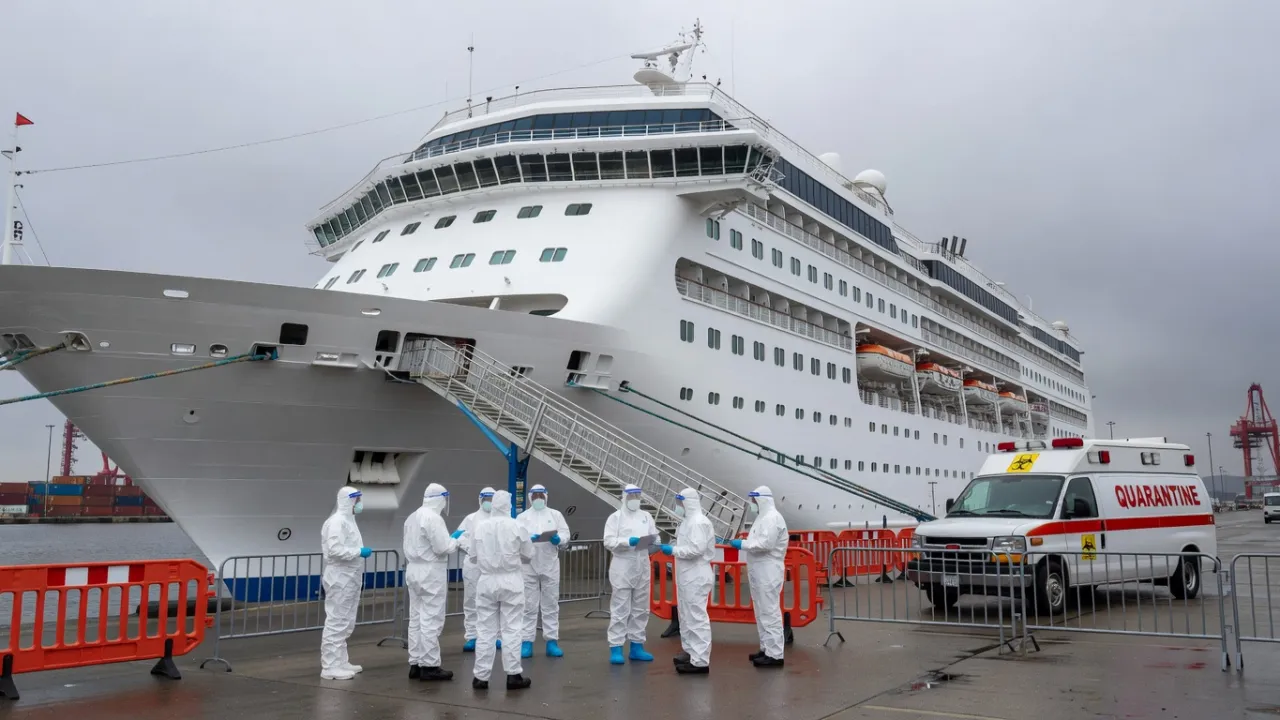
The MV Hondius was carrying approximately 150 passengers and crew members from 23 nationalities at the time of the initial report to the WHO.
Three passengers died during the voyage, with at least two cases confirmed as hantavirus by the WHO.
Singapore adopts an alarmist framing centered on the absence of a vaccine and treatment for hantavirus and the risks to global maritime hubs, while other countries relay a message of institutional control.
Coverage aligned with this reading
Preview: 3 of 6 media perspectives. Syntheses of the media analysed — not direct quotations.
Madrid tracks the hantavirus outbreak linked to the MV Hondius with precision: a second Spanish passenger tested positive during periodic quarantine monitoring, but the containment system is holding.
2 sources ·
Paris closely monitors the progression of cases linked to the MV Hondius, carefully measuring what each new confirmed case reveals about the international health response to a crisis born at sea.
3 sources ·
Athens observes international health management of the MV Hondius crisis: a second confirmed hantavirus case among Spanish passengers in quarantine is insufficient to justify widespread alarm, according to Greek authorities, but raises questions about disease traceability aboard luxury cruise vessels.
2 sources ·

Coverage that diverges
The Philippines treats the crisis as a consular emergency related to the protection of their expatriate sailors (OFW), whereas other countries cover the event from an epidemiological or international public health angle.
France explicitly raises the question of transmission between humans in a confined space such as a ship, and notes the absence of communication about the detected variant; other perspectives do not address this point substantively.
This grouping describes the publications analysed, not the position of these countries’ populations or of their governments.
What the coverage of each country leaves aside, while others put it forward.
Spain
Philippines
Greece
published on
countries
sources
articles
gap
A second Spanish passenger from the expedition ship MV Hondius has tested positive for hantavirus while already in quarantine at the Gómez Ulla Hospital in Madrid. At the time of the initial report to the World Health Organization, the vessel was carrying roughly 150 passengers and crew of 23 nationalities. Three people died during the voyage, including at least two hantavirus cases confirmed by the WHO.
Spanish health authorities stated that the discovery of this new case does not change the level of risk for the general population. The fact that it was detected within the isolation system already in place is presented as evidence that the quarantine protocol is working.
The episode highlights the difficulties of health governance in the face of cross-border maritime mobility: a Dutch-flagged ship, departed from Argentina, with a largely Filipino crew and passengers from many countries, evacuated to the Canary Islands and then repatriated to their respective states. This dispersal forces several jurisdictions to coordinate their responses.
Readings of the event diverge. Some actors stress that the situation is institutionally under control, others emphasize the lack of a vaccine and specific treatment and the risks to global port hubs, while others prioritize consular protection for sailors quarantined in Amsterdam. The question of possible human-to-human transmission in a confined space, the exact hantavirus variant involved and the precise circumstances of the three deaths remain poorly documented, as does the absence of any inquiry into responsibilities tied to the ship's operation.
DOMINANT ANGLE
Madrid tracks the hantavirus outbreak linked to the MV Hondius with precision: a second Spanish passenger tested positive during periodic quarantine monitoring, but the containment system is holding.
ANALYSIS
Madrid, May 27, 2026.
DOMINANT ANGLE
Paris closely monitors the progression of cases linked to the MV Hondius, carefully measuring what each new confirmed case reveals about the international health response to a crisis born at sea.
ANALYSIS
Paris, May 25, 2026.
DOMINANT ANGLE
Athens observes international health management of the MV Hondius crisis: a second confirmed hantavirus case among Spanish passengers in quarantine is insufficient to justify widespread alarm, according to Greek authorities, but raises questions about disease traceability aboard luxury cruise vessels.
ANALYSIS
Athens, May 25, 2026.
DOMINANT ANGLE
Manila assesses the scope of its responsibility toward stranded Filipino seafarers in the Netherlands, mobilizing top-tier consular diplomacy to protect its overseas workers.
ANALYSIS
Manila, May 25, 2026.
DOMINANT ANGLE
Bucharest monitors with attention the progression of the hantavirus outbreak aboard the MV Hondius, emphasizing the speed of Spain's quarantine response against a rare and potentially fatal disease.
ANALYSIS
Bucharest, May 25, 2026.
DOMINANT ANGLE
Singapore views the hantavirus outbreak aboard MV Hondius as a critical test case for cruise ship health security protocols across global maritime routes.
ANALYSIS
Singapore, May 25, 2026.
Explore every perspective on this subject across 6 countries.
Compare viewpoints and see where they diverge.
Measured with the previous method (distance between texts), on a different scale.