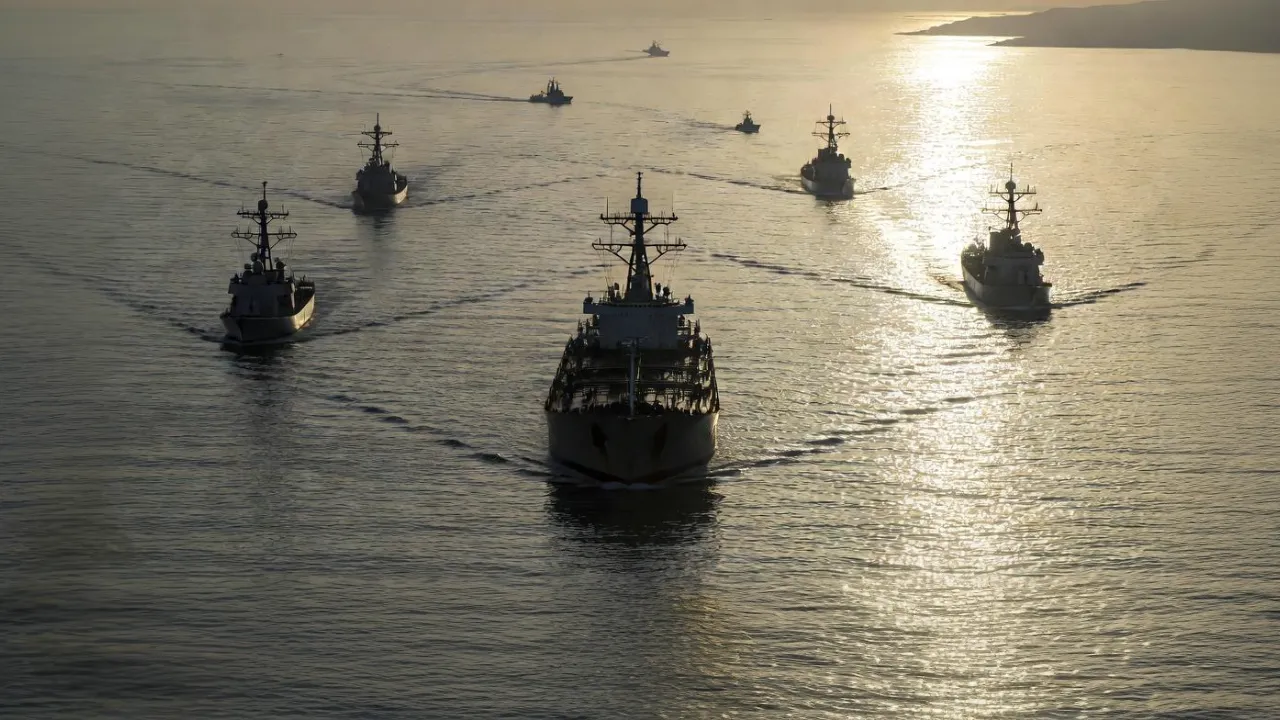
Since the war began on 28 February 2026, the Strait of Hormuz has been blocked. This maritime passage, through which roughly 20% of the world's oil and gas trade transits, has become the conflict's central pressure point. On the night of 3 to 4 May, a cargo ship was attacked by several small boats near the strait, underscoring how dangerous the area has become.
Against this backdrop, Donald Trump announced the launch, starting Monday 4 May, of operation "Project Freedom," intended to escort vessels from neutral countries — stranded for weeks — out of the Gulf. In parallel, Iran put forward a fourteen-point peace plan, conveyed to the United States through Pakistan, proposing the reopening of the strait in exchange for a halt to the strikes and a lifting of the blockade, with nuclear matters handled separately. Trump rejected the plan.
The stakes go beyond shipping alone. The strait functions as a bargaining lever, and control of this maritime chokepoint hardens positions on all sides. Some actors describe the escort as a response to blocked neutral vessels; others see it as an escalation and an infringement on sovereignty over the strait, which Tehran likens to the 1951 nationalization of oil. International law guaranteeing freedom of navigation is invoked by both sides.
Several points remain disputed or uncertain: the effectiveness of the US naval blockade imposed on 13 April, the impact of an OPEC+ production increase while the strait stays closed, and the outcome of the operation itself. If Iran lets the escorted convoys through, pressure eases; if it attacks them, the risk of renewed hostilities grows.
Explore every perspective on this subject across 15 countries.
Compare viewpoints and see where they diverge.
published on
countries
sources
articles
gap







