Hormuz Showdown: Trump's 'Project Freedom' vs Iran's Unyielding Grip on the Strait
published on
countries
sources
articles
Measured with the previous method (distance between texts), on a different scale.
Since the war began on 28 February 2026, the Strait of Hormuz has been blocked. This maritime passage, through which roughly 20% of the world's oil and gas trade transits, has become the conflict's central pressure point. On the night of 3 to 4 May, a cargo ship was attacked by several small boats near the strait, underscoring how dangerous the area has become.
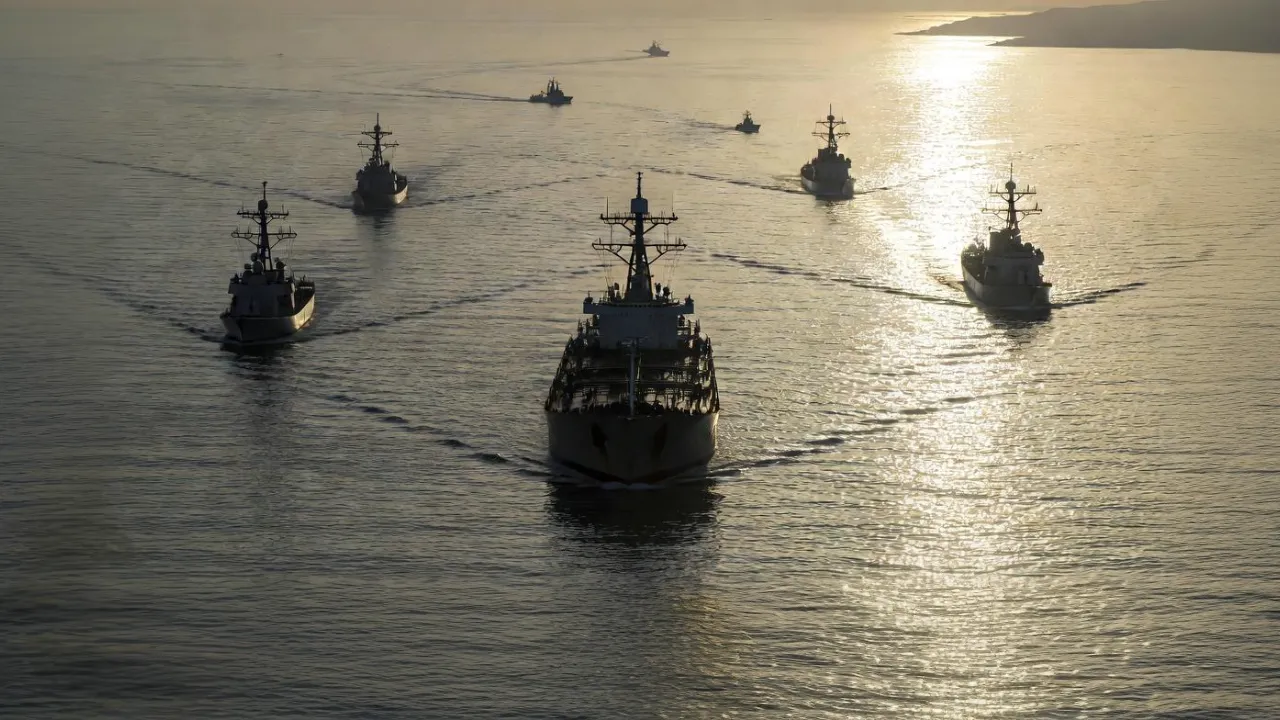
Against this backdrop, Donald Trump announced the launch, starting Monday 4 May, of operation "Project Freedom," intended to escort vessels from neutral countries — stranded for weeks — out of the Gulf. In parallel, Iran put forward a fourteen-point peace plan, conveyed to the United States through Pakistan, proposing the reopening of the strait in exchange for a halt to the strikes and a lifting of the blockade, with nuclear matters handled separately. Trump rejected the plan.
The stakes go beyond shipping alone. The strait functions as a bargaining lever, and control of this maritime chokepoint hardens positions on all sides. Some actors describe the escort as a response to blocked neutral vessels; others see it as an escalation and an infringement on sovereignty over the strait, which Tehran likens to the 1951 nationalization of oil. International law guaranteeing freedom of navigation is invoked by both sides.
Several points remain disputed or uncertain: the effectiveness of the US naval blockade imposed on 13 April, the impact of an OPEC+ production increase while the strait stays closed, and the outcome of the operation itself. If Iran lets the escorted convoys through, pressure eases; if it attacks them, the risk of renewed hostilities grows.
What the comparison reveals
Common ground and differences in coverage across the media analysed.
What the media report in common
The Strait of Hormuz has been effectively blocked since the war began on February 28, disrupting 20% of global oil exports
Iran submitted a 14-point peace proposal and has received a US response transmitted via Pakistan
Trump announced 'Project Freedom' to escort neutral ships out of the Gulf starting Monday morning Middle East time
Where media coverage diverges
Nature of the American operation
Washington frames 'Project Freedom' as a humanitarian gesture for neutral countries whose ships have been stranded for weeks. Tehran sees it as military escalation violating its sovereignty over the strait. South Korea and Japan, with dozens of vessels stranded, push for diplomatic solutions first.
Sovereignty over the strait
Iran claims 'management' of the strait as a non-negotiable strategic asset, likening this right to Mossadegh's 1951 oil nationalization. International law guarantees freedom of navigation; the US, South Korea, Australia, and Europe explicitly invoke this. Qatar and Iraq, dependent on the strait for exports, navigate diplomatically between both sides.
Coverage aligned with this reading
Coverage that diverges


This grouping describes the publications analysed, not the position of these countries’ populations or of their governments.
How each country reads it
Preview: 3 of 15 media perspectives. Syntheses of the media analysed — not direct quotations. Method & limitations
 United States
'Project Freedom': a humanitarian mission to free ships held hostage by maritime tyranny
2 sources · View sources
 Iran
Hormuz is a non-negotiable strategic asset: Tehran likens its grip to Mossadegh's oil nationalization
1 source · View sources
 South Korea
26 Korean ships stranded: Seoul caught between the American initiative and the UK-France coalition
2 sources · View sources
The full text, country by country
United States
DOMINANT ANGLE
'Project Freedom': a humanitarian mission to free ships held hostage by maritime tyranny
ANALYSIS
On Sunday May 3, Donald Trump announced on Truth Social the launch of 'Project Freedom,' a naval escort operation to free neutral countries' ships stranded in the Strait of Hormuz since the war began February 28.
Iran
DOMINANT ANGLE
Hormuz is a non-negotiable strategic asset: Tehran likens its grip to Mossadegh's oil nationalization
ANALYSIS
Iranian officials have hardened their position on the strait over recent days.
South Korea
DOMINANT ANGLE
26 Korean ships stranded: Seoul caught between the American initiative and the UK-France coalition
ANALYSIS
South Korea finds itself in a delicate position.
 Australia
DOMINANT ANGLE
Humanitarian crisis at Hormuz: crews running low on supplies as US Republicans push back on NATO withdrawal
ANALYSIS
Australian media widely covered the attack on a cargo ship by multiple small craft near the Strait of Hormuz overnight Saturday to Sunday.
 France
DOMINANT ANGLE
'Nacho Trump': financial markets no longer believe Hormuz will reopen
ANALYSIS
A new nickname is circulating in financial markets for Trump: 'Nacho Trump.
 China
DOMINANT ANGLE
Land corridors to bypass Hormuz: China watches a geostrategic restructuring of Middle Eastern trade
ANALYSIS
China is closely watching the logistics restructuring triggered by the Hormuz closure.
 Canada
DOMINANT ANGLE
OPEC+ votes a symbolic production hike: meaningless while Hormuz remains blocked
ANALYSIS
OPEC+ approved on Sunday a modest production hike for June, the third consecutive monthly increase: seven member countries will raise output targets by 188,000 barrels per day.
 Qatar
DOMINANT ANGLE
Gulf bypass plans for Hormuz remain years away from being operational
ANALYSIS
Al Jazeera covered 'Project Freedom' in detail, noting Trump warned any interference would be dealt with 'forcefully.
 India
DOMINANT ANGLE
Indian LPG tanker crosses Hormuz on May 2: Indian neutrality rewarded — or just lucky?
ANALYSIS
A Marshall Islands-flagged Indian tanker, the Sarv Shakti, carrying approximately 45,000 tons of LPG, transited the Strait of Hormuz on May 2.
 Philippines
DOMINANT ANGLE
18 Filipino seafarers home after refusing Hormuz passage: 1,300 compatriots have already safely crossed
ANALYSIS
Eighteen Filipino seafarers returned to Manila Thursday and Friday after refusing to sail through the Strait of Hormuz aboard the MSC Ishyka, a Liberian-flagged vessel.
 Iraq
DOMINANT ANGLE
An Iraqi supertanker transits Hormuz with 1 million barrels: a lifeline for Baghdad
ANALYSIS
Automated ship tracking data revealed on Saturday, May 2, that a massive oil tanker carrying approximately one million barrels of Iraqi crude successfully transited the Strait of Hormuz.
 Brazil
DOMINANT ANGLE
Trump announces Hormuz ship escorts as Iran confirms receiving US peace response via Pakistan
ANALYSIS
Folha de S.
 Nigeria
DOMINANT ANGLE
OPEC+ avoids commenting on UAE's exit while voting a production hike that remains virtual
ANALYSIS
Vanguard Nigeria and Punch Nigeria widely covered Trump's announcement: the US will guide ships out of the Gulf from Monday.
 Pakistan
DOMINANT ANGLE
Islamabad under pressure as mediator: Pakistan transmits US response to Iran's 14-point plan
ANALYSIS
Pakistan occupies a crucial diplomatic position in this conflict: Islamabad is the main indirect communication channel between Washington and Tehran.
 Egypt
DOMINANT ANGLE
Trump declares the war over; Hormuz and nuclear issues remain the two unresolved knots of any peace
ANALYSIS
The Daily News Egypt publishes a deep analysis of the situation after Trump formally declared the war over in a letter to congressional leaders: 'There has been no exchange of fire with Iran since the ceasefire.
Explore every perspective on this subject across 15 countries.
Compare viewpoints and see where they diverge.