Common ground and differences in coverage across the media analysed.
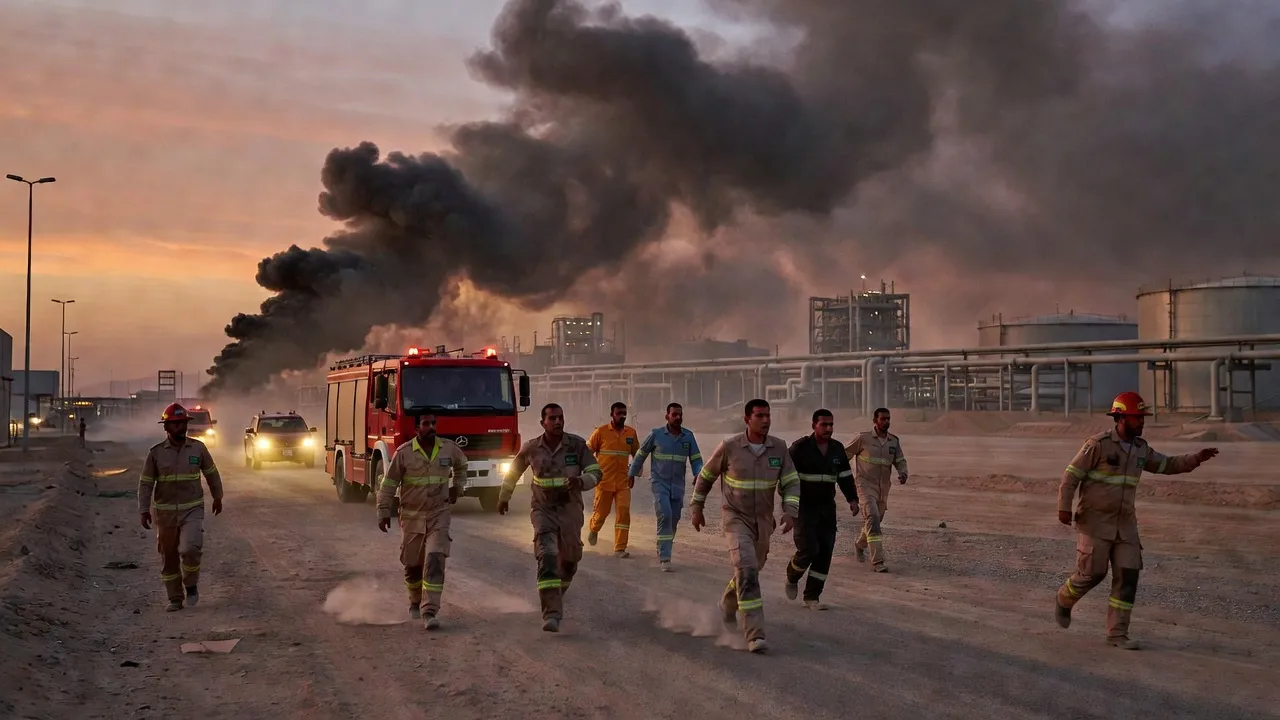
Flames and smoke were reported on Saturday, October 3, at an Aramco site south of Riyadh, according to witnesses cited by AFP and Reuters or by news agency dispatches.
Saudi authorities and Aramco had not confirmed the incident at the time the articles were written: Riyadh's version appears mainly in the form of a lack of confirmation.
Question: is the cause of the fire a Houthi attack? Belgian, Chilean, Iranian, Pakistani, and Portuguese media report the Houthi claim of responsibility; Russian media (Interfax, citing AP) does not mention it, and Lithuanian media writes that the circumstances remain unclear.
Question: what does the absence of Saudi communication on the extent of the damage indicate? Tabnak (Iran) sees it, with confirmation from Reuters, as a possible sign of the severity of the damage; French and Chilean media limit themselves to noting that Riyadh does not confirm.
This grouping describes the publications analysed, not the position of these countries’ populations or of their governments.
What the coverage of each country leaves aside, while others put it forward.
Russia
Iran
Preview: 3 of 10 media perspectives. Syntheses of the media analysed — not direct quotations. Method & limitations
Lisbon sees the claimed strike against Aramco in Riyadh as an extension of the regional conflict: a Yemen that has become the "new front" of the war in the Middle East, between Iran, the United States, and Riyadh.
2 sources · View sources
Singapore reports in news agency dispatches an escalation of the Yemeni-Saudi conflict, first weighing what the fire near Riyadh shows and what Riyadh does not confirm.
2 sources · View sources
Moscow describes a military escalation in Yemen, citing mainly official Yemeni sources and Western agencies, without taking up the Houthi claim on Riyadh.
4 sources · View sources
DOMINANT ANGLE
Lisbon sees the claimed strike against Aramco in Riyadh as an extension of the regional conflict: a Yemen that has become the "new front" of the war in the Middle East, between Iran, the United States, and Riyadh.
ANALYSIS
Lisbon, October 4, 2026.
DOMINANT ANGLE
Singapore reports in news agency dispatches an escalation of the Yemeni-Saudi conflict, first weighing what the fire near Riyadh shows and what Riyadh does not confirm.
ANALYSIS
Singapour, 4 October 2026.
DOMINANT ANGLE
Moscow describes a military escalation in Yemen, citing mainly official Yemeni sources and Western agencies, without taking up the Houthi claim on Riyadh.
ANALYSIS
Moscow, October 4, 2026.
DOMINANT ANGLE
Brussels gauges the escalation in Yemen in terms of a spreading war: the claimed attack on Aramco in Riyadh is seen as a further step towards a large-scale conflict around the Red Sea.
ANALYSIS
Brussels, October 4, 2026.
DOMINANT ANGLE
Santiago is relaying the Houthi claim as an episode of military escalation in Yemen, first citing the statement by Yahya Sarea, then the Saudi reservations.
ANALYSIS
Santiago, October 4, 2026.
DOMINANT ANGLE
Paris is interpreting the Yemeni escalation as a war of cross-reprisals between pro-Iranian Houthis and Riyadh, where the claim against Aramco remains unconfirmed on the Saudi side.
ANALYSIS
Paris, October 4, 2026.
DOMINANT ANGLE
Tehran is reporting on Ansarallah's strike on Aramco in Riyadh, focusing on the damage caused to Saudi energy infrastructure, relying more on Reuters than any Yemeni source.
ANALYSIS
Tehran, October 4, 2026.
DOMINANT ANGLE
Rome is placing the Saudi episode in a broader file: ANSA is linking it to the secret meeting at Camp David on Yemen and Iran, rather than solely to military logic.
ANALYSIS
Rome, October 4, 2026.
DOMINANT ANGLE
Vilnius sees the Aramco incident as a risk to Saudi oil supplies, emphasizing the group's weight in the kingdom's economy and the series of Houthi attacks since July.
ANALYSIS
Vilnius, October 4, 2026.
DOMINANT ANGLE
Islamabad gauges the Yemeni escalation in terms of Saudi security: Pakistani media describes a war that has reached Riyadh and its oil facilities, against a backdrop of bombings in Sanaa.
ANALYSIS
Islamabad, October 4, 2026.
Explore every perspective on this subject across 10 countries.
Compare viewpoints and see where they diverge.
published on
countries
sources
articles
gap
Beyond the Houthi claim, the October 3 reports provide details on the affected site, the series of attacks since summer, and the Yemeni tolls, with each editorial team citing its own sources, including Western agencies, Houthi media, or the Yemeni army.
The attack is based on the sole Houthi claim: neither Riyadh nor Aramco confirmed damage, and the coalition announces 97 operations against Houthi positions.
France 24 reports that an AFP journalist saw firefighters trying to put out a fire at Aramco's refinery in Riyadh, with ambulances and police vehicles nearby. Geo News repeats the same description.
« could indicate the severity of the damage »
Vedomosti, citing the AP agency, writes that the police have blocked access roads and that security measures have been strengthened around the site. According to the newspaper, neither Saudi Aramco nor the Saudi government's International Communications Center responded to AP.
Tabnak, an Iranian website, describes the Riyadh refinery as the only large refinery in the capital and the center of the country, with a capacity of around 120,000 to 130,000 barrels per day. It adds that regional media reported, in the morning, a significant disruption to flights at Riyadh's King Khalid Airport and at Dammam Airport. This information comes from these regional media, which Tabnak does not name in the texts.
Russian press in the corpus, including Interfax and Vedomosti, follows AP. Interfax notes that the agency does not indicate the causes of the fire. None of the four Russian texts mention the Houthi claim or the coalition's denial; they rely on other sources, TASS on the Yemeni army, RIA Novosti on an anonymous interlocutor in Sanaa.
Lithuanian media 15min and Verslo žinios start from the company. Verslo žinios presents Aramco as "the flagship of the Saudi economy" and notes that the circumstances remain unclear. The texts do not report the detailed claim.
Belgian press adds a historical reminder. According to VRT NWS, a ceasefire had been in place since 2022 between the Houthis and the government army supported by Riyadh, before the war opposing the United States and Israel to Iran.
These differences measure what each corpus retains and cites. They say nothing about what happened in Riyadh: on this point, the only verifiable information from witnesses remains the smoke and flames.
Verslo žinios and 15min are reconstructing the timeline. In July, the Houthis announced a maritime blockade of Saudi Arabia and attacked Saudi oil tankers in the Red Sea. In August, an attack targeted an airport and an Aramco facility in Najran.
Vedomosti is adding Saudi dates. The Houthis allegedly attacked several cities in the kingdom, including Aramco sites, on September 8. The East-West oil pipeline was suspended on September 11 after strikes near Riyadh and Medina.
TASS indicates that the Houthis launched an offensive in the southwest in early August and took the port of Mokha and access to Bab el-Mandeb on September 10 and 11. According to Vedomosti, France will send troops to protect the Yanbu oil port. Sud Ouest quotes Minister Jean-Noël Barrot, who says the deployment of French soldiers and defense systems aims solely to protect exports.
Combat figures come from different parties. According to TASS, the spokesperson for the Yemeni government army, Colonel Majed Al-Nuzaili, claims that 474 attacks in 24 hours killed or injured 1,540 Houthis, mainly on the Taiz fronts, and destroyed or neutralized 216 pieces of equipment.
RIA Novosti quotes a source in Sanaa: six airstrikes targeted the Al-Hafa camp east of the capital, the An-Nahdayn camp to the south, and military sites near Mount Attan.
Iranian media YJC and Tabnak recall Ansarallah's statement from the previous day: more than 90 attacks in 24 hours against Yemen, and over 1,300 in recent weeks. The Straits Times mentions, via an AI-generated summary, a warning from the World Food Programme: three-quarters of Yemenis do not meet their basic food needs.
An AFP journalist heard at least five explosions in Sanaa; Almasirah does not detail targets or victims.
The Houthis had claimed Yanbu last week, then a maritime blockade of Saudi Arabia announced in July.
A meeting at Camp David on Yemen and Iran brought together JD Vance, Marco Rubio, Pete Hegseth, and Steve Witkoff, according to ANSA.
More divergent than 57% of recent comparable stories (reference: 90 recent stories measured with the same method).