
Common ground and differences in coverage across the media analysed.
India faces its worst energy crisis since independence, with 90% of LPG imports blocked
Dependence on the Strait of Hormuz represents a structural vulnerability that successive governments have failed to reduce
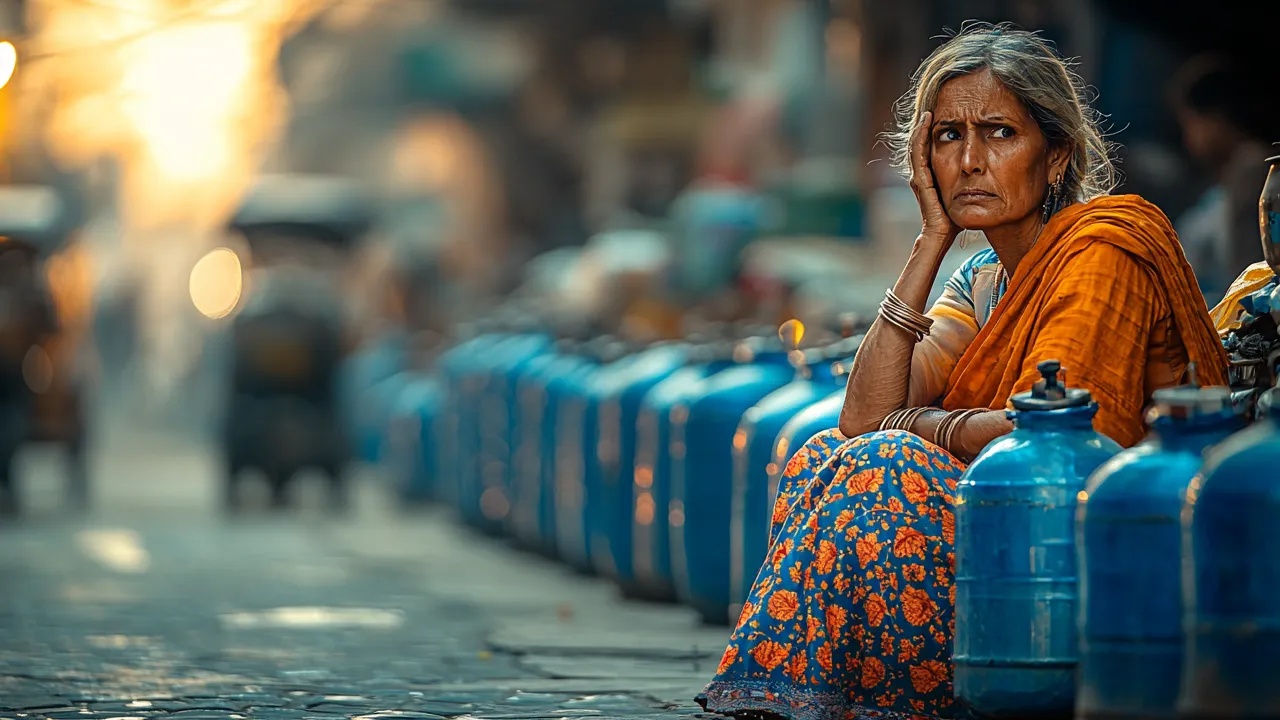
The social impact is severe: 330 million households depend on LPG for daily cooking
Western countries point to Iran's closure of the strait, while China, Russia, and the Global South blame the U.S.-Israeli war as the primary cause.
Coverage aligned with this reading
Russia and China propose alternative land pipelines (BRI, Arctic routes), while the U.S. and UK push their LNG exports and free market solutions.
Coverage that diverges
Some blame India's lack of diversification, others present it as an innocent victim of conflict between major powers.
Coverage aligned with this reading
This grouping describes the publications analysed, not the position of these countries’ populations or of their governments.
What the coverage of each country leaves aside, while others put it forward.
India
China
United States
Preview: 3 of 6 media perspectives. Syntheses of the media analysed — not direct quotations. Method & limitations
The rival neighbor in difficulty — Muslim solidarity and the Iran-Pakistan pipeline as a missed solution
1 source · View sources
The Kingdom as a reliable partner for India amid Iranian destabilization
1 source · View sources
India must undertake its own energy Zeitenwende—lessons from Germany's disengagement
1 source · View sources
DOMINANT ANGLE
The rival neighbor in difficulty — Muslim solidarity and the Iran-Pakistan pipeline as a missed solution
ANALYSIS
Pakistan observes India's energy crisis with a mixture of shared anxiety and barely contained satisfaction.
DOMINANT ANGLE
The Kingdom as a reliable partner for India amid Iranian destabilization
ANALYSIS
Saudi Arabia covers India's crisis with acute awareness that the Kingdom is both part of the problem and part of the solution.
DOMINANT ANGLE
India must undertake its own energy Zeitenwende—lessons from Germany's disengagement
ANALYSIS
Germany observes India's LPG crisis with the analytical rigor and historical consciousness that characterize German media.
DOMINANT ANGLE
Qatar as mediator and supplier—seeking alternative logistical solutions
ANALYSIS
Qatar covers India's crisis with acute awareness of its own role: the country is one of India's principal LPG suppliers, and the Strait of Hormuz closure blocks its own exports.
DOMINANT ANGLE
Indian vulnerability as proof of superiority of China's energy diversification model
ANALYSIS
Chinese media coverage of India's LPG crisis is strategically calibrated.
DOMINANT ANGLE
The Indian ally in difficulty—between humanitarian concerns and commercial opportunism
ANALYSIS
American media covers India's LPG crisis through two main angles: geopolitical implications for the U.
Explore every perspective on this subject across 6 countries.
Compare viewpoints and see where they diverge.
published on
countries
sources
articles
gap
The closure of the Strait of Hormuz has cut off roughly 90% of India's liquefied petroleum gas imports, triggering one of the most severe energy crises the country has faced. The stakes are not only industrial: close to 330 million households rely on LPG for daily cooking, turning a supply disruption into an immediate domestic concern for a vast share of the population.
In response to the emergency, authorities have invoked exceptional measures to manage essential commodities and moved to rapidly increase domestic production. At the same time, the crisis is accelerating the search for longer-term alternatives: new pipelines, supplier diversification, and the expansion of piped gas are all back on the table.
The shock has exposed a long-standing, structural vulnerability. Dependence on the Hormuz maritime passage has persisted across successive governments, and the episode has reopened the debate over how prepared the country really was.
Responsibility, however, remains contested. Some actors attribute the crisis to the strait's closure, while others see it primarily as the consequence of a wider regional conflict. Proposed remedies diverge as well: some favor alternative overland infrastructure, others bet on open markets and gas exports. Beyond these competing readings, one shared certainty endures: for hundreds of millions of people, the concrete question remains the next meal.
Measured with the previous method (distance between texts), on a different scale.