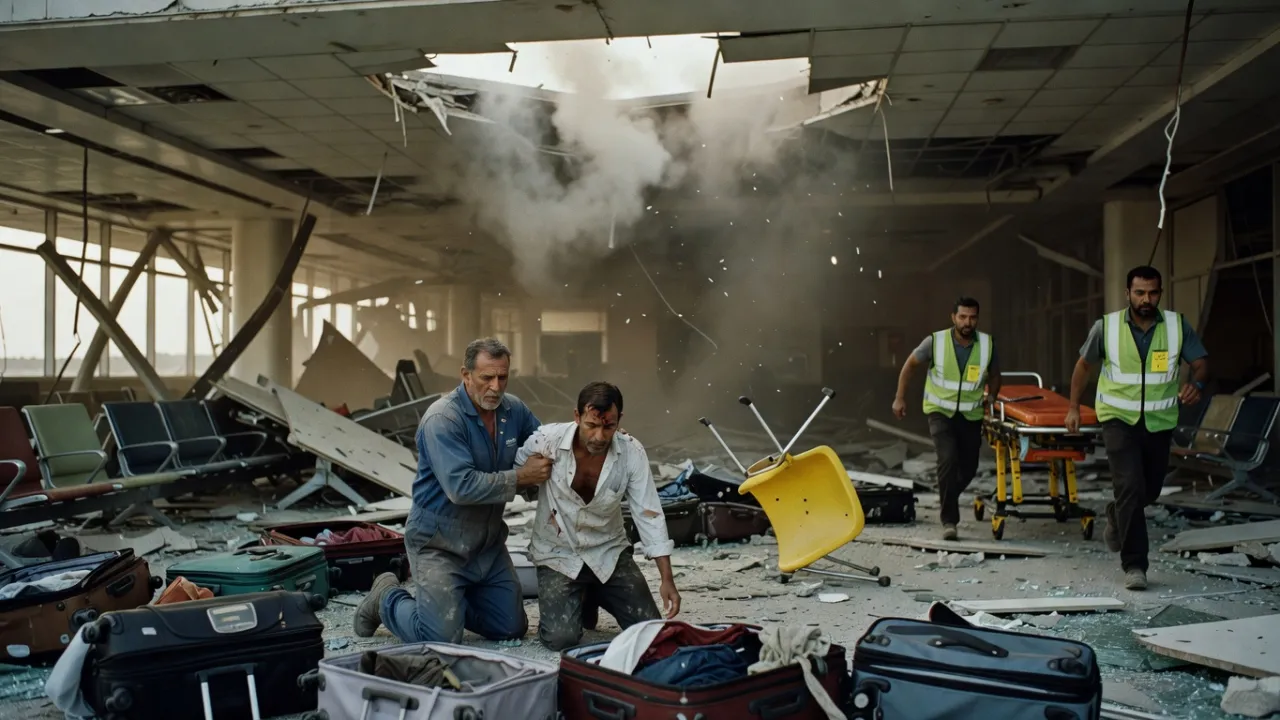
Iran Hits Kuwait Airport: 13 Missiles, 17 Drones, One Killed, 63 Injured as April Truce Cracks Open
published on
countries
sources
articles
Measured with the previous method (distance between texts), on a different scale.
On 3 June 2026, a combined wave of drones and ballistic missiles attributed to Iran targeted sites in Kuwait and Bahrain. In Kuwait, the military says it intercepted thirteen ballistic missiles and seventeen drones, but at least one device struck Terminal 1 of the international airport, killing an Indian national and injuring 63 people, seven of whom required emergency surgery. In Bahrain, facilities hosting the US Fifth Fleet were also targeted and several projectiles intercepted. Within 24 hours, Kuwait expelled two Iranian diplomats and declared its chargé d'affaires persona non grata.
Iran's Revolutionary Guards described the strikes as retaliation for a US operation on Qeshm Island, in the Strait of Hormuz, where the American command says it hit a ground-control station. The attack comes as a truce reached on 8 April, meant to pave the way for a nuclear deal and the reopening of Hormuz, is being renegotiated. Markets reacted sharply: Wall Street fell by about 600 points and oil tightened, with some observers warning that a prolonged closure of the strait would send prices soaring.
Several points remain disputed. Kuwaiti and US authorities attribute the terminal's destruction to an Iranian drone, while Tehran maintains that a malfunctioning American Patriot missile crashed into the building. Actors also diverge on the state of the truce: Washington says negotiations are continuing, while the Iranian side laments the lack of tangible progress and some Gulf capitals speak openly of a breakdown. Whether Hormuz can reopen, and at what cost, remains an open question.
What the comparison reveals
Common ground and differences in coverage across the media analysed.
What the media report in common
An Iranian drone and missile attack struck Terminal 1 of Kuwait International Airport on June 3, 2026, killing one person — an Indian national — and injuring 63 others, including seven who required emergency surgery.
Kuwait expelled two Iranian diplomats and declared the chargé d'affaires persona non grata within 24 hours of the attack.
Kuwait's armed forces say they intercepted 13 ballistic missiles and 17 drones; the US Fifth Fleet headquarters in Bahrain was also targeted.
Where media coverage diverges
Who actually destroyed Terminal 1?
Kuwait and the United States attribute the destruction directly to an Iranian drone. Tehran, through IRGC spokesman Brigadier General Hossein Mohebi, insists a failed American Patriot missile crashed into the terminal. RT amplifies the Iranian version; the Jerusalem Post documents the US denial; Al Jazeera lets both versions stand side by side.
Coverage that diverges
Is the April 8 ceasefire over?
Trump says talks continue. Tehran, via Foreign Minister Araghchi, says there is no tangible progress. Gulf outlets (Khaleej Times, Gulf Times) openly describe a rupture. European media (Tagesschau, La Repubblica) use the word escalation. Asian commentary (Korea Herald, Japan Today) opens the door to a wider strategic failure of the Trump approach.
Coverage aligned with this reading
Coverage that diverges
Can the Strait of Hormuz be reopened?
The Straits Times reveals a quiet successor to Project Freedom: discreet US escorts along the Omani coast, transponders switched off. Khaleej Times warns oil could reach $150 a barrel if closure extends past September. Iraqi News documents rising Turkish oil exports as a workaround. Tehran maintains its grip on the waterway.
Coverage aligned with this reading
Coverage that diverges

This grouping describes the publications analysed, not the position of these countries’ populations or of their governments.
Blind spots
What the coverage of each country leaves aside, while others put it forward.
 United States
- Hard financial losses: the Dow drops 600 points, documented by De Telegraaf
- Detailed human toll: amputations, cerebral haemorrhages (Tagesschau)
- Strategic failure analysis: Korea Herald's dissection of the Trump style
 Iran
Iran- The identity of the dead at Kuwait — an Indian national
- The detailed civilian injury toll (63 wounded, 7 emergency surgeries)
- The expulsion of Iranian diplomats within 24 hours
 Qatar
Qatar- The theory of a failed US Patriot (covered by Mehr News and RT)
- The Iranian perspective on US strikes on Qeshm
 France
- Official position of the Quai d'Orsay on the expulsion of Iranian diplomats
- Concrete impact on French nationals in the UAE and Kuwait
How each country reads it
Preview: 3 of 18 media perspectives. Syntheses of the media analysed — not direct quotations. Method & limitations
 United Arab Emirates
Abu Dhabi calls for a unified Gulf response and warns markets: $150 a barrel if Hormuz stays closed past September
2 sources · View sources
- France
Paris counts the days and watches oil: 96th day of conflict, Araghchi mourns the absence of progress
2 sources · View sources
 Germany
Berlin clinically documents the wounds: amputations, cerebral haemorrhages, seven emergency surgeries
1 source · View sources
The full text, country by country
United Arab Emirates
DOMINANT ANGLE
Abu Dhabi calls for a unified Gulf response and warns markets: $150 a barrel if Hormuz stays closed past September
ANALYSIS
Abu Dhabi speaks simultaneously to the trading floor and to the chancellery.
France
DOMINANT ANGLE
Paris counts the days and watches oil: 96th day of conflict, Araghchi mourns the absence of progress
ANALYSIS
Paris approaches the sequence with the French grid of conflict analysis: count the days, measure the economic risk, listen for diplomatic signals.
Germany
DOMINANT ANGLE
Berlin clinically documents the wounds: amputations, cerebral haemorrhages, seven emergency surgeries
ANALYSIS
Berlin deploys its usual documentary precision.
 Italy
Italy
DOMINANT ANGLE
Rome reconstructs the operational sequence: Hellfire on tanker, Qeshm hit, Iranian missiles in reply
ANALYSIS
Rome treats the night of June 3 as a diplomatic file.
 United Kingdom
DOMINANT ANGLE
London dissects Qeshm: a fortified missile lair under the rock, a Shah-era legacy
ANALYSIS
London approaches the event through historical and military depth.
 India
India
DOMINANT ANGLE
New Delhi mourns its national killed in Kuwait and condemns Iran — the Indian angle centers on the human
ANALYSIS
New Delhi leads with the human angle.
 Russia
DOMINANT ANGLE
Moscow amplifies the Iranian Patriot version via RT and neutralizes the American narrative
ANALYSIS
Moscow plays three distinct scores.
 South Korea
DOMINANT ANGLE
Seoul publishes a frontal critique of the Trump style and calls for a Hormuz coalition
ANALYSIS
Seoul produces the day's most structured analysis.
 Japan
Japan
DOMINANT ANGLE
Tokyo reports the facts with technical precision and watches oil: a second tanker via Hormuz has docked
ANALYSIS
Tokyo handles the sequence with its usual precision.
 Turkey
DOMINANT ANGLE
Ankara relays the categorical Kuwaiti denial of the Iranian accusations and watches the Gulf crisis from a distance
ANALYSIS
Ankara handles the Gulf sequence from its particular position — a NATO ally with strong economic ties to Tehran.
 Egypt
Egypt
DOMINANT ANGLE
Cairo condemns any 'violation of sovereignty' and stands expressly with Kuwait and Bahrain
ANALYSIS
Cairo strikes a textbook diplomatic posture: explicit condemnation, full backing of Gulf victims, categorical rejection of any escalation.
 Brazil
DOMINANT ANGLE
Brasília follows the Bovespa drop and links the attack to Trump's tariff offensive — crisis within crisis
ANALYSIS
Brasília weaves two threads in parallel.
 Mexico
DOMINANT ANGLE
Mexico City links the attack to the fragility of the truce and reads the stock market as a seismograph
ANALYSIS
Mexico City handles the night of June 3 through an economic and political reading.
 Argentina
DOMINANT ANGLE
Buenos Aires reprints the NYT International Weekly and exposes Trump's strategic blindness on Hormuz
ANALYSIS
Buenos Aires publishes the day's sharpest critique from the Global South.
United States
DOMINANT ANGLE
Washington tells a story of crisis under control while the New York Times documents three months of ignored warnings
ANALYSIS
Washington produces two parallel stories on June 3.
Qatar
DOMINANT ANGLE
Doha calls the attack a 'heinous aggression' and triggers the Arab reflex: condemnation, solidarity, diplomatic caution
ANALYSIS
Doha rolls out the full Arab condemnation playbook.
Iran
DOMINANT ANGLE
Tehran denies hitting Terminal 1 and accuses a failed American Patriot — Mehr News sets the official version
ANALYSIS
Tehran rolls out a coordinated counter-narrative on the morning of June 3.
 Israel
DOMINANT ANGLE
Tel Aviv documents the military interception and rejects the Iranian version — Jerusalem Post sets the denial
ANALYSIS
Tel Aviv approaches the night of June 3 with the eye of a military analyst.
Explore every perspective on this subject across 18 countries.
Compare viewpoints and see where they diverge.