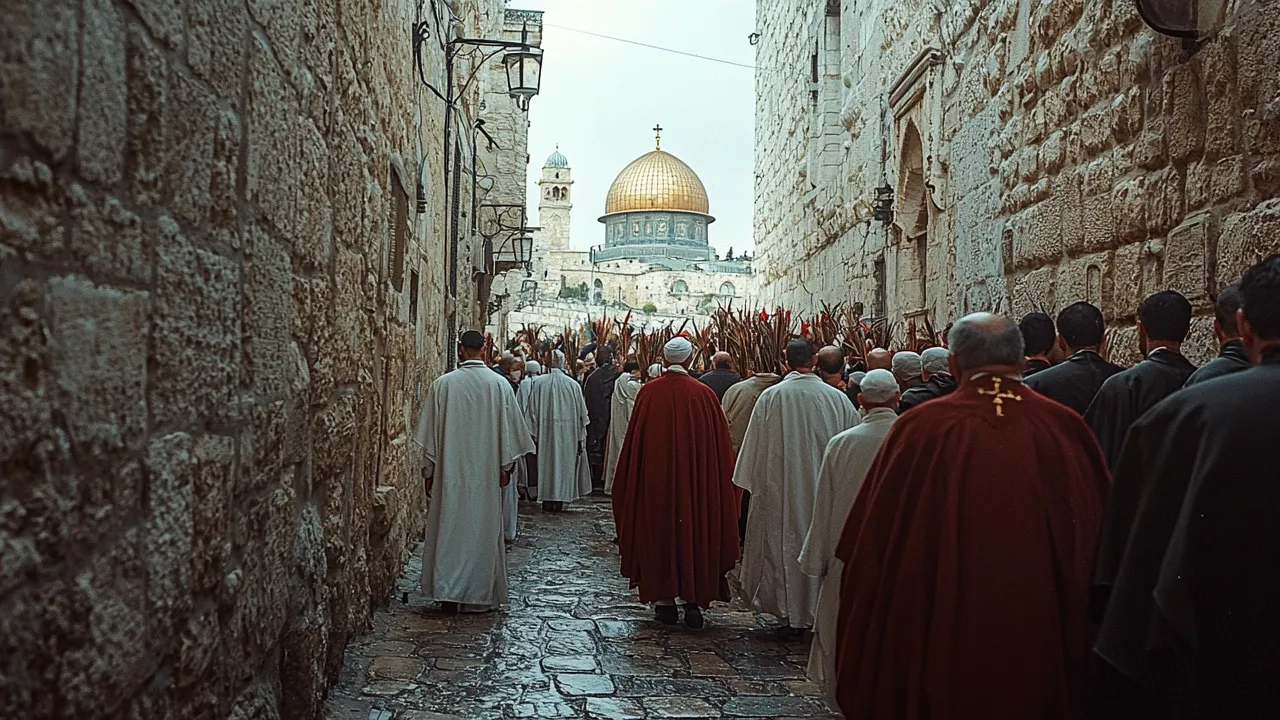
On Palm Sunday, Israeli police prevented Catholic leaders, among them the Latin Patriarch and a cardinal, from reaching the Church of the Holy Sepulchre in Jerusalem to celebrate one of the major masses of the Christian calendar. The episode is consistently confirmed by all the actors who reported it, and widely described as an infringement of religious freedom.
In the aftermath, Pope Leo XIV publicly condemned the use of God's name to justify war. His statement amplified the reach of the incident, which moved beyond its local context to become a topic of debate across some fifteen countries, where it was carried well beyond newsrooms that specialize in religious affairs.
To grasp the scale the affair took on, the place of the Holy Sepulchre must be recalled: it is the holiest site for a large part of the world's roughly 2.4 billion Christians, and the blockage occurred during the most important week of their calendar. Access to Jerusalem's holy sites has long been a sensitive matter, blending religion, security and diplomacy, and each incident there resonates beyond its immediate setting.
The interpretation, by contrast, remains disputed. Some actors read it as a sign of a wider pattern of restrictions targeting religious communities on the ground; others stress the universal message of peace carried by the Pope, or seek to play down the event's significance and to look for an explanation. The debate also pits those who point to a collective victim, Christianity as a whole, against those who emphasize individual figures.
Finally, uncertainty remains over the stated motives and the true reach of the episode. What happened is agreed upon; what it means, far less so.