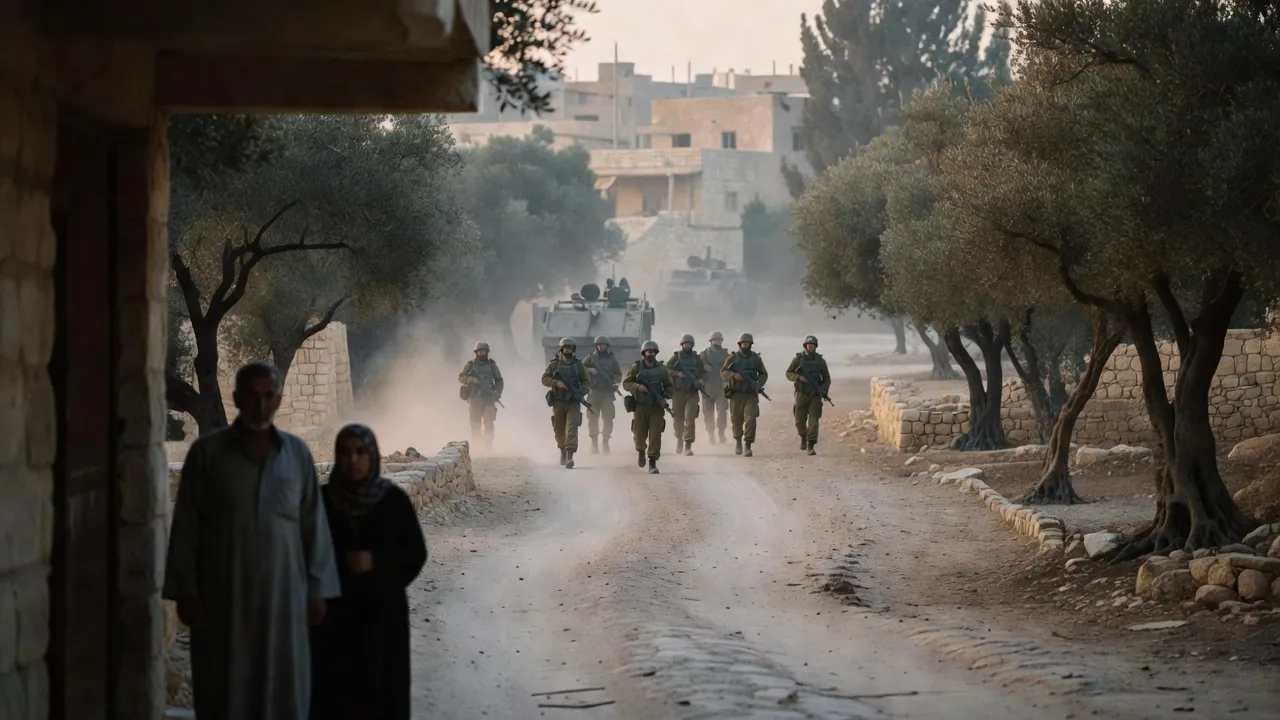
Common ground and differences in coverage across the media analysed.
A deadly clash occurred near the village of Tal (Tell), southwest of Nablus, resulting in four Palestinian deaths and two Israeli deaths (one settler and one security officer or soldier).
Netanyahu ordered the acceleration of legalization for existing settler outposts as well as the creation of new outposts in the West Bank.
The Israeli government also decided on additional security measures: demolition of a house, increased restrictions in certain villages, and a strengthened military presence.
Sources differ on the sequence of events: the Israeli army cites hikers being targeted, while Palestinian witnesses describe a settler incursion accompanied by soldiers aiming to set the village on fire.
The classification of new outposts under international law varies: some coverage consistently notes their illegality, while others report the announcement without judgment or frame it in a justificatory security context.
Some coverage highlights concrete measures by third countries (bans on settlement products, UN resolutions) and calls for binding sanctions, while others do not address this diplomatic dimension.
Coverage aligned with this reading
This grouping describes the publications analysed, not the position of these countries’ populations or of their governments.
What the coverage of each country leaves aside, while others put it forward.
Israel
Singapore
Qatar
Germany
Preview: 3 of 5 media perspectives. Syntheses of the media analysed — not direct quotations. Method & limitations
Jerusalem is justifying a security crackdown in the West Bank while accelerating settlement expansion, framing the two as inseparable responses to a deadly attack near Nablus.
2 sources · View sources
Doha condemns a colonial dynamic that, in its view, buries the two-state solution a little more each day
3 sources · View sources
Berlin is deciphering a complex situation with conflicting accounts, caught between Israel's military response and allegations of largely unpunished settler violence.
2 sources · View sources
DOMINANT ANGLE
Jerusalem is justifying a security crackdown in the West Bank while accelerating settlement expansion, framing the two as inseparable responses to a deadly attack near Nablus.
ANALYSIS
Jerusalem, July 25, 2026.
DOMINANT ANGLE
Doha condemns a colonial dynamic that, in its view, buries the two-state solution a little more each day
ANALYSIS
Doha, July 25, 2026.
DOMINANT ANGLE
Berlin is deciphering a complex situation with conflicting accounts, caught between Israel's military response and allegations of largely unpunished settler violence.
ANALYSIS
Berlin, July 25, 2026.
DOMINANT ANGLE
France notes the contradiction between the announcement of a "large-scale anti-terrorist operation" in the West Bank and the simultaneous acceleration of settlement expansion, deemed illegal under international law.
ANALYSIS
Paris, July 25, 2026.
DOMINANT ANGLE
Singapore weighs the risks of an escalation in the West Bank and scrutinizes signals of a lasting hardening of Israel's stance on settlements.
ANALYSIS
Singapore, July 25, 2026.
Explore every perspective on this subject across 5 countries.
Compare viewpoints and see where they diverge.
published on
countries
sources
articles
gap
On July 24, 2026, a clash in the village of Tell, southwest of Nablus in the occupied West Bank, resulted in six fatalities: two Israelis - a settler and a security officer - and four Palestinians, according to the Israeli army and the Palestinian Authority. In response, Israeli Prime Minister Benjamin Netanyahu ordered a large-scale military operation in the West Bank, including sector closures, new checkpoints, and the demolition of a house, as well as the acceleration of the legalization of existing settler outposts and the creation of new ones. These announcements came just days after a settler incursion into the Al-Aqsa compound in Jerusalem, which was condemned by several Arab and Muslim countries.
Measured with the previous method (distance between texts), on a different scale.