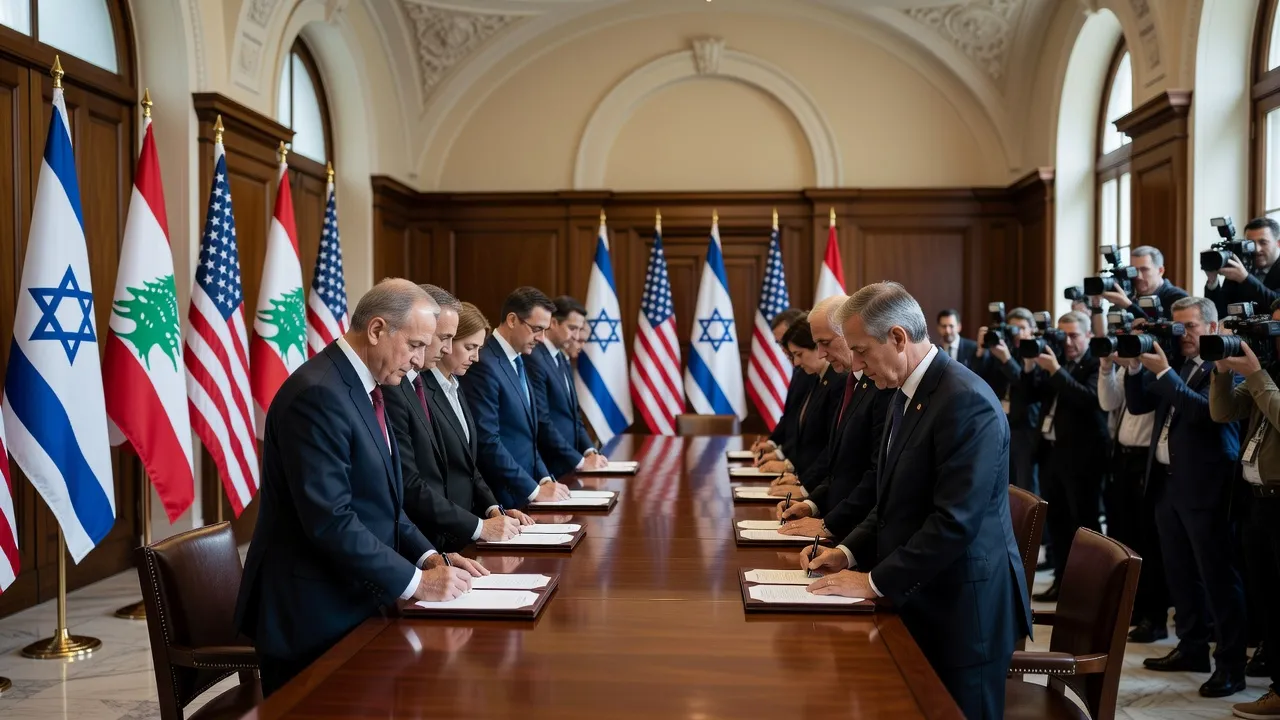
On 26 June 2026, after a fifth round of direct talks, a trilateral framework agreement was signed in Washington by the Israeli and Lebanese ambassadors, in the presence of Secretary of State Marco Rubio. He described the text as a "first step" and the "beginning of the beginning", stressing that much work remained before any lasting peace.
The agreement provides for a limited Israeli withdrawal from two pilot zones in southern Lebanon, one north and one south of the Litani river, where the Lebanese army would gradually take control. The detailed content of the text has not been made public. Any broader withdrawal is conditioned by the Israeli authorities on the full disarmament of Hezbollah, which rejected the agreement and warned of a risk of "civil war". Violence persisted during and after the talks: three people were killed by a drone the day before the signing, and seven more on the day itself.
The signing comes amid a rapid reshaping of the Middle East. The Israeli-Lebanese conflict, triggered on 2 March, has killed more than 4,200 people in Lebanon and displaced over one million. The agreement follows ten days after a U.S.-Iranian ceasefire memorandum, whose fragility was underscored by fresh mutual strikes on the very day of the signing.
Several points remain disputed. Israeli and U.S. actors present the agreement as a major advance, while others stress its partial and opaque nature. Lebanon is demanding a withdrawal from its entire territory, even as the signing coincides with troops staying in place. The disarmament of Hezbollah, the border demarcation and the replacement of the U.N. force, whose mandate expires at the end of 2026, all remain open questions.