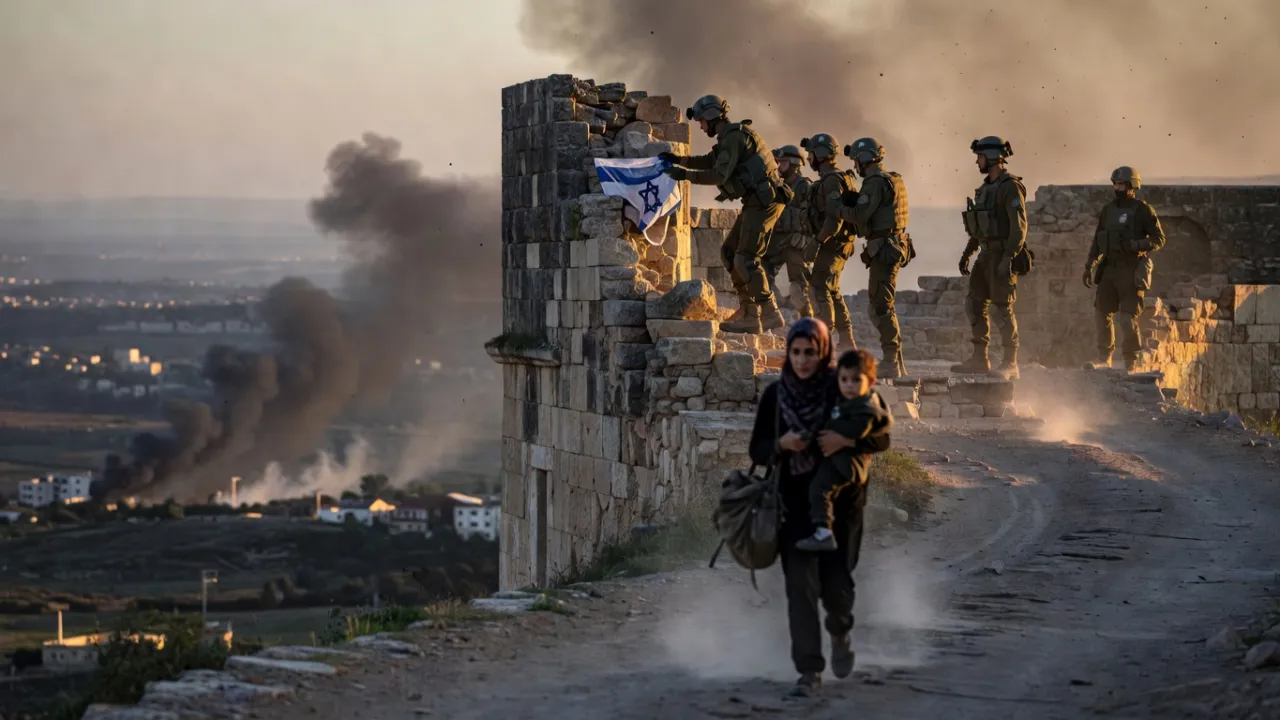
Israel Recaptures Beaufort Fortress as Trump Announces Israel-Hezbollah Ceasefire
published on
countries
sources
articles
Measured with the previous method (distance between texts), on a different scale.
On 31 May, Israeli forces crossed the Litani River for the first time since 2006 and retook the Crusader fortress of Beaufort, a rocky spur in southern Lebanon that Israel had evacuated in 2000 after eighteen years of occupation. The operation extended a "security zone" more than twenty kilometres into Lebanese territory, marking the deepest incursion in twenty-six years and materially breaking the nominal 17 April ceasefire.
On 1 June, the U.S. president announced a halt to operations against Beirut ("no Troops going to Beirut"), a move presented as intended to preserve the April truce with Tehran. The Israeli prime minister accepted verbally while keeping his military options in the south open. Regionally, France secured an emergency Security Council meeting, while Resolution 1701 was invoked by several Gulf and Arab capitals.
The human toll cited stands at around 3,300 to 3,412 Lebanese dead and 1.2 million displaced, against 24 Israeli soldiers and 4 civilians killed over the same period.
Several points remain disputed. Actors disagree over the causality of the de-escalation: the American account casts Washington's phone call as the decisive factor, while Tehran attributes it to a prior Iranian warning. The legal status of the incursion is also contested: some states speak of "occupation" and "aggression" citing Resolution 1701, others of a mere "incursion" or "advance." The actual effectiveness of the announced halt remains uncertain, as Israel's retained offensive options leave a grey zone open to renewed escalation.
What the comparison reveals
Common ground and differences in coverage across the media analysed.
What the media report in common
All media confirm the capture of Beaufort by the Golani Brigade on May 31 and the material breach of the nominal ceasefire of April 17.
Trump's announcement on June 1 ('no Troops going to Beirut') is widely relayed, but almost all editorials add that Netanyahu maintains the option to strike.
The fragility of the US-Iran agreement and the Lebanese condition posed by Tehran appears as the true political key to the sequence in most coverage.
Where media coverage diverges
What each got out of the Trump-Netanyahu call
The American narrative presents Trump as the arbiter who recalls the tanks. The Iranian narrative (Mehr News) inverts causality — the operation on Beirut would have been cancelled 'after the Iranian warning'. The Israeli narrative documents Netanyahu's maintenance of offensive options and internal resistance (Ben-Gvir).
Legal status of the Israeli incursion
Arab (qa, eg, sa) and Iranian media speak of 'occupation' and 'aggression' and invoke Resolution 1701. Western media (uk, de, it) speak of 'incursion', 'escalation', or 'advance'. French media speak of 'grave fault' without qualifying juridically.
Centrality of Beaufort vs centrality of Trump-Iran diplomacy
French, Italian, and Polish media accord the castle historical and patrimonial importance (UNESCO, Crusaders, 1982). American, Brazilian, and Indian media frame the event as an incident within a broader diplomatic sequence.
This grouping describes the publications analysed, not the position of these countries’ populations or of their governments.
Blind spots
What the coverage of each country leaves aside, while others put it forward.
 United States
- The precise role of Nabih Berri's advisor Ali Hamdan as Hezbollah-USA channel
- The mixed composition of Dahiyeh (Christians, Palestinian refugees) recalled by The Independent
- The attack on the Hiram hospital in Tyre and the 13 wounded medical staff
 Israel
- The detailed Lebanese civilian toll (3,370 dead, 20% women/children/medical personnel according to NPR)
- The 2024 UNESCO status of Beaufort Castle
- The position of Lebanese Prime Minister Salam ('scorched earth policy')
 Iran
- The 24 Israeli soldiers and 4 civilians killed during the same period
- The economic pressure exerted by the US naval blockade mentioned only obliquely
- The role of Qatar as parallel mediator
 Russia
- Moscow's proper role as historical partner of Syria and indirect actor in the regional war
- The economic repercussions for Russia of an Ormuz closure
- Tehran's consistency or inconsistency with its own diplomatic commitments
How each country reads it
Preview: 3 of 17 media perspectives. Syntheses of the media analysed — not direct quotations. Method & limitations
 Germany
Berlin reads the Trump-Netanyahu sequence with skepticism and sends its minister to try Beirut — canceled trip
1 source · View sources
 Italy
Rome reads the capture of Beaufort through the light of the Crusades and the Italian marines still deployed in Lebanon
2 sources · View sources
 Poland
Warsaw emphasizes the ceasefire break and insists on the Iranian warning — Tehran says the army's patience is limited
2 sources · View sources
The full text, country by country
Germany
DOMINANT ANGLE
Berlin reads the Trump-Netanyahu sequence with skepticism and sends its minister to try Beirut — canceled trip
ANALYSIS
Berlin listens as Trump says 'De-escalation' and wants to believe there will be a de-escalation, but German diplomacy remains cautious.
Italy
DOMINANT ANGLE
Rome reads the capture of Beaufort through the light of the Crusades and the Italian marines still deployed in Lebanon
ANALYSIS
Rome views the capture of Beaufort through the lens of the Crusades and the Italian marines still deployed in Lebanon, where 1,100 Italian troops are stationed.
Poland
DOMINANT ANGLE
Warsaw emphasizes the ceasefire break and insists on the Iranian warning — Tehran says the army's patience is limited
ANALYSIS
Warsaw views the Beaufort takeover as a clear break from the fragile April 17 balance, and Polish media focus on the warning rather than mediation.
Israel
DOMINANT ANGLE
Jerusalem celebrates the 'breaking of the fear wall' but documents the internal fracture over concessions to Trump
ANALYSIS
Jerusalem views the capture of Beaufort as a symbolic repair.
Iran
DOMINANT ANGLE
Tehran declares the halt of negotiations with Washington and makes the Lebanese ceasefire a non-negotiable red line
ANALYSIS
Tehran reasserts its narrative in two simultaneous gestures.
 Qatar
DOMINANT ANGLE
Qatar sets the legal framework: UN Resolution 1701 must apply and Lebanese sovereignty is non-negotiable
ANALYSIS
Qatar lays out the legal framework.
 Saudi Arabia
DOMINANT ANGLE
Riyadh documents the attack on the Tyre hospital and the 'alarm' of the UN, without calling for a rupture
ANALYSIS
Riyadh measures its words but conceals nothing.
 Turkey
DOMINANT ANGLE
Turkey relays the Paris-Gulf axis and pushes for the reopening of the Strait of Hormuz as a condition for regional stability
ANALYSIS
Turkey views the event through the lens of French diplomacy and offers its own interpretation: Daily Sabah publishes Macron's full statement — 'nothing justifies the major escalation in south Lebanon' — and lists his interlocutors (MBS, Sultan Haitham, MBZ, Sissi) one by one.
 Egypt
DOMINANT ANGLE
Cairo formally condemns the incursion and fears a surge of Palestinian and Lebanese refugees
ANALYSIS
Egypt's capital Cairo strongly and publicly condemns the Israeli incursion into Southern Lebanon as regional tensions escalate.
Russia
DOMINANT ANGLE
Russia contextualizes the war within the broader arc of American failure in the Middle East and tallies diplomatic setbacks
ANALYSIS
Russia presents the capture of Beaufort as a new chapter in the grand narrative that has structured its coverage of the Middle East since 2022: the failure of the US to impose a stable regional order and the maximalist drift of Israel that Washington can no longer contain.
 Brazil
DOMINANT ANGLE
Brazil follows the event from a distance and quantifies the entanglement of fronts — Beaufort, Beirut, Iran, Kuwait — without taking a side
ANALYSIS
Brazil observes the sequence from the other side of the Atlantic with an astonishingly precise neutrality.
 Nigeria
DOMINANT ANGLE
Abuja relays Rubio and the Iranian position – 'no trust in the enemy' says Qalibaf – without a clear line
ANALYSIS
Nigeria closely watches the event as a neutral and geopolitically detached observer.
 India
DOMINANT ANGLE
India observes the capture of Beaufort and Iran's suspension with the eye of a major energy consumer
ANALYSIS
India views the event through the prism of energy and regional stability.
 Indonesia
DOMINANT ANGLE
Jakarta views the event through the lens of Muslim solidarity, placing the Israeli flag as a symbol of aggression
ANALYSIS
Indonesia's coverage of the Beaufort takeover lacks the emotional intensity seen in the rest of Asian media.
United States
DOMINANT ANGLE
Washington tells a story of a Trump arbiter who brings tanks back in a few hours to save his deal with Tehran
ANALYSIS
Washington treats the capture of Beaufort as a fait accompli but focuses mainly on what follows: a call from Trump to Netanyahu, and the armored columns marching on Beirut that turned back.
 United Kingdom
DOMINANT ANGLE
London demands a halt from both sides and reminds that Beirut also hosts Christians and Palestinian refugees
ANALYSIS
London's coverage of the event is distinct from the rest of the Anglo-Saxon world through a precise diplomatic grammar and a concern for social pedagogy.
 France
DOMINANT ANGLE
Paris seizes the opportunity to become the power protector of Lebanon again and secures an emergency UN meeting
ANALYSIS
France shifts into historic mediator mode for Lebanon upon announcement of Beaufort capture.
Explore every perspective on this subject across 17 countries.
Compare viewpoints and see where they diverge.