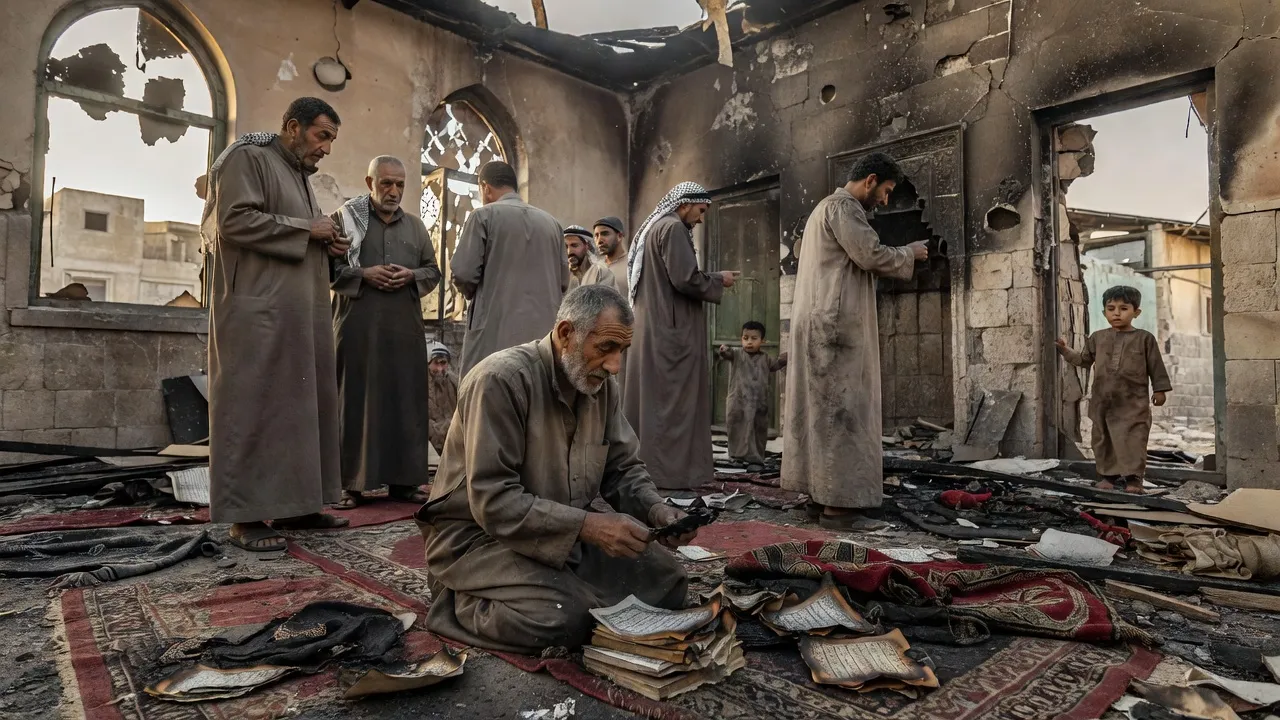
Israeli settlers torch two West Bank mosques amid surge in violence
published on
countries
sources
articles
Measured with the previous method (distance between texts), on a different scale.
Overnight from 25 to 26 July 2026, Israeli settlers set fire to two mosques in the occupied West Bank, in Qusra and in Kour near Tulkarem, daubing them with slogans hostile to Palestinians. The episode came a day after a clash near the village of Tal, southwest of Nablus, that left four Palestinians and two Israelis dead. Settlers also attacked several neighboring villages, while the Israeli army carried out a wave of arrests of Palestinians over the weekend. Prime Minister Benjamin Netanyahu, campaigning for the 27 October legislative elections, announced a reinforcement of military forces in the West Bank. Several Arab and Muslim countries condemned the escalation of settler violence in the region.
Key figures
- 6 deadKilled in the clash at the village of Tal, southwest of Nablus (4 Palestinians, 2 Israeli soldiers)1 source · PerthNow
- 3,600 arrestsPalestinians arrested in the West Bank since the start of the year, per the Palestinian Prisoners Club1 source · CGTN
- 87 killedPalestinians killed by Israelis in the West Bank since January 2026, including 21 by settlers1 source · Al Jazeera
- 8 countriesArab and Muslim countries that condemned settler incursions around the Al-Aqsa compound on 23 July1 source · Egyptian Streets
What the comparison reveals
Common ground and differences in coverage across the media analysed.
What the media report in common
Two mosques were set on fire during the night of Sunday in the occupied West Bank, in Qusra and in Kur near Tulkarem, with inscriptions evoking revenge.
These fires followed a deadly confrontation that occurred Friday near the village of Tell/Tal, which killed four Palestinians and two Israeli soldiers.
The Israeli military conducted dozens of arrests of Palestinians in the West Bank in the days following the incidents.
Where media coverage diverges
Nature of settler violence
Perspectives diverge on how to characterize the fires: for some, a retaliatory act inserted into a security context, or for others, a manifestation of an organized and unpunished colonial policy.
Responsibility of the Israeli state
Part of the Israeli press evokes inaction or tolerance by the military toward settler violence, while the Arab press sees a direct government responsibility, contested by articles focused on the security context.
Religious vs security framing
Pakistan and the Arab world emphasize the religious dimension of the attack on Muslim places of worship, while other perspectives prioritize a security framing linked to the escalation of violence.
This grouping describes the publications analysed, not the position of these countries’ populations or of their governments.
Blind spots
What the coverage of each country leaves aside, while others put it forward.
 Australia
- Arab and UN diplomatic reactions
- official position of the Israeli government
 China
- reactions from the UN and European countries
- direct voice of settlers or the Israeli government
 Egypt
- explanations or denials from Israeli authorities and settlers targeted
 Israel
- direct testimonies from Palestinian residents of the targeted villages
How each country reads it
Preview: 3 of 6 media perspectives. Syntheses of the media analysed — not direct quotations. Method & limitations
- Australia
Canberra examines a cycle of retaliation where Israeli and Palestinian narratives collide as sharply as settlers and West Bank villagers.
3 sources · View sources
- China
Beijing frames Israel's escalating violence in occupied West Bank, amid burning mosques, military closure of Nablus, and tight Israeli election calendar.
2 sources · View sources
- Egypt
Cairo condemns an organized colonial escalation in occupied West Bank, where settler incursions around Al-Aqsa and overnight raids confirm, in Cairo's view, a territorial fragmentation strategy threatening the two-state solution.
2 sources · View sources
The full text, country by country
Australia
DOMINANT ANGLE
Canberra examines a cycle of retaliation where Israeli and Palestinian narratives collide as sharply as settlers and West Bank villagers.
ANALYSIS
Canberra, July 27, 2026.
China
DOMINANT ANGLE
Beijing frames Israel's escalating violence in occupied West Bank, amid burning mosques, military closure of Nablus, and tight Israeli election calendar.
ANALYSIS
Beijing, July 27, 2026.
Egypt
DOMINANT ANGLE
Cairo condemns an organized colonial escalation in occupied West Bank, where settler incursions around Al-Aqsa and overnight raids confirm, in Cairo's view, a territorial fragmentation strategy threatening the two-state solution.
ANALYSIS
Cairo, July 27, 2026.
Israel
DOMINANT ANGLE
Israel's press splinters over settler violence in the West Bank following a deadly attack on Israelis—one camp condemns what they frame as a breakdown of law and order, while the other reads the incidents through a security lens shaped by prior Palestinian attacks.
ANALYSIS
Jerusalem, July 27, 2026.
 Pakistan
DOMINANT ANGLE
Islamabad condemns the burning of two mosques in the West Bank as a direct assault on Muslim holy sites, amid escalating settler colonization.
ANALYSIS
Islamabad, July 27, 2026.
 Qatar
DOMINANT ANGLE
Doha reads Israeli settler attacks in the West Bank as flagrant violations of international law calling for urgent international intervention and accountability.
ANALYSIS
Doha, July 27, 2026.
Explore every perspective on this subject across 6 countries.
Compare viewpoints and see where they diverge.