Ebola quarantine for Americans: Nanyuki burns, two dead, a Kenyan judge freezes Trump's plan
published on
countries
sources
articles
Measured with the previous method (distance between texts), on a different scale.
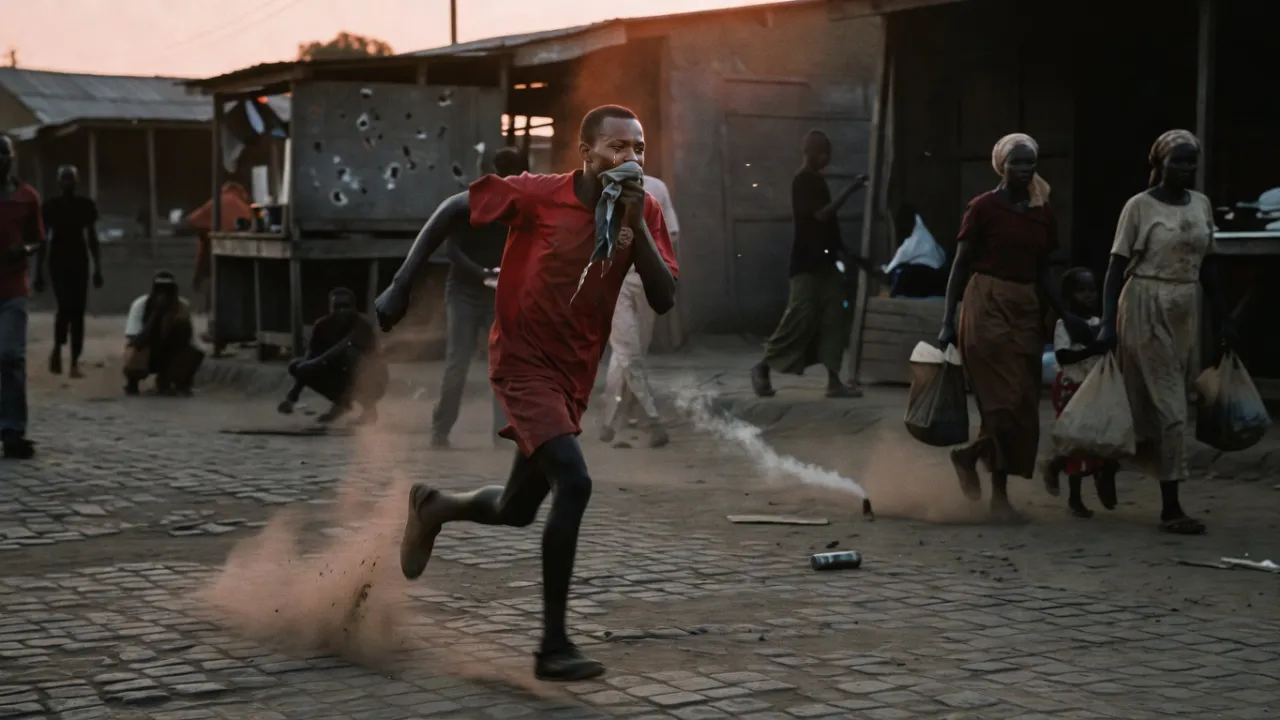
On 1 June 2026, hundreds of people gathered in Nanyuki, in central Kenya, to oppose a planned 50-bed American quarantine center at the Laikipia air base. The facility was intended for U.S. nationals potentially exposed to the Ebola virus during the ongoing outbreak in the Democratic Republic of Congo and Uganda. Kenyan defense forces first sealed off the base before riot police fired tear gas and warning shots. Two people were killed by gunfire.
On 2 June, the Kenyan High Court extended its freeze on the project by three weeks and ordered the government to make the agreement reached with Washington public. President William Ruto publicly acknowledged that it was Donald Trump who had personally asked him to authorize the center, defending the arrangement as part of a long-standing health cooperation between the two countries. On the American side, Secretary of State Marco Rubio had stated that his country could not admit any case of Ebola on its soil.
The episode reaches beyond Kenya alone. Nigeria stepped up surveillance at Lagos airport, South Africa called for an independent African biosecurity framework, and the WHO lowered its estimates of suspected cases in the DRC and Uganda. The wider backdrop is a U.S. administration reducing its presence on the continent, with a plan to halve the number of embassies able to issue visas.
The disagreements concern less the facts than how to read them. Kenyan actors denounce an infringement of sovereignty and demand that Americans be quarantined at home; Washington cites the logistical specificity of the area and its fear of domestic contamination; others see an imbalance in how health risks are handled. The exact content of the agreement, frozen by the courts, remains unpublished at this stage.
What the comparison reveals
Common ground and differences in coverage across the media analysed.
What the media report in common
A Kenyan court blocked for an additional three weeks the proposed U.S. quarantine center at Laikipia, ordering the government to disclose its agreement with Washington.
Two people were shot dead during the Nanyuki protests on June 1, 2026.
President William Ruto explicitly admitted that Trump personally asked him to authorize the center.
Where media coverage diverges
Who should host Americans exposed to Ebola?
Kenyans demand Americans be quarantined at home. Washington argues for the Laikipia area's specifics (proximity to DRC, existing U.S. military infrastructure). Europeans are silent. Arab outlets flag the 'double standard' nature of the arrangement.
Coverage aligned with this reading
Coverage that diverges
What does this agreement say about U.S.-Africa relations?
Kenyan outlets underline the imbalance — Trump asks, Ruto accepts. American outlets analyze the domestic health logic. Chinese and Russian outlets amplify the neo-colonial angle. European outlets nuance.
Coverage aligned with this reading
Coverage that diverges
Should measures extend beyond East Africa?
Nigeria has already reinforced surveillance in Lagos. South Africa calls for a regional framework. Brazil and Italy have ruled out suspected cases (prior coverage). The WHO, quoted by Asharq Al-Awsat, is accelerating vaccine development.
Coverage aligned with this reading





This grouping describes the publications analysed, not the position of these countries’ populations or of their governments.
Blind spots
What the coverage of each country leaves aside, while others put it forward.
 United States
- The two protestor deaths in Nanyuki
- Ruto's explicit admission that Trump personally asked for the center
- The extended judicial block by Kenya's High Court
 Kenya
Kenya- International analysis of the 'double standard'
- Wider context of U.S. cuts in Africa (visas, embassies)
 France
- Official Paris position on health cooperation with affected African countries
- Pasteur Institute's role in vaccine development
 China
China- Beijing's official position on African health sovereignty
- China's role in bilateral health cooperation with Kenya
How each country reads it
Preview: 3 of 7 media perspectives. Syntheses of the media analysed — not direct quotations. Method & limitations
- Kenya
Nairobi lives three parallel stories: civic refusal, presidential defense, judicial block — sovereignty is being negotiated live
2 sources · View sources
- United States
Washington explains why it doesn't want its own Ebola back — domestic fear more than African strategy
3 sources · View sources
- France
Paris reproduces the Kenyan sovereignty angle and reads the episode as a signal for Africa-Europe health cooperation
2 sources · View sources
The full text, country by country
Kenya
DOMINANT ANGLE
Nairobi lives three parallel stories: civic refusal, presidential defense, judicial block — sovereignty is being negotiated live
ANALYSIS
Nairobi is living the Ebola sequence as a three-voice drama.
United States
DOMINANT ANGLE
Washington explains why it doesn't want its own Ebola back — domestic fear more than African strategy
ANALYSIS
Washington has a symmetrically inverse reading from Nairobi's.
France
DOMINANT ANGLE
Paris reproduces the Kenyan sovereignty angle and reads the episode as a signal for Africa-Europe health cooperation
ANALYSIS
Paris reproduces the sovereignty angle without filtering it.
 United Kingdom
DOMINANT ANGLE
London highlights 'we don't have another country to run to' — Kenyan fear is documented
ANALYSIS
London has, in this coverage, the advantage of the field.
 Nigeria
DOMINANT ANGLE
Abuja and Lagos read the event as a warning signal and activate their own airport response
ANALYSIS
Nigeria reads the Kenyan crisis as a regional warning.
 South Africa
DOMINANT ANGLE
Cape Town recalls that Africa must train its own biosecurity leaders — without this base, every alert is endured
ANALYSIS
Cape Town brings a distinctive intellectual voice to the pool.
China
DOMINANT ANGLE
Beijing documents the Kenyan judicial block and suggests the neo-colonial angle without saying it
ANALYSIS
Beijing covers the episode with parsimony and strategy.
Explore every perspective on this subject across 7 countries.
Compare viewpoints and see where they diverge.