Common ground and differences in coverage across the media analysed.
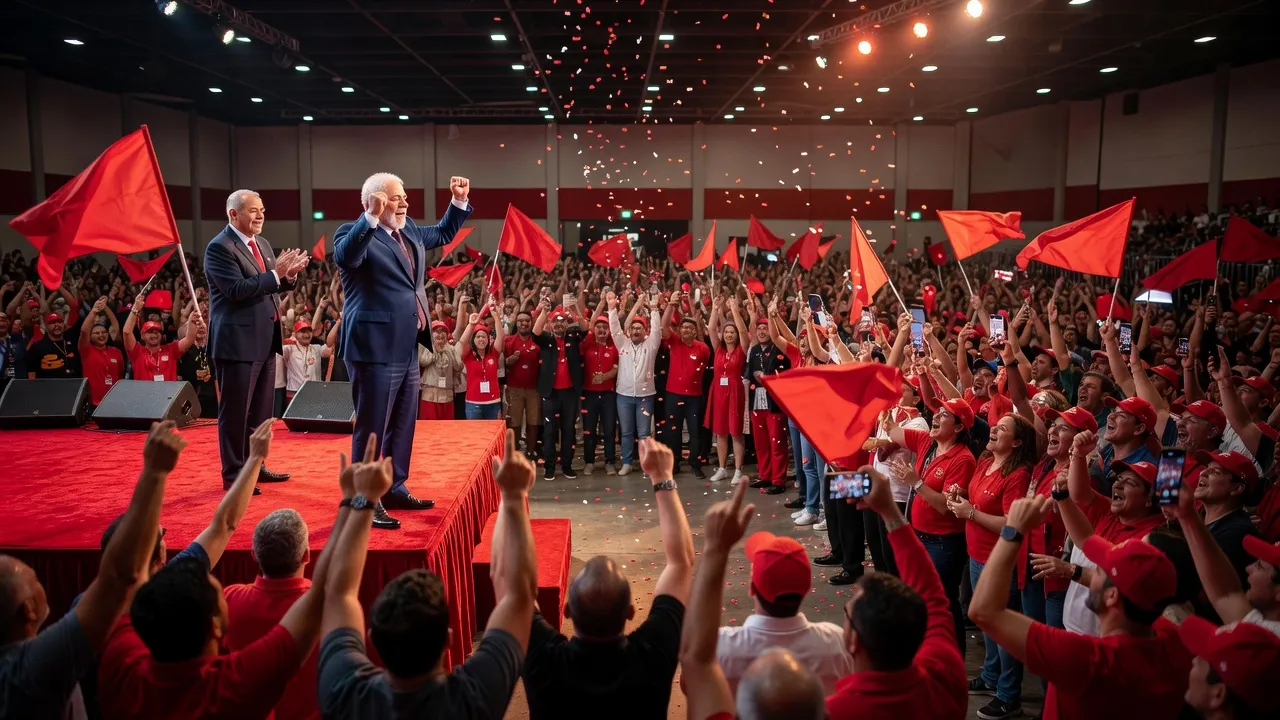
On August 2, the Workers' Party (PT) officially presented Lula's candidacy for a fourth term at Expo Center Norte in São Paulo, with 80-year-old Lula and Geraldo Alckmin confirmed as running mates.
Lula will face Senator Flávio Bolsonaro, 45, son of former president Jair Bolsonaro who was imprisoned for attempted coup in 2022, in October's election.
Lula highlights his physical vitality and fitness at age 80 as a campaign argument, positioning himself as a bulwark against a potential far-right return to power.
Some perspectives convey the reading of Lula as a 'physical barrier against the far-right,' while others detail accusations of being a 'thief' and 'corrupt' attributed to Javier Milei.
A majority of perspectives relay without reservation the narrative of vitality and struggle against aging championed by Lula, while others emphasize the recurring generational angle or question how long a historic left-wing figure should remain in power.
Some perspectives view the candidacy primarily through the lens of trade tensions and tariffs with Washington, while others accord it secondary importance, focusing on the electoral or regional diplomatic arena.
This grouping describes the publications analysed, not the position of these countries’ populations or of their governments.
What the coverage of each country leaves aside, while others put it forward.
Brazil
Argentina
Uruguay
Preview: 3 of 10 media perspectives. Syntheses of the media analysed — not direct quotations. Method & limitations
Montevideo reads in Lula's candidacy a decisive test for Mercosur's balance, where left-wing continuity in Brasília shapes the region's stance toward Washington.
3 sources · View sources
Brasilia gauges the scale of an unprecedented candidacy: at 80, Lula pursues a fourth term and 16 cumulative years in power, in a campaign built on fear of the far right and on a conservative bloc struggling to unite against him.
6 sources · View sources
Buenos Aires finds itself mediating a personal clash that has become a state-level crisis: Lula's bid for a fourth term collides with Javier Milei's anti-left tirade, marked by ambassador recalls and diplomatic summons.
5 sources · View sources
DOMINANT ANGLE
Montevideo reads in Lula's candidacy a decisive test for Mercosur's balance, where left-wing continuity in Brasília shapes the region's stance toward Washington.
ANALYSIS
Montevideo, August 3, 2026.
DOMINANT ANGLE
Brasilia gauges the scale of an unprecedented candidacy: at 80, Lula pursues a fourth term and 16 cumulative years in power, in a campaign built on fear of the far right and on a conservative bloc struggling to unite against him.
ANALYSIS
Brasilia, August 3, 2026.
DOMINANT ANGLE
Buenos Aires finds itself mediating a personal clash that has become a state-level crisis: Lula's bid for a fourth term collides with Javier Milei's anti-left tirade, marked by ambassador recalls and diplomatic summons.
ANALYSIS
Buenos Aires, August 3, 2026.
DOMINANT ANGLE
Santiago reads Lula's candidacy through the verbal clash with Milei, while gauging the cautious regional diplomacy chosen by Kast in response to neighboring populism.
ANALYSIS
Santiago, August 3, 2026.
DOMINANT ANGLE
Bogota weighs Lula's candidacy at age 80 as a mirror reflecting its own debates over the longevity of Latin American leftism and the aging of its historic figures.
ANALYSIS
Bogota, August 3, 2026.
DOMINANT ANGLE
Quito discerns in Lula's 80-year-old candidacy a regional counterpoint to the conservative wave that has already swept across multiple Latin American governments, with Ecuador itself having shifted rightward.
ANALYSIS
Quito, August 3, 2026.
DOMINANT ANGLE
Lima assesses the Milei-Lula crisis as symptomatic of regional polarization that could weigh on Brazil's October presidential election, while Peruvian diplomacy refrains from taking an official stance.
ANALYSIS
Lima, August 3, 2026.
DOMINANT ANGLE
Lisbon weighs Brazil's dual signal: Lula, 80, bidding for a fourth term, and surging public debt at its highest level since 2021.
ANALYSIS
Lisbon, August 3, 2026.
DOMINANT ANGLE
Paris reads Lula's candidacy as a dual challenge to age and to Donald Trump, a seventh electoral race framed by Brazilian sovereignty against American tariffs.
ANALYSIS
Paris, August 3, 2026.
DOMINANT ANGLE
Berlin examines both the chaotic restructuring of Brazil's right wing and the age of the outgoing president, who is running for a fourth term.
ANALYSIS
Berlin, August 3, 2026.
Explore every perspective on this subject across 10 countries.
Compare viewpoints and see where they diverge.
published on
countries
sources
articles
gap
The Workers' Party (PT) formally nominated Luiz Inacio Lula da Silva, 80, president of Brazil, for a fourth term on Sunday, August 2, at a convention held at the Expo Center Norte in Sao Paulo before roughly 3,000 supporters. Geraldo Alckmin (PSB) was renominated as the vice-presidential candidate. In the first round, set for October 4, 2026, Lula will face Senator Flavio Bolsonaro, 45, son of former president Jair Bolsonaro and the Liberal Party's candidate. A victory would bring Lula to 16 cumulative years as president of Brazil.
Measured with the previous method (distance between texts), on a different scale.