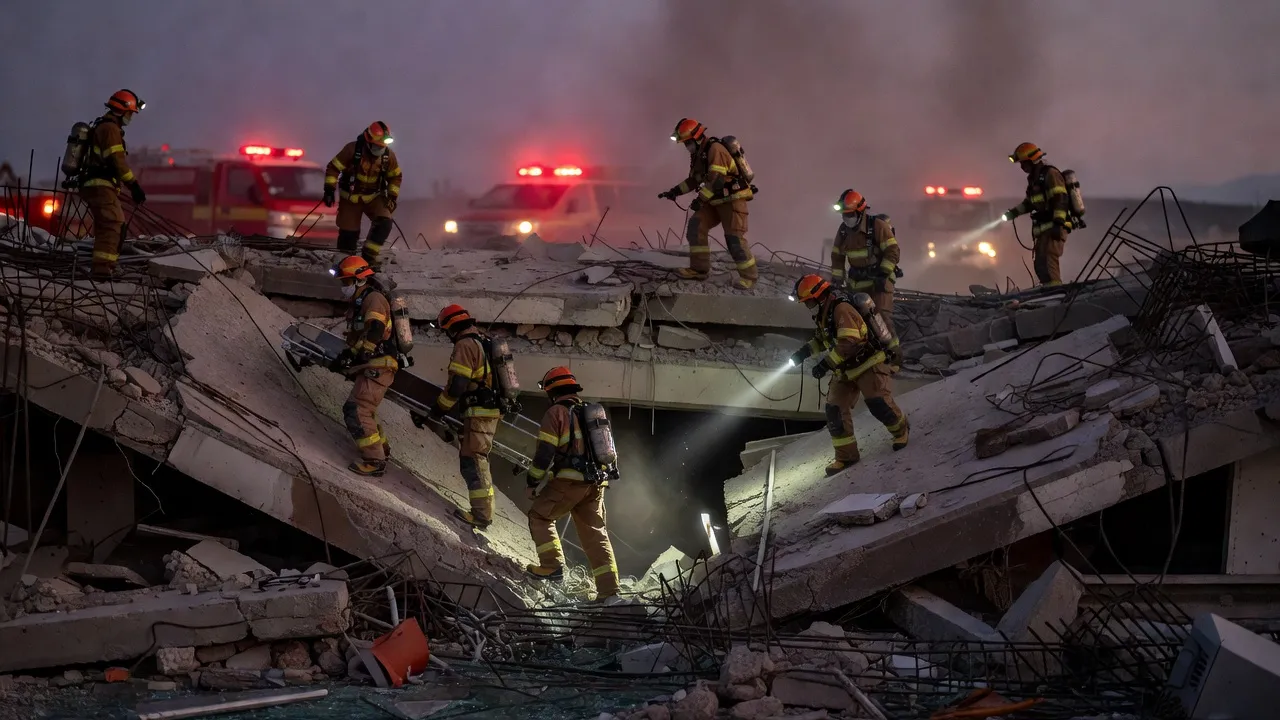
Magnitude 7.1 earthquake in southwestern Japan: a shopping mall collapses in Kumamoto
published on
countries
sources
articles
Measured with the previous method (distance between texts), on a different scale.
A magnitude 7.1 earthquake struck the island of Kyushu, in southwestern Japan, on Tuesday, July 28, with its epicenter in Kumamoto Prefecture. The next day, Prime Minister Sanae Takaichi announced a toll of at least 13 dead. An explosion caused the partial collapse of the second floor of the Aeon Mall shopping center in Kashima, where dozens of people remained missing. A tsunami warning issued for Ariake Bay was lifted within hours. Several thousand people were evacuated to shelters across the region.
Key figures
What the comparison reveals
Common ground and differences in coverage across the media analysed.
What the media report in common
A 7.1 magnitude earthquake (according to Japan Meteorological Agency, JMA) struck the Kumamoto/Kyushu region, bringing the death toll to at least 13 confirmed deaths according to Prime Minister Sanae Takaichi.
The second floor of Kashima's Aeon Mall shopping center collapsed following an explosion likely related to a gas leak, leaving 20 to 30 employees unreachable or trapped.
Approximately 9,000 to 10,000 people were evacuated to over 500 shelter centers spread across multiple prefectures, with massive deployment of rescue services and military personnel.
Where media coverage diverges
JMA vs USGS magnitude
Divergence between Japan Meteorological Agency, which maintains a magnitude of 7.1, and the U.S. Geological Survey, which revised it to 6.8; this gap in scientific measurement occupies a central place in some coverage and remains marginal elsewhere.
Coverage aligned with this reading
Economic vs humanitarian angle
Some coverage emphasizes regional industrial repercussions (semiconductors, automobiles), while others remain exclusively focused on the human toll and rescue operations.
Coverage that diverges
Mobilized memorial reference
Chinese press connects the earthquake to the national trauma of Tangshan (1976), while Japanese and Australian coverage refer to the local precedent of the 2016 Kumamoto earthquake.
This grouping describes the publications analysed, not the position of these countries’ populations or of their governments.
Blind spots
What the coverage of each country leaves aside, while others put it forward.
 France
- semiconductor supply chains (TSMC)
- Toyota factory closures
- international aid or solidarity with disaster victims
 United Kingdom
- regional economic or industrial consequences (semiconductors, automobiles)
 Australia
- regional economic or industrial repercussions
How each country reads it
Preview: 3 of 10 media perspectives. Syntheses of the media analysed — not direct quotations. Method & limitations
- Australia
Canberra assesses the magnitude of a catastrophe that rekindles memories of a devastating earthquake that struck the same Kyushu region a decade ago.
5 sources · View sources
 China
Beijing reads the Kumamoto earthquake as more than a foreign news story—it resonates with China's own seismic memory, revived by this year's 50th anniversary of the catastrophic 1976 Tangshan disaster.
3 sources · View sources
 Germany
Berlin assesses a dual shock: the immediate humanitarian crisis in Kumamoto and the broader, structural risk to semiconductor supply chains vital to German industry.
5 sources · View sources
The full text, country by country
Australia
DOMINANT ANGLE
Canberra assesses the magnitude of a catastrophe that rekindles memories of a devastating earthquake that struck the same Kyushu region a decade ago.
ANALYSIS
Canberra, 29 July 2026.
China
DOMINANT ANGLE
Beijing reads the Kumamoto earthquake as more than a foreign news story—it resonates with China's own seismic memory, revived by this year's 50th anniversary of the catastrophic 1976 Tangshan disaster.
ANALYSIS
Beijing, July 29, 2026.
Germany
DOMINANT ANGLE
Berlin assesses a dual shock: the immediate humanitarian crisis in Kumamoto and the broader, structural risk to semiconductor supply chains vital to German industry.
ANALYSIS
Berlin, July 28, 2026.
France
DOMINANT ANGLE
France assesses the scale of the Kumamoto earthquake through the lens of Japan's past disasters, balancing nuclear vigilance with memories of the 2016 tremors.
ANALYSIS
Paris, July 29, 2026.
 Japan
DOMINANT ANGLE
Tokyo assesses the scale of a disaster that revives memories of 2016, caught between a race against time at the collapsed Kashima shopping mall and heightened seismic vigilance along the Hinagu fault.
ANALYSIS
Tokyo, July 29, 2026.
 South Korea
DOMINANT ANGLE
Seoul reads Japan's 7.1-magnitude earthquake through tremors felt across its own southern provinces, weighing seismic readiness against growing scrutiny of emergency alert systems
ANALYSIS
Seoul, July 28, 2026.
 Malaysia
DOMINANT ANGLE
Kuala Lumpur monitors the economic aftershock of the Kumamoto earthquake, balancing humanitarian solidarity with concerns over regional automotive supply chain disruptions.
ANALYSIS
Kuala Lumpur, July 29, 2026.
United Kingdom
DOMINANT ANGLE
London decodes the Kumamoto earthquake through the lens of scientific precision and the mounting human toll, hour after hour.
ANALYSIS
London, July 29, 2026.
 United States
DOMINANT ANGLE
Washington measures the Kumamoto catastrophe through its own seismic expertise, with the USGS revising the magnitude to 6.8 while Tokyo maintains 7.1, reflecting a coverage approach that treats the quake as a scientific case study as much as a humanitarian crisis.
ANALYSIS
Washington, July 29, 2026.
 South Africa
DOMINANT ANGLE
Pretoria tracks a toll that mounts hour by hour in Japan, caught between rescue efforts under the rubble of a shopping mall and regional industrial vigilance.
ANALYSIS
Pretoria, July 29, 2026.
Explore every perspective on this subject across 10 countries.
Compare viewpoints and see where they diverge.