Common ground and differences in coverage across the media analysed.
Morocco intercepted migrants on Saturday near Fnideq, predominantly sub-Saharan, following online calls relayed on social media for a second collective crossing of the Ceuta border.
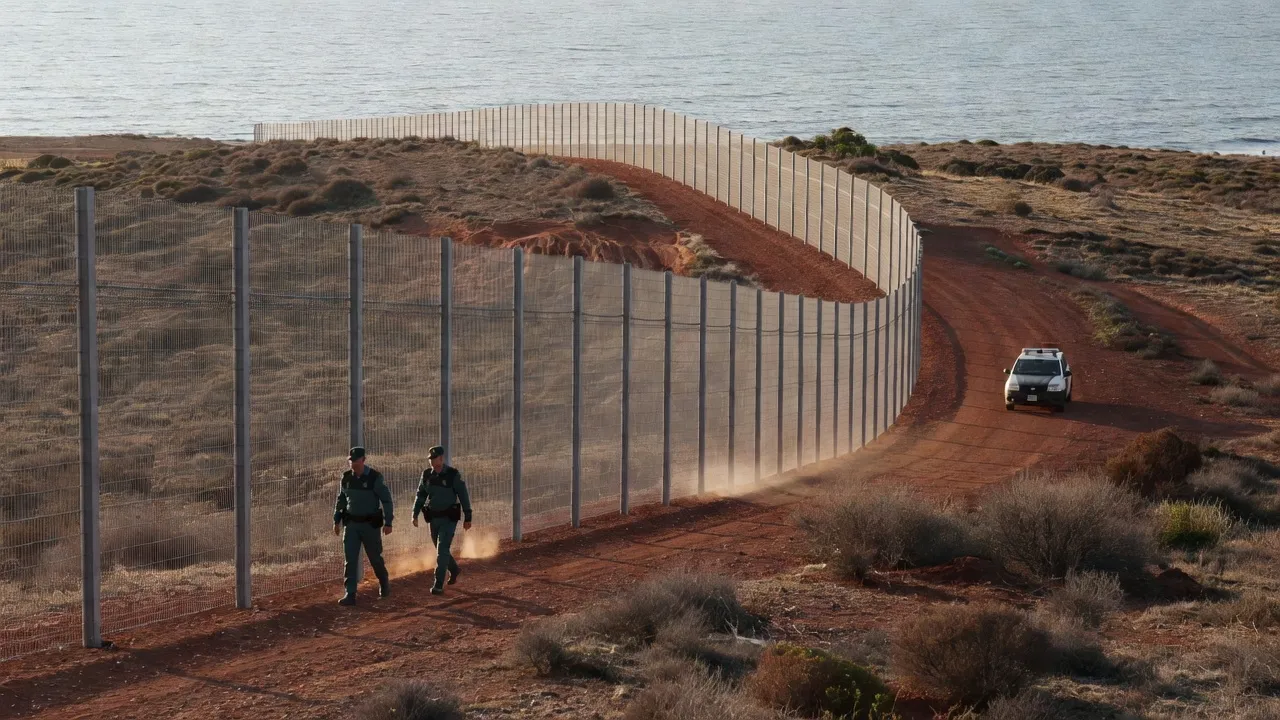
Spain reinforced its police and military apparatus at Ceuta and Melilla (additional personnel, maritime barrier) in response to these calls.
This episode is a direct continuation of the July 30-31 crisis, when approximately 72,000 migrants crossed the border over several days.
News outlets do not count the same scope: ES/IT/AU/UK cite the figure of 111 (or 110 according to TVE) persons intercepted near Fnideq, sourced from Reuters/EFE, while FR/SN retain 294 arrests reported by Le360 (248 sub-Saharans, 46 Moroccans), a total that appears to include persons arrested for online incitement in addition to candidates intercepted at the border. The figures therefore do not measure the same object.
The number of deaths attributed to the late July crossing varies according to counting methodology: QA retains 94 confirmed deaths (80 recorded on the Spanish side, 14 bodies recovered in Morocco), UK and AU cite up to 96-100 deaths according to Ceuta's mayor, while AR recalls a much wider gap between the Moroccan official toll (11), a Spanish medico-legal commission (at least 80), and NGOs (up to 141). This figure concerns the July event and not the arrests of the day, but its ambiguity feeds confusion between the two episodes.
Coverage aligned with this reading
Coverage that diverges
News outlets from the country of origin (Senegal) and part of the French press devote most of their coverage to investigating fake accounts and the viral rumor of border opening on a Spanish holiday, while other perspectives focus on the deployment of the Spanish-Moroccan police and military apparatus and Madrid's dependence on Rabat.
This grouping describes the publications analysed, not the position of these countries’ populations or of their governments.
What the coverage of each country leaves aside, while others put it forward.
Spain
Senegal
Russia
Preview: 3 of 9 media perspectives. Syntheses of the media analysed — not direct quotations. Method & limitations
Buenos Aires frames the new tensions at Ceuta as a direct continuation of July's migration crisis, rather than an isolated incident.
2 sources · View sources
Australia observes the second surge toward Ceuta as a working case study in EU-Morocco border cooperation, while recognizing distinct differences from Australia's own maritime arrival management framework.
4 sources · View sources
Madrid reinforces its security deployment at Ceuta and Melilla amid preparations for a potential second border incursion, while acknowledging Spain's reliance on Morocco's security cooperation.
5 sources · View sources
DOMINANT ANGLE
Buenos Aires frames the new tensions at Ceuta as a direct continuation of July's migration crisis, rather than an isolated incident.
ANALYSIS
Buenos Aires, August 16, 2026.
DOMINANT ANGLE
Australia observes the second surge toward Ceuta as a working case study in EU-Morocco border cooperation, while recognizing distinct differences from Australia's own maritime arrival management framework.
ANALYSIS
Canberra, August 16, 2026.
DOMINANT ANGLE
Madrid reinforces its security deployment at Ceuta and Melilla amid preparations for a potential second border incursion, while acknowledging Spain's reliance on Morocco's security cooperation.
ANALYSIS
Madrid, August 15, 2026.
DOMINANT ANGLE
Paris decodes how online rumors once again prompted migrants to attempt crossing to Ceuta, fifteen days after late July's massive influx, illustrating the interplay between digital disinformation and Morocco-Spain border enforcement.
ANALYSIS
Paris, August 16, 2026.
DOMINANT ANGLE
Rome draws a parallel from the Ceuta crisis to its own externalization agreements in central Mediterranean, where border control depends on a North African partner whose interests shift unpredictably.
ANALYSIS
Rome, August 16, 2026.
DOMINANT ANGLE
Doha links Morocco's Ceuta security buildup to unheeded Spanish border union warnings before July's mass crossing, per an investigation reported by Gulf Times.
ANALYSIS
Doha, August 16, 2026.
DOMINANT ANGLE
Moscow reads Ceuta as a barometer of Spain's structural dependence on Moroccan control over the migrant corridor reaching Europe.
ANALYSIS
Moscow, August 16, 2026.
DOMINANT ANGLE
Dakar decodes the viral rumors that pushed sub-Saharan youth toward Ceuta's border, while Rabat reports mass arrests of irregular migration candidates.
ANALYSIS
Dakar, August 16, 2026.
DOMINANT ANGLE
London examines Morocco's enforcement operations as a mirror of its own post-Brexit outsourcing strategy, recognizing that Europe's reliance on Rabat echoes Britain's Channel border logic.
ANALYSIS
London, August 16, 2026.
Explore every perspective on this subject across 9 countries.
Compare viewpoints and see where they diverge.
published on
countries
sources
articles
gap
On Saturday, August 15, 2026, Moroccan forces arrested migrants near Fnideq, at the border with Spain's Ceuta enclave, after online calls mistakenly announced that the border crossing would open on this Spanish holiday. Spanish authorities maintained reinforced security at Ceuta and Melilla, in coordination with Morocco. The incident comes two weeks after the massive crossing of July 30–31, when approximately 72,000 people entered the enclave.
The August 15 arrests dispersed attempts to gather, but arrest tallies and the human toll from July remain counted differently across sources.
11 deaths according to Rabat, 80 according to Spanish forensic authorities, up to 141 according to NGOs.
Viewed millions of times on Instagram, shared by recently created accounts, according to Dakaractu.
Approximately 9,000 personnel (police, civil guards, military) deployed in Ceuta and Melilla, according to Madrid.
Measured with the previous method (distance between texts), on a different scale.