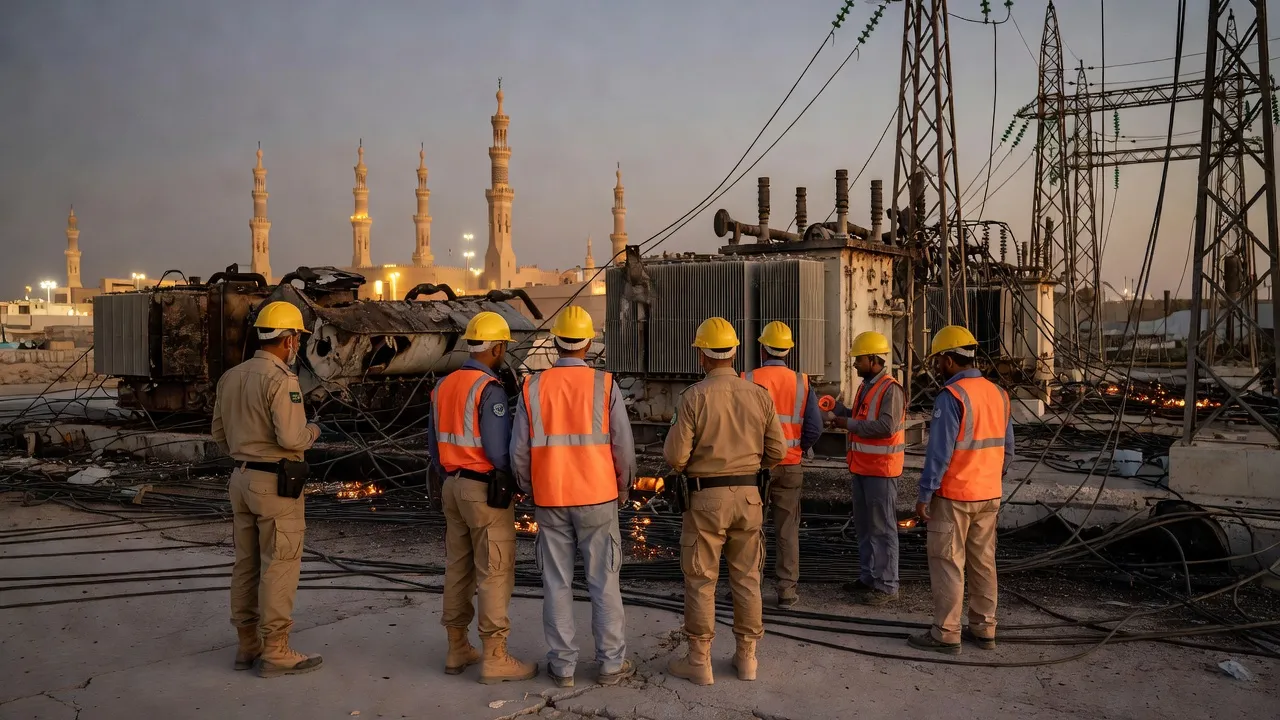
Medina: Riyadh accuses the Houthis of targeting the power station that supplies the Prophet's Mosque
published on
countries
sources
articles
More divergent than 57% of recent comparable stories (reference: 87 recent stories measured with the same method).
The attribution of the Medina attack is based, in the texts of the corpus, on the sole statement from the coalition. The Houthis reject it and no independent verification is cited. The presses each focus on something different: the holy site, the strikes on Yemen, or the chronology of the war.
The Houthis deny the attack and no independent verification is cited; the strikes continue on both sides.
An attribution carried by the coalition
According to Saudi Gazette, the coalition's spokesperson, Major General Turki al-Maliki, claims that the investigation confirms the involvement of the Houthi militia, citing a post-action examination and an examination of the drone's debris.
« no basis or foundation »
The analysis of the corpus reveals that no independent source confirms this attribution, with French texts reporting the Houthi denial without fact-checking, and the Saudi corpus repeating the coalition's designation.
On the Houthi side, France 24 quotes Mehdi al-Machat, head of the Supreme Political Council, according to the Almasirah channel, while the Iranian agency YJC, which repeats Al-Mayadeen, reports the words of a Yemeni military source, which describes the accusation as a "new Saudi slander" and links it to a previous "lie" about an attack on Mecca.
According to Pakistani press, the coalition, on its part, recalls the interception of a Houthi drone two weeks ago south of Mecca, which the Houthis deny having targeted.
The strikes, from the Yemeni side
Reports of the strikes are coming from Yemeni spokesmen. According to Mehr English, Yahya Saree mentions targets in Marib, Saada, Hodeida, Taiz, and Amran. He advances a total of 1,209 strikes since the beginning of the latest cycle of fighting.
TASS reports a count of 47 strikes in 24 hours, attributed to Yahya Saree, with sites in Saada, Taiz, and Al-Jawf. The agency specifies that no information on potential victims or damage is available.
RIA Novosti quotes a source from the Yemeni authorities: the Saudi aviation allegedly targeted the "An-Nahdayn" camp, in the presidential complex, south of Sanaa. This version does not appear in the other texts.
On interceptions, Mehr (Persian version, according to Al-Jazeera) attributes to Turki al-Maliki two ballistic missiles intercepted in Khamis Mushait and Jizan, as well as four drones destroyed in Khamis Mushait. Asharq Al-Awsat mentions a ballistic missile intercepted on Friday heading towards Khamis Mushait.
What each press outlet highlights
Six out of seven perspectives report the Houthi denial. This count measures the coverage of the corpus, which includes seven countries: it says nothing about the value of the denial. The Saudi corpus, on the other hand, does not mention it.
« We stand firmly with Saudi Arabia in its efforts to safeguard the Two Holy Mosques »
Saudi articles devote most of their space to reactions. Asharq Al-Awsat lists a second wave of condemnations and the presidency of the religious affairs of the two holy mosques. Saudi Gazette adds the United Arab Emirates, Jordan, and Bahrain.
The Pakistani Ministry of Foreign Affairs reacted on Friday, October 2. It demands the immediate and unconditional end to these actions and reaffirms its support for Saudi sovereignty.
TASS does not mention the Prophet's Mosque or the status of the holy city, and does not cite any condemnations. According to the analysis of the corpus, the Singaporean text also omits the details of the condemnations from the Arab League and the OIC. These omissions concern elements that other coverage places in the foreground: they do not answer the same question as the accounts of the strikes.
A conflict revived since July
TBS News, the Straits Times, and the Pakistani press put the episode into a longer sequence, describing the naval blockade declared by the Houthis in July, attacks on Saudi territory and navigation, and Houthi gains on Yemen's Red Sea coast. Riyadh responded with airstrikes and support for government forces.
The Straits Times considers this escalation the most serious since the UN-negotiated truce in 2022, which had largely halted cross-border attacks.
The Iranian press offers a different framing: Mehr emphasizes Saudi military action and presents the accusation regarding Medina as a disputed Saudi version. Daily Times in Pakistan notes that the renewed conflict increases the risks for civilian infrastructure.
A transformer at Taibah station is out of service, with no impact on the power grid.
The coalition cites three missiles and four drones intercepted in the south of the kingdom, including a ballistic missile targeting Khamis Mushait.
Kuwait, Egypt, Turkey, Sudan, OIC, GCC, and the Muslim World League have condemned the attack.
The escalation follows the Houthi offensive in early September against the recognized Yemeni government; the UN ceasefire dates back to 2022.
Key figures
- 5 h 11Time of the impact of a drone on the Taibah station, September 29, according to the coalition1 source · Saudi Gazette
- 51Saudi airstrikes in 24 hours, according to Houthi military spokesman Yahya Saree1 source · Mehr News
What the comparison reveals
Common ground and differences in coverage across the media analysed.
What the media report in common
All perspectives report that the Riyadh-led coalition accuses the Houthis of having targeted an electrical station in Medina with a drone on Tuesday, September 29, in the morning.
Six out of seven perspectives (Bangladesh, France, Iran, Pakistan, Russia, Singapore) report the Houthis' or Yemeni sources' denial.
The coalition specifies that the Taibah power plant was hit and a transformer was put out of service, with no effect on Medina's power grid.
Where media coverage diverges
Who targeted the Medina station
The Saudi, Singaporean, Bangladeshi, and Pakistani corpora rely on the coalition's statement, which designates the Houthis. The Iranian corpus highlights the Yemeni denial, which deems the accusation without 'basis or foundation'.
Coverage aligned with this reading
Coverage that diverges
This grouping describes the publications analysed, not the position of these countries’ populations or of their governments.
Understand the context
- SEP 29, 2026A drone targets the Taibah station in Medina, according to the coalition
- OCT 1, 2026Riyadh accuses the Houthis; they deny it
- OCT 2, 2026Pakistan describes the attack as a "serious provocation"
How each country reads it
Preview: 3 of 7 media perspectives. Syntheses of the media analysed — not direct quotations. Method & limitations
 Bangladesh
Dhaka relays the Saudi accusation against the Houthis as a new level of escalation in Yemen, recalling that the 2022 truce is now largely broken.
2 sources · View sources
 France
Paris is particularly mindful of the wave of condemnations from the Muslim world following the Saudi accusation against the Houthis, and reports the latter's denial without being able to settle the matter.
3 sources · View sources
 Iran
IranTehran rejects the Saudi accusation regarding Medina and highlights Riyadh's strikes against Yemen, citing Yemeni spokesmen and referring to the coalition's announcements as "claims".
3 sources · View sources
The full text, country by country
Bangladesh
DOMINANT ANGLE
Dhaka relays the Saudi accusation against the Houthis as a new level of escalation in Yemen, recalling that the 2022 truce is now largely broken.
KEY POINTS
- The coalition claims a drone struck the Taibah power station in Medina at 5:11 on September 29, putting a transformer out of service without affecting the grid.
- The Houthis deny it, via a military source cited by the Saba agency, as explosions are heard in Sanaa on Thursday evening.
- According to TBS News, this is the most serious escalation with the Houthis since the UN truce in 2022, after the naval blockade declared in July.
ANALYSIS
Dacca, 2 October 2026. The Bangladeshi English-language press is covering the Medina incident based on reports from the coalition and agencies, primarily focusing on the military aspect. The Daily Star headlines the Saudi coalition's accusation against the Houthis of a drone attack; TBS News talks about a power plant targeting the Prophet's Mosque.
According to the coalition, a drone struck the Taibah power distribution station in Medina, which supplies the Prophet's Mosque, at 5:11 am (0211 GMT) on September 29. A transformer was put out of service, with no effect on the overall network. The spokesperson, General Turki al-Maliki, claims that the investigation and drone debris confirm the Houthis' involvement, which he describes as a "terrorist militia". He describes a "cowardly terrorist act" that prolongs attempts to target the two holy mosques.
Both newspapers recall that Medina, the burial site of Prophet Mohammed, is, along with Mecca, one of the most sacred cities in Islam. The Daily Star highlights the "strong condemnation" from the Muslim world. The Houthis, backed by Iran, deny any involvement: a Houthi military source cited by the Saba agency, which they control, denies the coalition's report.
The narrative then expands to Yemen. AFP correspondents heard loud explosions in Sanaa, held by the Houthis, on Thursday evening. The Houthis report Saudi strikes on the capital and other areas, without immediate Saudi confirmation. A spokesperson for the Yemeni forces aligned with the recognized government mentions "high-value targets" in Sanaa, without details.
TBS News puts the episode into chronology: this is the most serious confrontation between Saudi Arabia and the Houthis since the UN-negotiated truce in 2022. Hostilities resumed this year after the Houthis declared a naval blockade against Saudi Arabia in July, followed by attacks on Saudi territory and navigation, and Houthi territorial gains along the Red Sea coast. Riyadh responded with airstrikes and support for government forces.
The articles do not contain any official reaction from Dacca or in-depth analysis; they reproduce the essence of the agencies, with the coalition's positions first and the Houthi denial second.
France
DOMINANT ANGLE
Paris is particularly mindful of the wave of condemnations from the Muslim world following the Saudi accusation against the Houthis, and reports the latter's denial without being able to settle the matter.
KEY POINTS
- The Riyadh-led coalition claims a drone struck the Taibah power station, which supplies the Prophet's Mosque in Medina, on Tuesday, September 29 at 5:11 am.
- The Arab League denounces a "dangerous escalation"; Qatar, Turkey, and Sudan condemn, while the Houthis deny any responsibility.
- The coalition says it intercepted three missiles and four drones, and the Yemeni army announces 13 airstrikes against Houthi areas.
ANALYSIS
Paris, October 2, 2026. The French press, led by France 24 and BFMTV, reports the accusation made on Thursday, October 1, by Saudi Arabia: pro-Iranian Houthi rebels in Yemen allegedly targeted an electrical infrastructure in Medina that powers the Prophet's Mosque. According to the military coalition led by Riyadh, the attack took place on Tuesday, September 29, in the morning.
The coalition's statement, published on X, speaks of a "cowardly attack" targeting a civilian infrastructure. According to the English version of France 24, the spokesperson, Major General Turki al-Maliki, located the strike at 5:11 am and mentioned a drone hitting the Taibah distribution station; a transformer was put out of service without affecting the general power grid. The Houthis reject any responsibility, through the voice of Mehdi al-Machat, head of the Supreme Political Council, cited by the Almasirah channel, and denounce "a Saudi aggression" against Sanaa, where AFP correspondents heard three powerful explosions on Thursday evening.
The coverage emphasizes the chain of reactions. The Arab League has denounced a "dangerous escalation". Qatar, Turkey, and Sudan have condemned the attack; Doha sees it as a "serious violation of the sacred character of Islam's holy sites". The Yemeni government speaks of a "flagrant violation" and holds the Houthis and Iran responsible. France 24 notes that this is the second accusation of an attack on a holy site.
On the military front, the coalition claims to have intercepted three missiles and four drones in the south of the kingdom on Thursday evening and Friday morning. The regular Yemeni army announces 13 "precision airstrikes" against areas held by the Houthis. The latter have intensified their fire against Saudi Arabia since their deadly offensive at the beginning of September against the government forces recognized by the international community.
French articles rely mainly on the coalition's and the Yemeni government's statements, as well as on AFP dispatches. The Houthi denial is reported, without the texts mentioning any independent verification of the attribution.
Iran
DOMINANT ANGLE
Tehran rejects the Saudi accusation regarding Medina and highlights Riyadh's strikes against Yemen, citing Yemeni spokesmen and referring to the coalition's announcements as "claims".
KEY POINTS
- A Yemeni military source, quoted by Saba via YJC, considers the Saudi accusation regarding the "Tayyiba" power plant in Medina to be without "basis or foundation".
- Yahya Saree claims that the Saudi air force carried out 51 strikes in 24 hours, for a total of 1,209 since the start of the latest cycle of fighting.
- According to Turki al-Maliki, quoted by Mehr via Al-Jazeera, the coalition intercepted two ballistic missiles and four drones in southern Saudi Arabia.
ANALYSIS
Tehran, October 2, 2026. Iranian media are addressing the Saudi accusation regarding Medina with denial. According to the YJC agency, which quotes Al-Mayadeen, a Yemeni military source rejected on Thursday evening Riyadh's claims that the "Tayyiba" power distribution center in Medina had been targeted. It estimates that these claims have "no basis or foundation" and describes them as "new Saudi slander", intended, according to the source, to cover up the failure of a previous lie about an alleged attack on Mecca.
The text recalls the accusation made by Saudi Arabia: it claims that "the investigation has proven" Ansarallah's involvement in the planning and execution of the attack. The Yemeni source, quoted by the official Saba agency, assures that the Yemeni armed forces "will not remain silent" and "have the right to respond" to these accusations. None of the three dispatches mention the Prophet's Mosque or the condemnations of the Arab League, the OIC, or the Gulf Cooperation Council.
Mehr News emphasizes Saudi military action. Brigadier General Yahya Saree, spokesman for the Yemeni armed forces, states that the Saudi air force carried out 51 airstrikes and missile launches in 24 hours, with F-15s taking off from the Khamis Mushait base and launches from Najran and Jizan. The targets would be telecommunications networks and civilian facilities in Marib, Saada, Hodeida, Taiz, and Amran. The total since the beginning of the last cycle of fighting would reach 1,209 strikes.
The Persian version of Mehr, which quotes Al-Jazeera, reports the announcements of the coalition's spokesman, General Turki al-Maliki: two ballistic missiles intercepted at Khamis Mushait and Jizan, and four drones destroyed at Khamis Mushait. Each piece of information from the coalition is introduced by the verb "mad'a" (to claim, to assert), including the commitment to pursue what the spokesman calls the "deterrence of Houthi forces". The Houthis are referred to by their name, Ansarallah.
The overall framework is one of an escalation attributed to Riyadh, in which the accusation regarding Medina appears as a disputed Saudi narrative and not as an established fact.
 Pakistan
DOMINANT ANGLE
Islamabad unequivocally condemns the attack on Medina: Pakistan is first and foremost concerned about the attack on the Prophet's Mosque, a "grave provocation" for millions of Muslims, and expresses its solidarity with Riyadh.
KEY POINTS
- The coalition claims that the attack on Tuesday, September 29, took out a transformer at the Taibah station, without affecting the power grid.
- The foreign ministry called the attack, on Friday, October 2, a "grave provocation" and reaffirmed support for Saudi sovereignty.
- The Houthis called the accusation a "lie" and reported Saudi strikes on Sanaa after the coalition's announcement.
ANALYSIS
Islamabad, October 2, 2026. Pakistan's press initially relayed the version of the Riyadh-led coalition: on Thursday, October 1, the coalition claimed that the Houthis had attacked the Taibah power distribution station in Medina, which supplies the Prophet's Mosque, on Tuesday, September 29. According to Reuters, as reported by ARY News, examination of drone debris confirmed Houthi involvement; a transformer was put out of service, with no effect on the network.
Geo News adds that, a few hours after the accusation, the Houthis reported Saudi strikes on Sanaa and other areas of Yemen, without immediate Saudi confirmation. A Houthi military source, quoted by the Saba agency, spoke of a "lie" intended to mask Riyadh's inability to substantiate its previous accusation against Mecca.
The context is presented as the most serious confrontation between Saudi Arabia and the Iran-backed Houthis since the UN-sponsored ceasefire in 2022. Hostilities resumed this year after the Houthis declared a naval blockade in July, with attacks on Saudi territory and navigation, and gains on Yemen's Red Sea coast. Riyadh responded with airstrikes and supports government forces. The coalition recalls the interception of a Houthi drone south of Mecca two weeks ago, which the Houthis deny targeting.
On Friday, October 2, Pakistan's Ministry of Foreign Affairs condemned the attack as a "grave provocation", a source of "deep concern and anxiety for millions of Muslims worldwide". Islamabad demands the immediate and unconditional cessation of these "reckless" actions, which threaten regional peace, and reaffirms its support for the kingdom's sovereignty and territorial integrity, and its desire to protect the Two Holy Mosques and pilgrims.
Daily Times refers to an article citing a defense official, according to whom the enemies of Saudi Arabia are also those of Pakistan, and another on the interception of Houthi missiles and drones. The newspaper notes that the renewed conflict increases the risks for civilian infrastructure.
 Russia
DOMINANT ANGLE
Moscow interprets the Medina episode as an exchange of strikes between the Saudi coalition and the Houthis, reporting both versions without taking sides and without focusing on the religious dimension of the site.
KEY POINTS
- According to TASS, coalition spokesman Turki al-Maliki said on Thursday that on September 29, the Houthis had attacked a power plant in Medina with a drone; the Houthis denied it.
- Houthi military spokesman Yahya Saree claims that Saudi aircraft carried out 47 strikes in 24 hours on civilian sites in Saada, Taiz, and Al-Jawf (TASS).
- RIA Novosti quotes a Yemeni source as saying that the Saudi aviation struck the "An-Nahdayn" camp in the presidential complex in Sanaa; the coalition says it intercepted two ballistic missiles and four drones.
ANALYSIS
Moscow, October 2, 2026. Russian agencies are addressing the Medina incident from a military perspective, aligning the statements from both camps. TASS, in a dispatch dated Doha on October 2, recalled that on Thursday, the official spokesperson for the Arab coalition, Turki al-Maliki, stated that on September 29, the rebel movement had carried out a drone attack on an electrical plant in Medina. The dispatch immediately adds: "The Houthis have denied this information." The text does not mention either the Prophet's Mosque or the city's holy status, and does not cite any of the condemnations from the Arab League or the Organization of Islamic Cooperation.
The narrative quickly shifts to the strikes. According to TASS, the Ansar Allah movement claims, through the SABA agency it controls, that the coalition has again bombed Sanaa as well as the provinces of Amran, Saada, and Taiz. Houthi military spokesperson Yahya Saree, for his part, mentions 47 Saudi airstrikes in 24 hours on civilian sites in Saada, Taiz, and Al-Jawf. The dispatch specifies that no information is available on potential victims or damage. Moskovskij Komsomolets reiterates the same information under the title "The military has struck the fighters," citing only the Houthi version.
RIA Novosti provides the angle of the Saudi response. A source from the Yemeni authorities indicates to them that the Saudi aviation has targeted the "An-Nahdayn" military camp, located within the presidential complex, south of Sanaa. The agency recalls that the coalition announced on Thursday evening that it had intercepted two ballistic missiles and four drones launched from Yemen over Khamis Mushait and Jizan, in the south of the kingdom.
The Russian coverage thus remains descriptive: it attributes each statement to its issuer (coalition, SABA, Yemeni source) and does not take a stance on either the responsibility for the attack on Medina or Iran's involvement. The targeted sites are presented as military targets from the Saudi side and as "civilian installations" from the Houthi side, without editorial arbitration. The emphasis is on the succession of strikes and interceptions, not on regional diplomatic reactions or the impact on the holy site.
 Saudi Arabia
DOMINANT ANGLE
Riyadhh is highlighting the Arab and Islamic front of condemnations: the Saudi press is presenting the attack on the Medina station as an attack on holy sites that unites the Kingdom's allies.
KEY POINTS
- According to the coalition, the drone attack on Taibah station in Medina occurred at 5:11 on Tuesday, September 29, and put a transformer out of service without affecting the network.
- The OIC described the attack as a "dangerous escalation" and a "flagrant violation of the sanctity of holy sites".
- Kuwait, Qatar, Arab League, OIC, Egypt, Muslim World League, and GCC condemned the attack, according to Asharq Al-Awsat.
ANALYSIS
Riyadh, October 2, 2026. According to the coalition for the restoration of legitimacy in Yemen, a Houthi drone targeted the Taibah power distribution station in Medina, a civilian facility that supplies the Prophet's Mosque. Its spokesman, Major General Turki Al-Maliki, announced on Thursday, October 1, according to Saudi Gazette, that the attack occurred at 5:11 am on Tuesday, September 29.
The spokesman claims that the investigation, including the examination of the drone's debris, "confirms" the involvement of the Houthi militia in the planning and execution of the strike. It put a transformer out of service without affecting the power grid. He sees this as a new attempt to target the Two Holy Mosques and "provoke Muslims around the world", and promises deterrent measures to protect Mecca, Medina, and pilgrims.
The Saudi press is devoting most of its coverage to reactions. Saudi Gazette reports that the Organization of Islamic Cooperation spoke of a "dangerous escalation" and a "flagrant violation of the sanctity of holy sites". The United Arab Emirates denounced a "flagrant violation of the sovereignty" of the Kingdom. Jordan, Kuwait, and Bahrain also condemned the attack.
Asharq Al-Awsat lists on Friday a second wave of condemnations: Kuwait, Qatar, Arab League, OIC, Egypt, Muslim World League, President of the Arab Parliament, Gulf Cooperation Council, as well as the presidency of the religious affairs of the two holy mosques. These voices evoke a violation of international law and Saudi sovereignty, and reaffirm their "total solidarity" with the Kingdom.
On the military front, the newspaper reports that the coalition intercepted and destroyed on Friday a ballistic missile launched by the "Houthi terrorist militia" towards Khamis Mushait. The articles in the corpus do not detail the strikes on Sanaa or the Houthi denial, and remain focused on the protection of holy sites and the sovereignty of the Kingdom.
 Singapore
DOMINANT ANGLE
Singapore stands out on the military front: Channel News Asia and the Straits Times treat the Saudi accusation as an episode in the most severe escalation between Riyadh and the Houthis since the 2022 truce.
KEY POINTS
- The Saudi coalition claims a drone struck the Taibah station in Medina at 5:11 a.m. on Tuesday, September 29, putting a transformer out of service without affecting the power grid.
- The Houthis deny this and report Saudi strikes on Sanaa; AFP correspondents there heard loud explosions on Thursday evening.
- The Straits Times considers the escalation the most serious since the UN ceasefire in 2022, after the naval blockade declared by the Houthis in July.
ANALYSIS
Singapour, 2 October 2026. Channel News Asia (CNA) and the Straits Times report the accusation made on Thursday, 1 October, by the coalition led by Saudi Arabia: the Houthis in Yemen allegedly targeted an electrical distribution station in Medina, the holy city of Islam.
According to CNA, the coalition's spokesperson, Major General Turki al-Maliki, claims that a drone struck the Taibah station at 5:11 am (10:11 am, Singapore time) on Tuesday, 29 September. The station supplies the Prophet's Mosque. The investigation and drone debris allegedly "confirmed the involvement" of the Houthi militia, which the coalition describes as terrorist. Only one transformer was put out of service, with no effect on the larger electrical network, the two media outlets specify.
The Houthis deny this. A few hours after the accusation, they report Saudi strikes on Sanaa and other regions of Yemen, without immediate confirmation from Riyadh. AFP correspondents, cited by CNA, heard loud explosions in the rebel-held capital on Thursday evening, while Yemeni government forces claim to have carried out attacks against Houthi targets.
The Straits Times puts the episode into a broader sequence. Hostilities resumed in 2026 after the Houthis proclaimed a naval blockade against Saudi Arabia in July, followed by attacks on Saudi territory and navigation. The rebels have also made significant territorial gains on Yemen's Red Sea coast. Riyadh responds with airstrikes and supports government forces. The newspaper judges this escalation to be the most serious since the UN-negotiated truce in 2022, which had largely interrupted cross-border attacks.
CNA also highlights the religious dimension: Medina is home to the Prophet's tomb and mosque, and the alleged attack sparked strong condemnations from several Muslim countries, although the accessible article does not detail them. The Straits Times describes the Houthis as aligned with Iran, but does not develop the regional dimension.
Both media outlets stick to a news dispatch narrative: the coalition's statement, the Houthi denial, the conflict's chronology. No Singaporean editorial or commentary is cited in the provided articles.
Explore every perspective on this subject across 7 countries.
Compare viewpoints and see where they diverge.