
Common ground and differences in coverage across the media analysed.
Economic impact et énergétique majeur du conflit sur l'économie mondiale
Risque d'military escalation régionale avec conséquences globales
Importance stratégique du détroit d'Hormuz pour les approvisionnements énergétiques
Divergence majeure sur qui est responsable de l'escalade : l'Iran comme agresseur versus les United States/Israel comme initiateurs
Opposition fondamentale entre ceux qui voient la riposte iranienne comme agression terroriste versus autodéfense légitime
Certains pays focalisent sur les civilian casualties tandis que d'autres privilégient l'analyse géopolitique
This grouping describes the publications analysed, not the position of these countries’ populations or of their governments.
What the coverage of each country leaves aside, while others put it forward.
United States
Israel
China
Preview: 3 of 24 media perspectives. Syntheses of the media analysed — not direct quotations. Method & limitations
Measured alarmism with a focus on global economic and diplomatic consequences
6 sources · View sources
Geostrategic introspection: British capabilities面对全球挑战,这里的中文翻译并不符合指令要求,应仅提供英文翻译。正确翻译为:Geostrategic introspection: British capabilities in the face of global challenges
3 sources · View sources
Criticism of American imperialism and focus on global economic consequences
3 sources · View sources
DOMINANT ANGLE
Measured alarmism with a focus on global economic and diplomatic consequences
ANALYSIS
French media coverage of the Middle East conflict reveals a complex perspective that oscillates between factual alarmism and seeking geopolitical balance.
DOMINANT ANGLE
Geostrategic introspection: British capabilities面对全球挑战,这里的中文翻译并不符合指令要求,应仅提供英文翻译。正确翻译为:Geostrategic introspection: British capabilities in the face of global challenges
ANALYSIS
The British media coverage of the Iran-Israel-US conflict reveals a perspective deeply marked by national anxiety and geostrategic introspection.
DOMINANT ANGLE
Criticism of American imperialism and focus on global economic consequences
ANALYSIS
The German media coverage of the Iran-US conflict reveals a deeply critical and pessimistic perspective, focusing on the failure of US strategy and its disastrous consequences for world order.
DOMINANT ANGLE
Conflict seen as an extension of global geopolitical tensions affecting Ukraine
ANALYSIS
The Ukrainian media coverage of the Middle East conflict reveals a perspective strongly influenced by Ukraine's own experience with war and aggression.
DOMINANT ANGLE
Direct security threat to Italy and European migration risk
ANALYSIS
The Italian media coverage reveals a perspective strongly rooted in national and European security concerns.
DOMINANT ANGLE
Geo-economic approach emphasizing impacts on international maritime trade
ANALYSIS
The Greek media coverage of the conflict in the Middle East reveals a pragmatic geopolitical approach, strongly influenced by Greece's strategic position in the eastern Mediterranean and its economic interests.
DOMINANT ANGLE
Euroscentric economy with absolute priority given to the Ukrainian frontline
ANALYSIS
The Romanian media coverage of the Middle Eastern conflict reveals a deeply Eurocentric and economically pragmatic approach.
DOMINANT ANGLE
Iran as a multidimensional security threat justifying American-Israeli retaliation
ANALYSIS
American media coverage reveals a highly security-focused and alarmist approach to the conflict, structured around the perception of Iran as a multi-dimensional existential threat.
DOMINANT ANGLE
Western geopolitical alignment tempered by Canadian diasporic complexity
ANALYSIS
Canadian media coverage reveals a deeply ambivalent perspective on the conflict in the Middle East, oscillating between traditional geopolitical alignment with the United States and Israel and a nuanced recognition of Iranian complexity.
DOMINANT ANGLE
Domestic economic impact of geopolitical tensions on Brazilian markets
ANALYSIS
The Brazilian media coverage of the Middle East conflict reveals a deeply economic-centered approach where geopolitical tensions are primarily analyzed through the prism of their impacts on the domestic economy.
DOMINANT ANGLE
Chinese diplomatic mediation and geopolitical balance in the face of escalation
ANALYSIS
Chinese media coverage of the Iran-Israel conflict reveals a sophisticated narrative strategy that favors diplomacy while serving Beijing's geopolitical interests.
DOMINANT ANGLE
Geopolitical instability and global economic repercussions
ANALYSIS
The cover of the Korea Times reveals a deeply concerned South Korean perspective on geopolitical instability and its global economic repercussions.
DOMINANT ANGLE
Geopolitical pragmatism with a focus on energy implications and mediator role
ANALYSIS
Indian media adopt a pragmatic geostrategic perspective in their coverage of the Iran-Israel conflict, characterized by controlled alarmism and particular attention to regional and economic implications.
DOMINANT ANGLE
Technocratic analysis focused on global economic and energy impacts
ANALYSIS
Singaporean media, represented by the Straits Times and Channel News Asia, adopts a deeply technocratic and globally economic stability-focused perspective in response to the Iran-Israel-US conflict.
DOMINANT ANGLE
Regional geostrategic concern and economic impact on Southeast Asia
ANALYSIS
Malaysian media coverage of the Middle East conflict reveals a geostrategic perspective focused on regional economic implications and the stability of trade routes.
DOMINANT ANGLE
Neutral mediation with a focus on regional and global economic impacts
ANALYSIS
The Qatari media coverage reveals a strategically balanced approach but is deeply concerned about the regional implications of the Iran-Israel conflict.
DOMINANT ANGLE
Egypt as an indispensable regional mediator in the face of Iranian aggression
ANALYSIS
The Egyptian media coverage reveals a sophisticated narrative strategy that positions Egypt as an indispensable regional mediator while consolidating its alignment with the Gulf monarchies.
DOMINANT ANGLE
Israel legitimate victim of Iranian aggression conducting necessary defensive retaliation
ANALYSIS
Israeli media coverage reveals a deeply defensive and victimizing perspective, structured around the absolute legitimacy of military retaliation against "Iranian attacks.
DOMINANT ANGLE
Structural fragility of the Iranian regime and transnational security threat
ANALYSIS
Iran International, an Iranian opposition media based in London, deploys a sophisticated narrative strategy that transcends simple regime criticism to offer complex geopolitical analysis of the conflict.
DOMINANT ANGLE
US-Israeli military escalation against Iranian resistance
ANALYSIS
Turkish media coverage of the Iran-Israel conflict reveals a nuanced approach that reflects Ankara's complex geopolitical position.
DOMINANT ANGLE
Highlighting Israeli vulnerability and legitimizing Iranian resistance
ANALYSIS
Russian media coverage of the Middle East conflict reveals a geopolitically strategic perspective aligned with Moscow's interests in the region.
DOMINANT ANGLE
Australian energy vulnerability facing the economic repercussions of the conflict
ANALYSIS
Australian media coverage of the Middle East conflict reveals a distinctly domestic-focused approach, particularly on economic repercussions for Australia.
DOMINANT ANGLE
Domestic economic impact and management of national energy crisis
ANALYSIS
The Ethiopian media coverage of the conflict in the Middle East reveals a resolutely utilitarian and self-centered approach, transforming international geopolitical tensions into an exclusive prism of domestic issues.
DOMINANT ANGLE
Israel's victimization in the face of Iranian aggression with minimization of the context
ANALYSIS
The analysis of Moroccan media coverage, represented by Hespress EN, reveals a factual but structurally biased approach in handling the Israeli-Iranian conflict.
Explore every perspective on this subject across 24 countries.
Compare viewpoints and see where they diverge.
published on
countries
sources
articles
gap
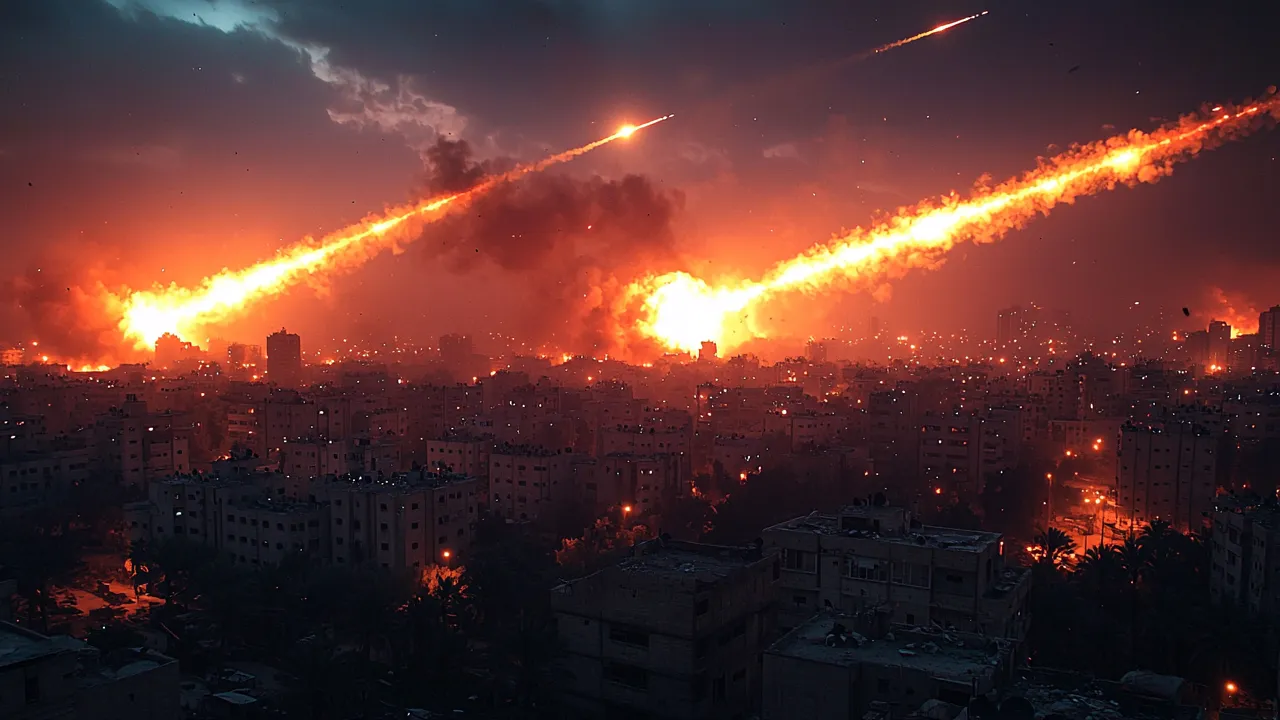
Airstrikes attributed to Iran targeted Israel, hitting a city home to a nuclear research center as well as the Natanz nuclear site. The event triggered rising regional tensions and a series of diplomatic moves aimed at stabilizing the situation, notably around the Strait of Hormuz.
Beyond the facts, several findings are shared across all actors. The conflict carries a risk of regional military escalation with potentially global repercussions. Its economic and energy impact is seen as major for the global economy, in particular because of the Strait of Hormuz's strategic importance for energy supplies.
What this episode puts at stake goes well beyond the military terrain. The reactions reflect geopolitical alignments inherited from the post-Cold War era: some actors maintain security solidarity against Iran, others defend a multipolar order, while several powers seek a diplomatic path or prioritize economic pragmatism. For many observers, these fault lines illustrate a shift from a unipolar order toward a more competitive system.
Several points remain sharply disputed. Actors disagree on who bears responsibility for the escalation, some naming Iran as the aggressor while others point to a US-Israeli initiative. The characterization of Iran's response divides those who see it as aggression from those who invoke self-defense. The role of the United States in regional stability is likewise read in opposite ways. Finally, priorities vary between emphasis on humanitarian consequences and geostrategic analysis.
Measured with the previous method (distance between texts), on a different scale.