
Common ground and differences in coverage across the media analysed.
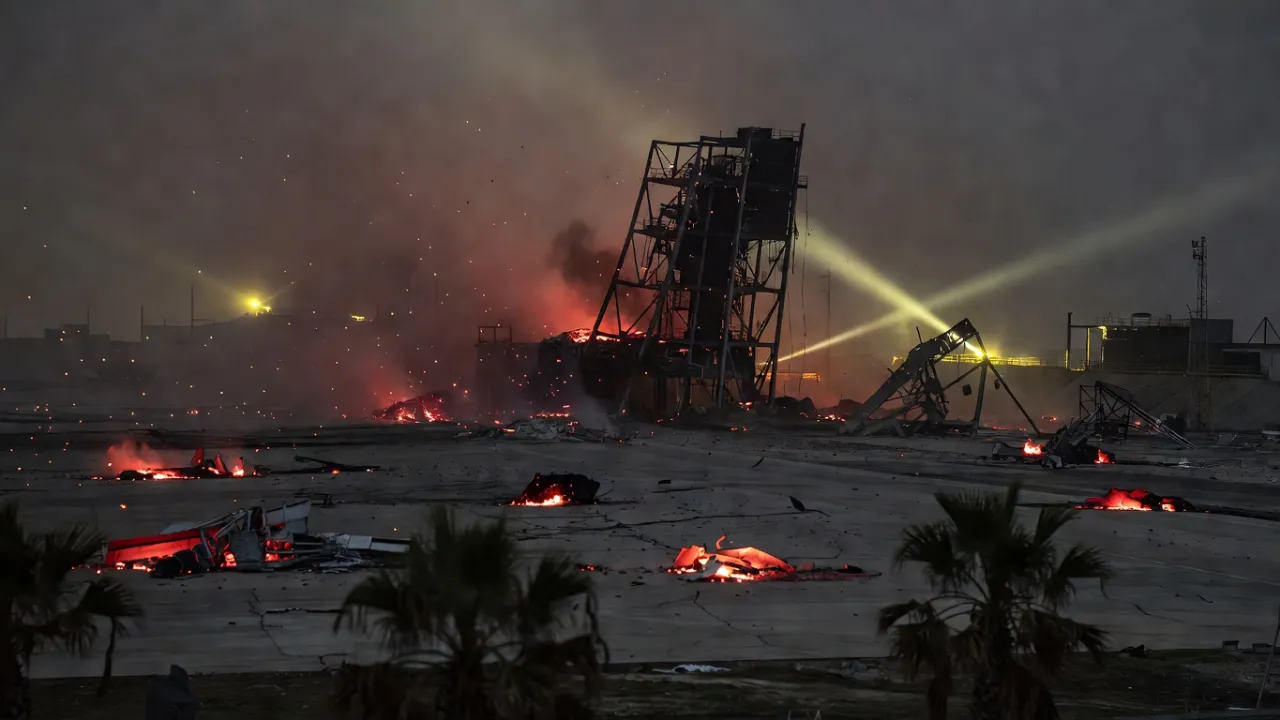
The explosion of Blue Origin's New Glenn rocket at launch at Cape Canaveral on May 31, 2026, constitutes a major industrial setback for Jeff Bezos, unanimously recognized as such across all perspectives.
All perspectives agree that NASA's Artemis lunar program is directly undermined, with Blue Origin being the supplier of the Blue Moon lander intended for crewed missions.
The destroyed payload was a classified satellite contracted by the US Space Force, conferring on the incident a dimension of national security beyond mere industrial accident.
The United States, Canada, and Japan read the incident as an internal industrial problem to be corrected; Russia and China see it as confirmation of structural fragility in the American privatized space model.
Coverage aligned with this reading
Germany, India, and Israel advocate for increased space autonomy (Ariane, ISRO, Israeli capabilities); Canada and Japan remain anchored in Artemis partnership despite the setback.
Washington and Tel-Aviv place implications for the Space Force and defense front and center; Qatar, Brazil, and Saudi Arabia favor commercial and geopolitical readings of dependencies.
Coverage aligned with this reading
Coverage that diverges
This grouping describes the publications analysed, not the position of these countries’ populations or of their governments.
What the coverage of each country leaves aside, while others put it forward.
France
United Kingdom
Australia
Preview: 3 of 11 media perspectives. Syntheses of the media analysed — not direct quotations. Method & limitations
Brasilia assesses the scope of the Blue Origin catastrophe against its own space ambitions: the New Glenn explosion reignites debate over Brazil's reliance on a launch market dominated by fragile players.
1 source · View sources
Washington draws a stark conclusion: New Glenn's failure on the pad exposes both the fragility of Blue Origin as a second player in US commercial spaceflight and the Pentagon's deepening dependence on SpaceX for launch capability.
2 sources · View sources
Berlin measures the industrial fallout from New Glenn's explosion through the lens of European space sovereignty, highlighting vulnerabilities in a sector overly dependent on a US-dominated duopoly.
3 sources · View sources
DOMINANT ANGLE
Brasilia assesses the scope of the Blue Origin catastrophe against its own space ambitions: the New Glenn explosion reignites debate over Brazil's reliance on a launch market dominated by fragile players.
ANALYSIS
Brasilia, May 31, 2026.
DOMINANT ANGLE
Washington draws a stark conclusion: New Glenn's failure on the pad exposes both the fragility of Blue Origin as a second player in US commercial spaceflight and the Pentagon's deepening dependence on SpaceX for launch capability.
ANALYSIS
Washington, May 31, 2026.
DOMINANT ANGLE
Berlin measures the industrial fallout from New Glenn's explosion through the lens of European space sovereignty, highlighting vulnerabilities in a sector overly dependent on a US-dominated duopoly.
ANALYSIS
Berlin, May 31, 2026.
DOMINANT ANGLE
Moscow views Blue Origin's New Glenn explosion as evidence of structural limitations in America's privatized space model, contrasting Washington's lunar ambitions with the industrial setbacks of its commercial partners.
ANALYSIS
Moscow, May 31, 2026.
DOMINANT ANGLE
Beijing reads the New Glenn explosion as confirmation that the US space sector remains structurally fragile despite record market valuations and global dominance ambitions.
ANALYSIS
Beijing, June 1, 2026.
DOMINANT ANGLE
Tokyo measures carefully the consequences of New Glenn's explosion on the Artemis lunar timeline, a program in which Japan has committed JAXA astronauts and national resources in exchange for an unprecedented role on the Moon.
ANALYSIS
Tokyo, May 31, 2026.
DOMINANT ANGLE
New Delhi reads in New Glenn's failure a validation of its own industrial gambit: low-cost, reliable space access as a lever of geopolitical influence, with American rivals weakened by their overambitions.
ANALYSIS
New Delhi, June 1, 2026.
DOMINANT ANGLE
Ottawa assesses the ripple effects of the New Glenn explosion on the Artemis timeline, in which Canada has invested direct human and technological presence: astronaut Jeremy Hansen and the future Canadarm3.
ANALYSIS
Ottawa, June 1, 2026.
DOMINANT ANGLE
Riyadh gauges the strategic scope of the New Glenn explosion through its own space ambitions anchored in Vision 2030: Bezos's setback underscores that the space race remains a terrain of calculated risk, even for the most well-capitalized actors.
ANALYSIS
Riyadh, June 1, 2026.
DOMINANT ANGLE
Tel-Aviv assesses the strategic exposure created by New Glenn's destruction: with AMOS satellites dependent on American launchers, any fragility in the US launch chain directly cascades into Israeli orbital coverage capacity.
ANALYSIS
Tel-Aviv, June 1, 2026.
DOMINANT ANGLE
Doha reads New Glenn's explosion as a symptom of fragility in an overly concentrated American space model, questioning the implications for nations betting on these partnerships.
ANALYSIS
Doha, May 31, 2026.
Explore every perspective on this subject across 11 countries.
Compare viewpoints and see where they diverge.
published on
countries
sources
articles
gap
On 31 May 2026, Blue Origin's heavy-lift New Glenn rocket exploded during launch at Cape Canaveral, destroying the vehicle along with its payload, a classified satellite contracted by the US Space Force. No injuries were reported, but the damage to the launch pad 36A infrastructure implies a reconstruction estimated at no less than fifteen months before any resumption. The event is unanimously described as a major industrial setback for Jeff Bezos's company.
Beyond the accident itself, the incident touches several sensitive areas. NASA's Artemis lunar programme is directly weakened, as Blue Origin supplies the Blue Moon lander intended for crewed missions. The destruction of a military payload also gives the event a national-security dimension that goes beyond a mere technical failure.
The backdrop is one of intensified space competition. The Artemis architecture relies on two private suppliers, SpaceX and Blue Origin, without the institutional redundancy of state agencies. Blue Origin's temporary sidelining mechanically strengthens SpaceX, already holder of numerous Pentagon contracts, and raises the question of a launch market concentrated around a single player.
The broader significance of the incident remains disputed. Some actors read it as an internal industrial problem to be corrected within the technological alliance, while others interpret it as a sign of structural fragility in the privatised space model. Several countries argue for greater launch autonomy, while others see the event as a window of opportunity for their own national space programmes.
Measured with the previous method (distance between texts), on a different scale.