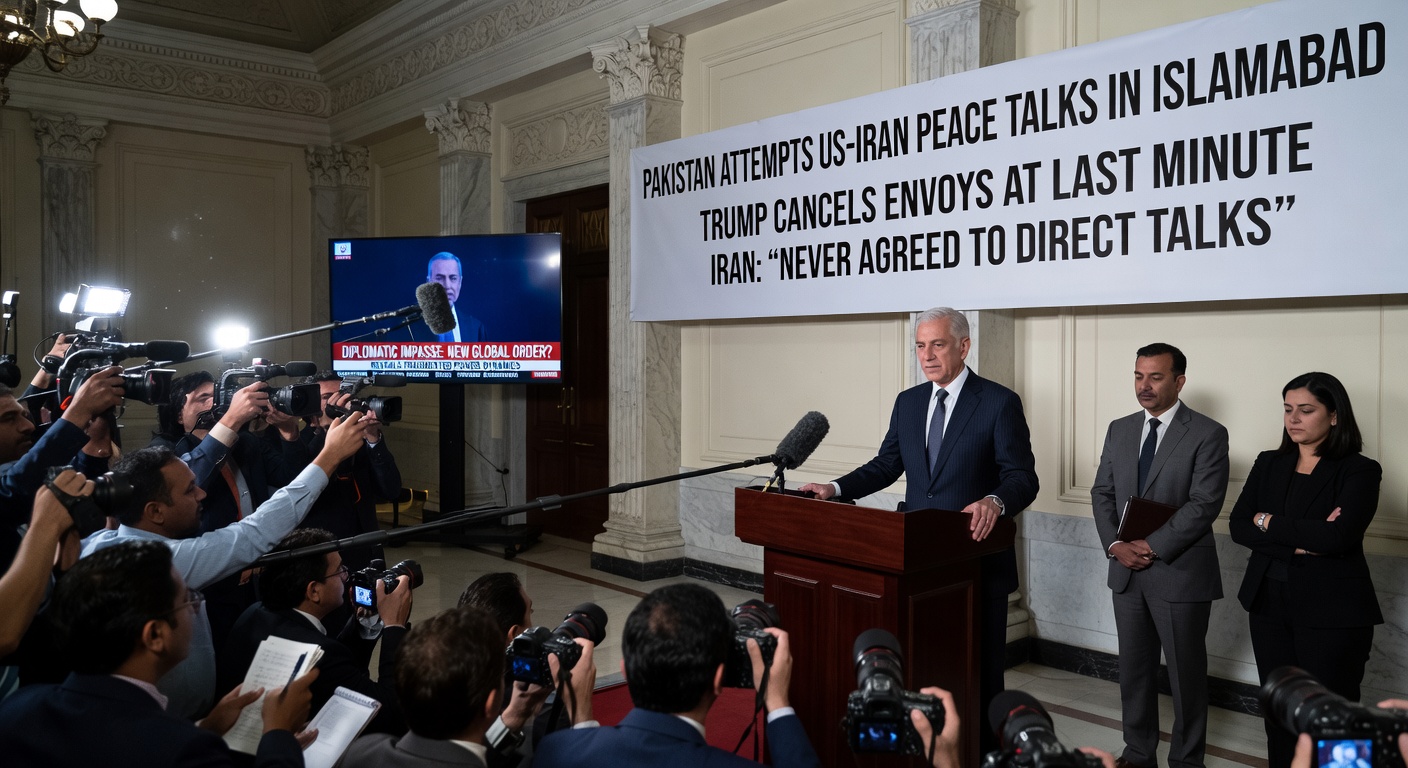
Pakistan Steps In as Mediator Between the US and Iran — Then Trump Cancels His Envoys
April 26, 2026·19 COUNTRIES
19countries·32sources·48articles
Asia (6)
Middle East (5)
Europe (3)
Americas (2)
Russia & CIS (1)
Oceania (1)
Other (1)
Asia
Middle East
Europe
Americas
Russia & CIS
Oceania
Other
EXPLORE THIS STORY
Context
A second round of talks between the United States and Iran was due to take place in Islamabad, with Pakistan acting as facilitator. Iran's foreign minister, Araghchi, was received there in that context. At the last minute, Donald Trump cancelled the trip of his envoys, Jared Kushner and Steve Witkoff, stating that the exchanges could continue by phone.
Accounts differ on the very nature of the planned meeting. Tehran calls Washington's demands "maximalist" and maintains that no direct meeting with US representatives was on the agenda. Washington, for its part, frames the cancellation as a show of strength. After a call with Iranian President Pezeshkian, Pakistan's prime minister said his country would remain an "honest and sincere" facilitator.
The episode reflects two underlying dynamics. First, the assertion of "Global South" states — Pakistan, Turkey, Gulf countries — as mediation spaces capable of substituting for Western diplomatic formats. Second, an American approach marked by last-minute reversals and maximum pressure, which sustains permanent uncertainty around the negotiations.
For Islamabad, emerging from a period of severe economic difficulty and seeking to regain regional weight, this mediation is also a signal sent to several capitals. In parallel, Qatar has maintained a role as a Gulf diplomatic relay.
Several points remain disputed: responsibility for the deadlock, the real scope of Pakistan's role, and the interpretation of Trump's message — between negotiating tactic and sign of disorganisation. The economic and maritime consequences, tied in particular to the Strait of Hormuz, remain a source of concern.