
Common ground and differences in coverage across the media analysed.
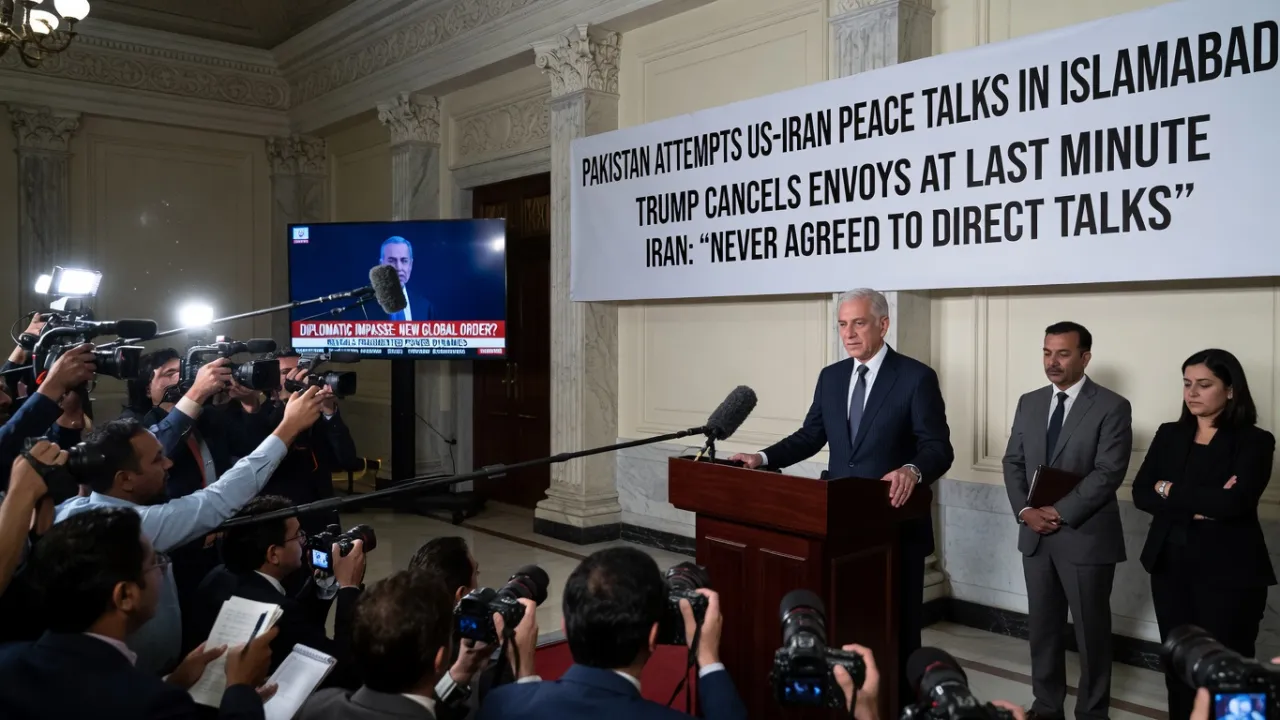
Pakistan hosted Iranian Foreign Minister Araghchi in Islamabad as part of a mediation effort for a second round of US-Iran negotiations.
Trump cancelled Kushner and Witkoff's trip at the last minute, saying Iran could call the US instead.
Iran maintained it never agreed to direct talks with US representatives in Pakistan.
Western media (fr, ca, uk, au) frame Trump's cancellation as erratic and revealing of his unreliability. Iranian media (ir) insist Tehran never agreed to direct talks and that Washington keeps setting maximalist terms. Pakistani media (pk) emphasize Islamabad's resilience and the PM's continued determination.
Asian media (cn, kr, sg) see Pakistan's mediation as part of a broader Global South bloc — alongside Turkey, Saudi Arabia, and Egypt — capable of managing major conflicts independently. Western outlets downplay this role and view it as an opportunistic bid for diplomatic prestige. Turkey (tr) watches closely, itself a candidate for the regional mediator role.
US and Canadian media read Trump's cancellation as a classic hardball negotiating tactic. Middle Eastern outlets (qa, il) see it as dangerous escalation undermining any diplomatic exit. RT (ru) frames it as structural proof of American diplomatic disorganisation. Iran frames it as proof of American bad faith.
Preview: 3 of 19 media perspectives. Syntheses of the media analysed — not direct quotations. Method & limitations
Islamabad, broker of a fragile peace: national pride and a perilous mission
2 sources · View sources
Tehran denies direct talks were planned and labels US demands 'maximalist'
1 source · View sources
Trump cancels Kushner and Witkoff's trip: 'We have all the cards, Iran can call'
3 sources · View sources
DOMINANT ANGLE
Islamabad, broker of a fragile peace: national pride and a perilous mission
ANALYSIS
Pakistani media covered the mediation with intense national pride mixed with caution.
DOMINANT ANGLE
Tehran denies direct talks were planned and labels US demands 'maximalist'
ANALYSIS
Iran's state media built a narrative of strategic coherence: Tehran never agreed to direct talks with Americans, and Washington's demands — full nuclear demilitarization, ending support for regional militias — are unacceptable.
DOMINANT ANGLE
Trump cancels Kushner and Witkoff's trip: 'We have all the cards, Iran can call'
ANALYSIS
American media focused on Trump's unpredictable decision to cancel the trip after announcing it.
DOMINANT ANGLE
Paris watches a Pakistan seeking status and an American diplomacy running free
ANALYSIS
French media analysed the episode through two lenses: the rise of the Global South as a diplomatic space, and the 'Trump method' that turns every negotiation into a media stunt.
DOMINANT ANGLE
A new mediating bloc — Pakistan, Turkey, Saudi Arabia, Egypt — reshuffles the global order
ANALYSIS
The South China Morning Post took a structural geopolitical view: the Pakistani episode illustrates the recomposition of world order around middle powers capable of filling the vacuum left by America's retreat from multilateralism.
DOMINANT ANGLE
New Delhi watches Pakistan's rise as mediator with unspoken unease
ANALYSIS
Indian media covered the episode factually but revealed an underlying ambivalence: Pakistan gaining diplomatic credibility as a mediator between two superpowers is an uncomfortable image for India.
DOMINANT ANGLE
Ottawa caught between hope and anxiety over Trump's volatility
ANALYSIS
Canadian media followed the announcement and cancellation of the envoys' trip with characteristic caution.
DOMINANT ANGLE
Cairo, a quiet co-actor in a mediation that failed to convince Washington
ANALYSIS
Egypt and Pakistan jointly expressed hope for a second round of US-Iran talks, positioning Cairo as part of the same mediating bloc.
DOMINANT ANGLE
Doha in active support: Qatar's Amir calls Trump to back Pakistan's mediation
ANALYSIS
Qatar's Amir Sheikh Tamim bin Hamad al-Thani backed Pakistan's mediation in a direct phone call with Trump, stressing the need to consolidate the US-Iran ceasefire and discussing the impact of the crisis on maritime security and global supply chains.
DOMINANT ANGLE
Singapore: trade hub watches Islamabad as a market barometer
ANALYSIS
Channel News Asia titled directly: 'Trump cancels Pakistan talks trip, says Iran war on hold' — a formulation reflecting Singapore's anxiety that the war is suspended, not resolved.
DOMINANT ANGLE
Moscow reads Trump's cancellation as proof of American diplomatic disorganisation
ANALYSIS
RT framed the cancellation bluntly as US diplomacy 'stalling.
DOMINANT ANGLE
Seoul tracks Islamabad as an energy security and supply chain alarm
ANALYSIS
The Korea Times covered the full sequence in four separate articles, with a headline that captured the outcome precisely: 'hopes for Iran breakthrough fade.
DOMINANT ANGLE
Sydney sees Islamabad's failure as a warning on ceasefire fragility and Trump's unpredictability
ANALYSIS
The Sydney Morning Herald ran a series of live updates titled 'Peace talks in Pakistan collapse as Trump cancels envoy trip.
DOMINANT ANGLE
London watches American diplomacy going AWOL — and a missed opportunity in the Middle East
ANALYSIS
BBC reported soberly but precisely: Trump cancelled after the Iranian delegation had already left Pakistan, calling the planned 18-hour trip pointless.
DOMINANT ANGLE
Jerusalem watches every signal: is America's cancellation an escalation or a strategic withdrawal?
ANALYSIS
The Jerusalem Post covered Trump's cancellation closely, noting his refusal to send envoys on an 18-hour flight 'to sit around talking about nothing.
DOMINANT ANGLE
Rome follows the diplomatic saga pragmatically: Italy wants energy stability, not theatrics
ANALYSIS
ANSA published three successive dispatches covering the announcement, Araghchi's arrival, and Trump's cancellation.
DOMINANT ANGLE
Ankara, potential co-mediator, watches Islamabad as a test of the Global South diplomatic format
ANALYSIS
Daily Sabah covered the full sequence in three articles, noting the military-channel dimension of Pakistan's mediation — Araghchi met Pakistan's Army Chief, not a civilian diplomat — as a significant detail.
DOMINANT ANGLE
Tokyo notes Araghchi's arrival and an expected Iranian offer — brief but real coverage
ANALYSIS
The Japan Times published a factual article focusing on Trump's expectation of 'an offer satisfying US demands' as Araghchi arrived in Pakistan — which, in retrospect, explains part of the cancellation logic: the offer that came through was deemed insufficient.
DOMINANT ANGLE
Berlin monitors the stalled negotiations — with the unease of a Europe excluded from the format
ANALYSIS
Tagesschau headlined 'Iran's Foreign Minister travels to Pakistan for talks,' noting that American negotiators were also reported to be en route to Islamabad.
Explore every perspective on this subject across 19 countries.
Compare viewpoints and see where they diverge.
published on
countries
sources
articles
gap
A second round of talks between the United States and Iran was due to take place in Islamabad, with Pakistan acting as facilitator. Iran's foreign minister, Araghchi, was received there in that context. At the last minute, Donald Trump cancelled the trip of his envoys, Jared Kushner and Steve Witkoff, stating that the exchanges could continue by phone.
Accounts differ on the very nature of the planned meeting. Tehran calls Washington's demands "maximalist" and maintains that no direct meeting with US representatives was on the agenda. Washington, for its part, frames the cancellation as a show of strength. After a call with Iranian President Pezeshkian, Pakistan's prime minister said his country would remain an "honest and sincere" facilitator.
The episode reflects two underlying dynamics. First, the assertion of "Global South" states — Pakistan, Turkey, Gulf countries — as mediation spaces capable of substituting for Western diplomatic formats. Second, an American approach marked by last-minute reversals and maximum pressure, which sustains permanent uncertainty around the negotiations.
For Islamabad, emerging from a period of severe economic difficulty and seeking to regain regional weight, this mediation is also a signal sent to several capitals. In parallel, Qatar has maintained a role as a Gulf diplomatic relay.
Several points remain disputed: responsibility for the deadlock, the real scope of Pakistan's role, and the interpretation of Trump's message — between negotiating tactic and sign of disorganisation. The economic and maritime consequences, tied in particular to the Strait of Hormuz, remain a source of concern.
Measured with the previous method (distance between texts), on a different scale.