Common ground and differences in coverage across the media analysed.
The encyclical 'Magnifica Humanitas' explicitly calls on governments to slow AI development and establish robust legal frameworks with independent oversight.
The document covers four common themes across all coverage: worker rights in the face of automation, child safety online, ownership of AI data, and the need to reduce competition between technology companies.
All perspectives note that the Pope judges it impermissible to delegate lethal and irreversible decisions to AI systems, positioning the Vatican in opposition to autonomous weapons.
Some countries analyze the encyclical primarily as a geopolitical signal against American deregulation, while others see it first and foremost as legitimate religious moral authority.
Preview: 3 of 6 media perspectives. Syntheses of the media analysed — not direct quotations.
Beijing extracts from the papal message what resonates with its own strategic concerns: the warning against uncontrolled technological competition and the call to subordinate AI to collective human interests, read as an involuntary convergence with Chinese governance rhetoric.
1 source ·
Paris watches with keen interest as Pope Leo XIV enters the AI regulation debate, viewing his moral authority as potentially influential in shaping ongoing European policy frameworks.
1 source ·
Seoul carefully weighs Pope Leo's call to slow AI development: a papal signal that resonates in one of the world's most technologically advanced economies, torn between digital ambitions and social anxieties.
1 source ·
Coverage aligned with this reading
Coverage that diverges
Countries heavily engaged in national technological competition receive the injunction to slow down with caution and reserve, while less competitive countries welcome it favorably.
Coverage aligned with this reading
Coverage that diverges
Several perspectives center their coverage on the condemnation of autonomous weapons, while others focus on the socioeconomic issues of automation.
Coverage aligned with this reading
Coverage that diverges
This grouping describes the publications analysed, not the position of these countries’ populations or of their governments.
What the coverage of each country leaves aside, while others put it forward.
Philippines
France
China
published on
countries
sources
articles
gap
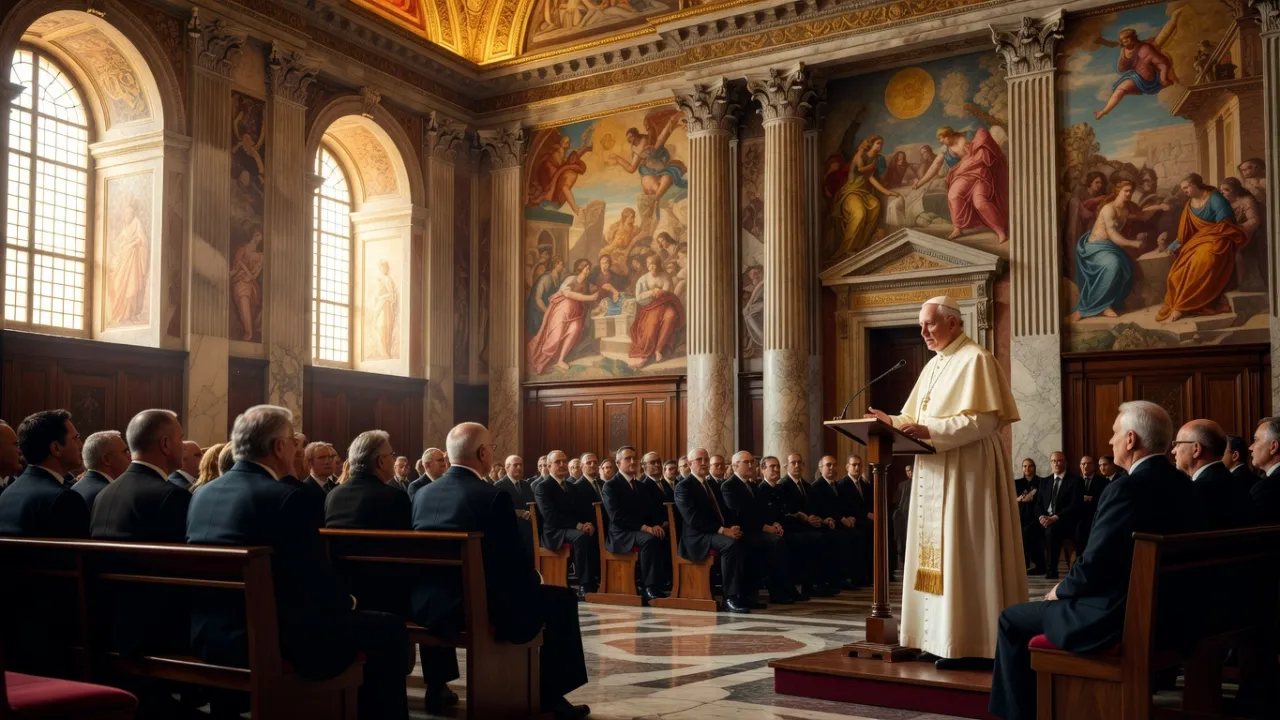
In his first major document, the encyclical "Magnifica Humanitas," Pope Leo XIV explicitly calls on governments to slow the development of artificial intelligence and to establish robust legal frameworks backed by independent oversight. The text is built around four themes: protecting workers' rights against automation, children's online safety, ownership of AI data, and the need to ease competition between technology companies.
The document deems it impermissible to delegate lethal and irreversible decisions to automated systems, positioning the Vatican against autonomous weaponry. The presence of a co-founder of Anthropic at the presentation was widely read as a sign that the industry itself takes the appeal seriously. The pope's independence is repeatedly stressed: the first American pontiff, he criticized the war in Iran and drew rebukes from Donald Trump.
The encyclical lands amid a divide between three models of AI governance: the accelerated deregulation pursued by the U.S. administration, the European Union's gradual legislative framing through the AI Act, and the state supervision claimed by China. Addressing 1.4 billion Catholics, the Vatican casts itself as a cross-cutting moral actor. The matter of lethal autonomous weapons echoes debates at the United Nations, where several states defend strict regulation that others have so far blocked.
Reception remains contested. Some actors see the text primarily as a geopolitical signal against deregulation, others as a religious moral authority. Countries deeply engaged in the technological race greet the call to slow down with reserve, while others view it as welcome. Several readings center the text on autonomous weapons, whereas others emphasize the socio-economic stakes of automation.
DOMINANT ANGLE
Beijing extracts from the papal message what resonates with its own strategic concerns: the warning against uncontrolled technological competition and the call to subordinate AI to collective human interests, read as an involuntary convergence with Chinese governance rhetoric.
ANALYSIS
Beijing, May 27, 2026.
DOMINANT ANGLE
Paris watches with keen interest as Pope Leo XIV enters the AI regulation debate, viewing his moral authority as potentially influential in shaping ongoing European policy frameworks.
ANALYSIS
Paris, May 25, 2026.
DOMINANT ANGLE
Seoul carefully weighs Pope Leo's call to slow AI development: a papal signal that resonates in one of the world's most technologically advanced economies, torn between digital ambitions and social anxieties.
ANALYSIS
Seoul, May 25, 2026.
DOMINANT ANGLE
Manila receives the encyclical Magnifica Humanitas as a moral validation of its own vulnerability in the face of artificial intelligence: in a predominantly Catholic nation, the voice of the pontiff carries the weight of national law itself.
ANALYSIS
Manila, May 25, 2026.
DOMINANT ANGLE
Singapore weighs Pope Leo's call to slow artificial intelligence against its own Smart Nation ambitions: between ethical caution and regional competitiveness, the city-state seeks balance that the Vatican frames as 'responsible stewardship.'
ANALYSIS
Singapore, May 26, 2026.
DOMINANT ANGLE
London views Pope Leo XIV's encyclical as an unprecedented normative reference point in the global AI regulation debate, particularly against the aggressive deregulation being pushed by Washington.
ANALYSIS
London, May 27, 2026.
Explore every perspective on this subject across 6 countries.
Compare viewpoints and see where they diverge.
Measured with the previous method (distance between texts), on a different scale.